

Are Dog Car Seats Worth It — and When Is a Carrier Enough?
Your dog rides in the back seat every week, and the seat you bought slides around. Is a real car seat worth the money?
Yes — if your dog rides in the car most weeks and the seat locks to the car's own anchor points. A booster held by a seatbelt is a cushion, not a restraint. For short trips with a dog that settles, the carrier you already own is often enough.
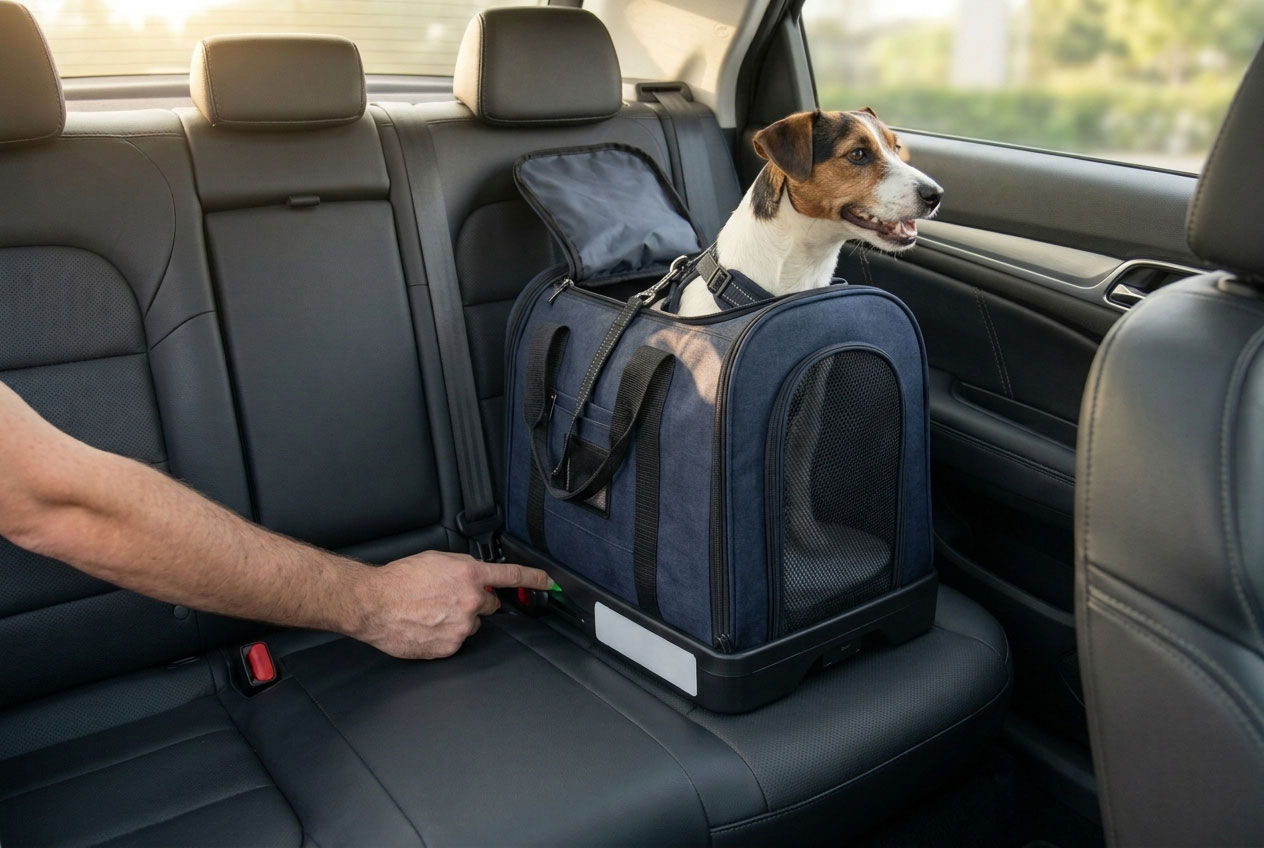
I handle international sales for ANVOYA, and this question comes up from buyers and from dog owners in the same week. The answer is not one product. It is a decision, and it turns on three things: how often the dog rides, how the seat is anchored, and what the dog actually does in the car. This article works through those three things in order.
Are dog car seats worth it?
You already own a carrier, and it works. The question is whether a car seat buys you anything the carrier does not.
A car seat is worth it when the dog rides in the car several times a week and the seat locks to ISOFIX anchor points. It is not worth it for a dog that rides twice a year, or for a seat that only straps to the seatbelt.
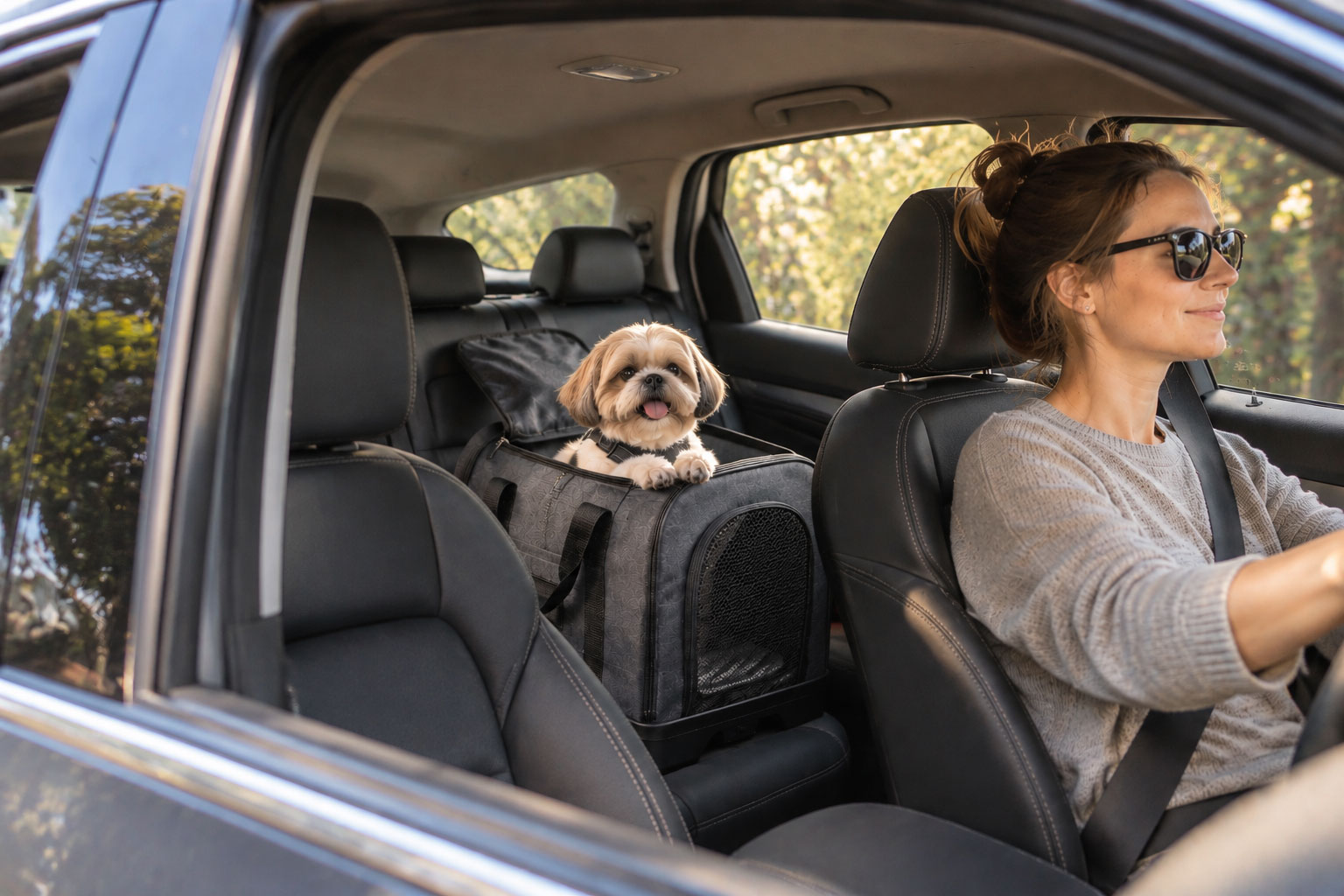
The first question is not about the seat. It is about the dog's week. A dog that rides to the park, to daycare, and to the vet every week spends hours in the car over a year. A dog that rides twice a year, to the groomer and back, spends almost none. The same seat is worth it for the first dog and a waste of money for the second. Start with the calendar, not the catalogue.
The second question is about the seat itself. A car seat is two things: a bed and an anchor. The bed is comfort. The anchor is safety. A soft bed that slides across the back seat is a cushion, and a cushion does not hold a dog when the car stops suddenly. A seat that locks to the car's own anchor points holds the dog in place, and it holds the driver too. A dog that stays put does not climb into the front seat, does not block the mirror, and does not distract the person driving. That is the part people forget. A car seat is not only about the dog. It is about the driver keeping both hands on the wheel and both eyes on the road.
The third question is about the dog's behaviour in the car. Some dogs curl up and sleep from the driveway to the destination. Some stand, pace, and press against the window for the whole trip. A dog that settles needs less seat than a dog that moves. A dog that moves needs a seat that holds it, and a seat that holds it needs an anchor that does not give.
The answer turns on how often the dog rides and what the dog does in the car. The price tag does not decide it. Our stroller guide asks the same question from the other side — whether pet strollers are good for dogs — and the logic is the same: the dog's week decides, not the product.
What makes a car seat actually hold a dog in a crash?
A crash is physics. The seat either connects to the car or it does not, and that connection decides everything.
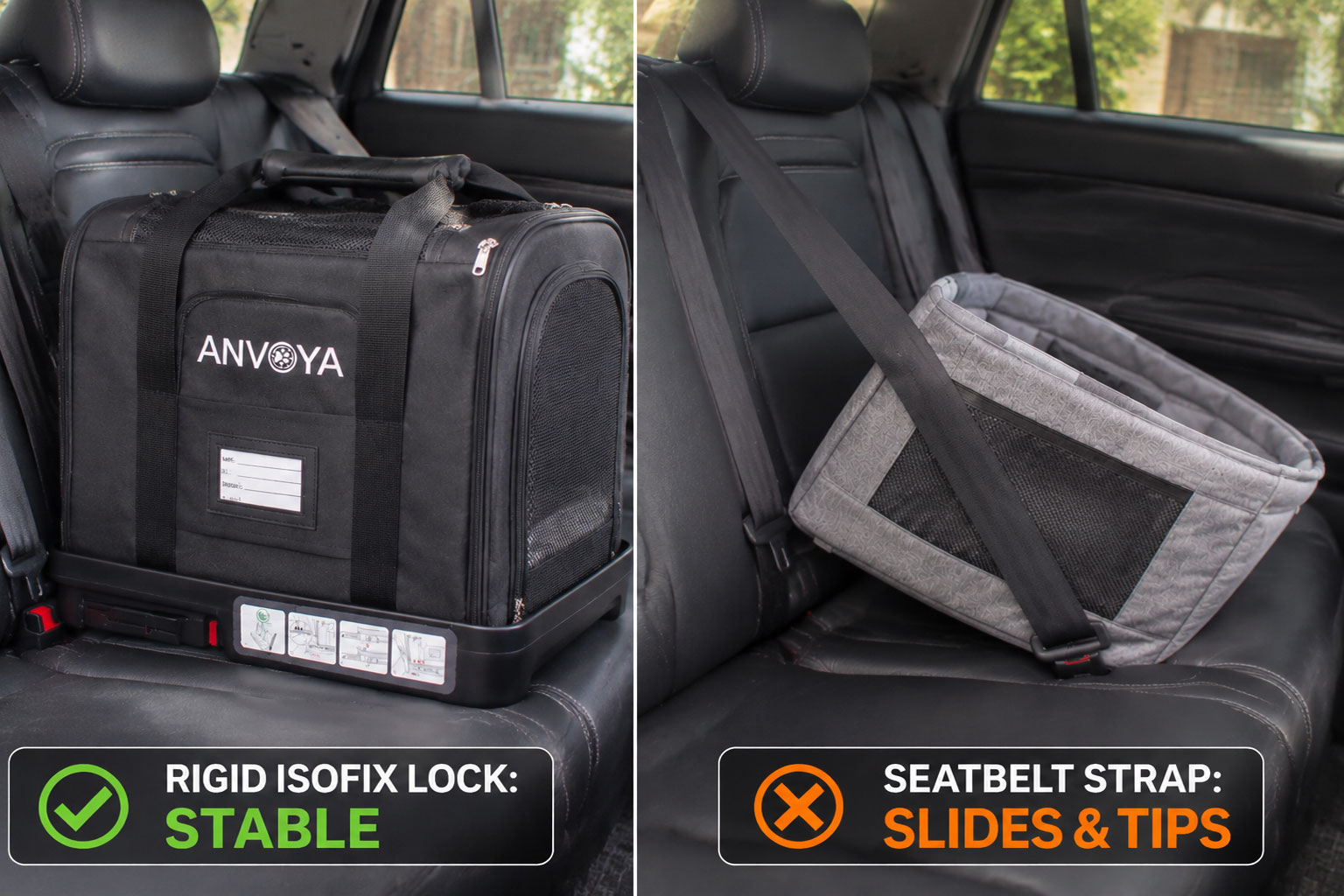
What holds a dog is the anchor. A seat locked to the car's ISOFIX points stays put; a booster held by a seatbelt slides and tips. At 35 mph, an unrestrained 60-pound dog becomes roughly a 2,700-pound projectile, according to the Center for Pet Safety.
The number that matters comes from the Center for Pet Safety. At 35 miles per hour, an unrestrained 60-pound dog becomes roughly a 2,700-pound projectile. The dog does not get heavier. The force comes from the speed and the sudden stop. A 60-pound dog at 35 mph hits whatever is in front of it with enormous force. That is the physics every car seat has to deal with, and it is the reason the anchor matters more than the padding.
CPS tests harnesses, carriers, and crates on a dynamic sled, using a protocol modeled on the federal child-restraint standard, FMVSS 213. The sled runs at 30 mph. The test measures how far the dummy dog travels forward, whether the webbing and buckles hold, and whether the attachment points stay intact. A product that passes earns CPS certification. A product that fails is published as a failure. That is the part worth knowing: CPS publishes the failures, so a certification means something. Our guide to what "crash tested" means explains the difference between an independent test and a manufacturer's own claim.
Now the anchor. A car seat can attach in three ways. The first is ISOFIX: two rigid metal arms that click into the car's built-in anchor points, the same points a child seat uses. The connection is rigid, and you hear it lock. The second is a seatbelt strap: a belt routed through the seat or around it. The belt stretches in a crash, and the seat moves with it. The third is a tether or a hook to the headrest or the seat frame. It keeps the seat from sliding across the bench, and it does not hold it in a crash. Only the first one is a lock. The other two are restraints of a weaker kind.
Our ISOFIX explainer works through the difference in detail. Our full safety guide covers the whole system — seat, belt, harness, anchor, and vehicle — for readers who want the complete picture.
One line to be clear about: our AERO was tested to ECE R129, the child car seat standard. There is no crash-test regulation written for pets, so no pet crash-test certificate exists. The CPS figure above is about dogs in general, and the anchor advice applies to any seat you buy, from any brand.
Car seat, travel bed, or crate — which one fits your dog?
| What it holds | What it asks of the dog | Best for | Watch out for | |
|---|---|---|---|---|
| Car seat | A small dog, raised, in a bed that locks to the car | Sit or lie still in a raised bed | A dog that rides often and settles | A seat that only straps on — it slides |
| Travel bed | A dog lying down, unsecured | Lie still without a restraint | A calm dog on a short, slow trip | No restraint at all in a crash |
| Crate | A dog inside a rigid box | Accept confinement | A dog that needs containment; long trips | An unsecured crate becomes a projectile |
A car seat fits a small dog that rides often and settles in a raised bed. A travel bed fits a calm dog on short trips. A crate fits a dog that needs containment, and it must be secured — an unsecured crate is itself a projectile.
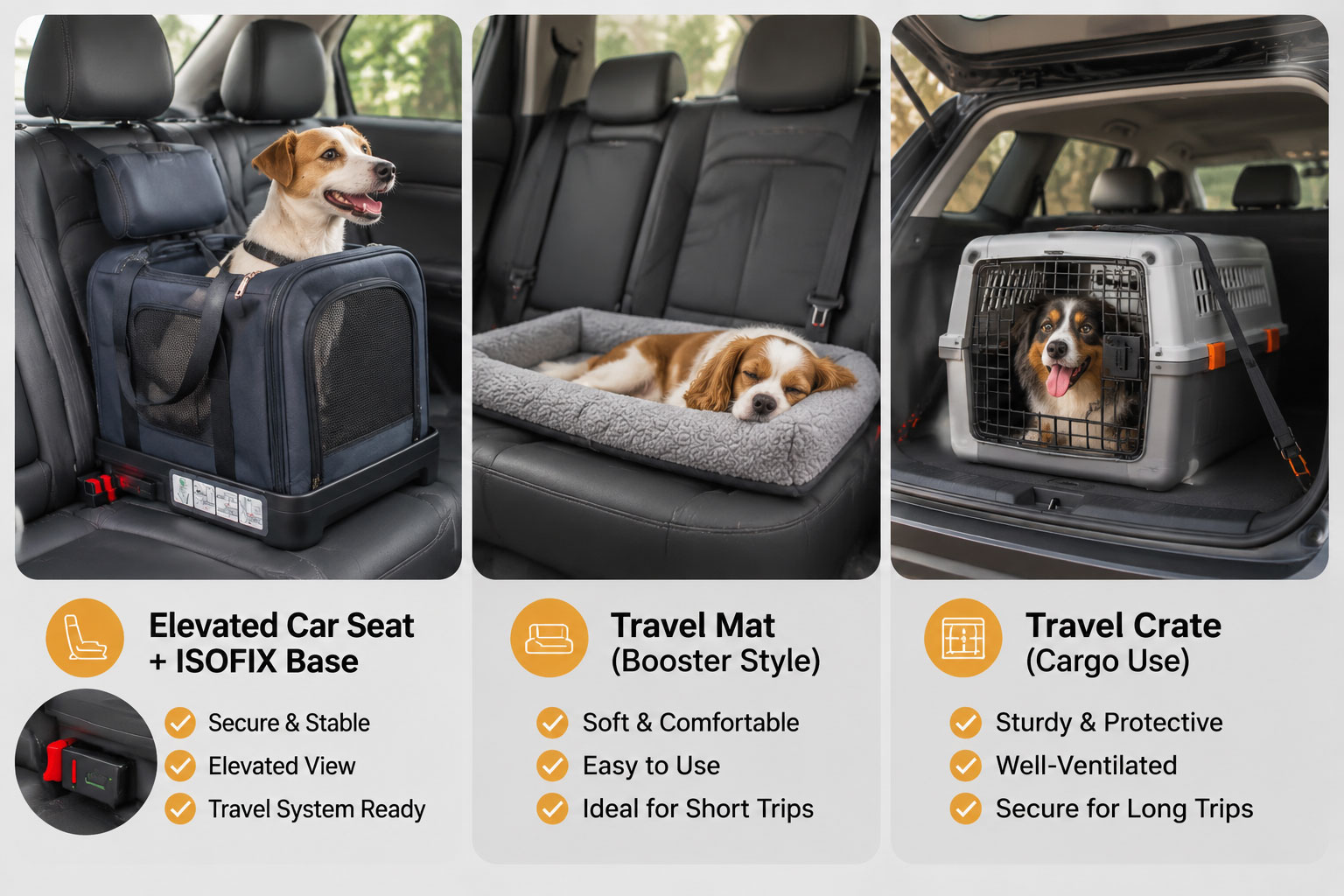
A car seat is a bed with an anchor. The raised bed lets a small dog see out the window, and the anchor keeps the bed in place. It fits a dog that rides often and settles in one spot. It does not fit a dog that paces, because a pacing dog will climb out of a raised bed, and a dog that climbs out of a raised bed is a dog loose in the car.
A travel bed is comfort without restraint. It is a padded mat or a bolster bed that sits on the back seat. A calm dog lies on it and sleeps. A nervous dog slides off it. In a crash, a travel bed holds nothing. It is the right choice for a short, slow trip with a dog that lies down on its own — the school run, the five-minute drive to the park — and the wrong choice for a highway drive.
A crate is containment. A rigid crate holds the dog inside a box, and the box holds the dog's body in a crash. It is the strongest option for a dog that needs containment, and for long trips. But a crate only works when it is secured. A crate strapped to the cargo tie-downs stays put. A crate sitting loose in the boot becomes a projectile, and a projectile made of hard plastic is worse than a dog on its own. Our harness guide covers the same logic for a different restraint: the anchor is the whole point, and the product is only as good as what holds it.
The pattern across the three is simple. The more the dog moves, the more the restraint matters. The longer the trip, the more the anchor matters. And the cheaper the option, the more you have to check what it actually holds.
When is a carrier or harness enough?
A ten-minute drive to the vet. The dog curls up in the carrier, the carrier clicks onto the base, and nothing moves for the whole trip. That is a carrier doing its job, and a car seat would add nothing to that trip except a second product to store.
A carrier or harness is enough for short, familiar trips with a dog that settles. It is not enough for a long drive, a dog that paces, or a seat that has nothing to lock onto.
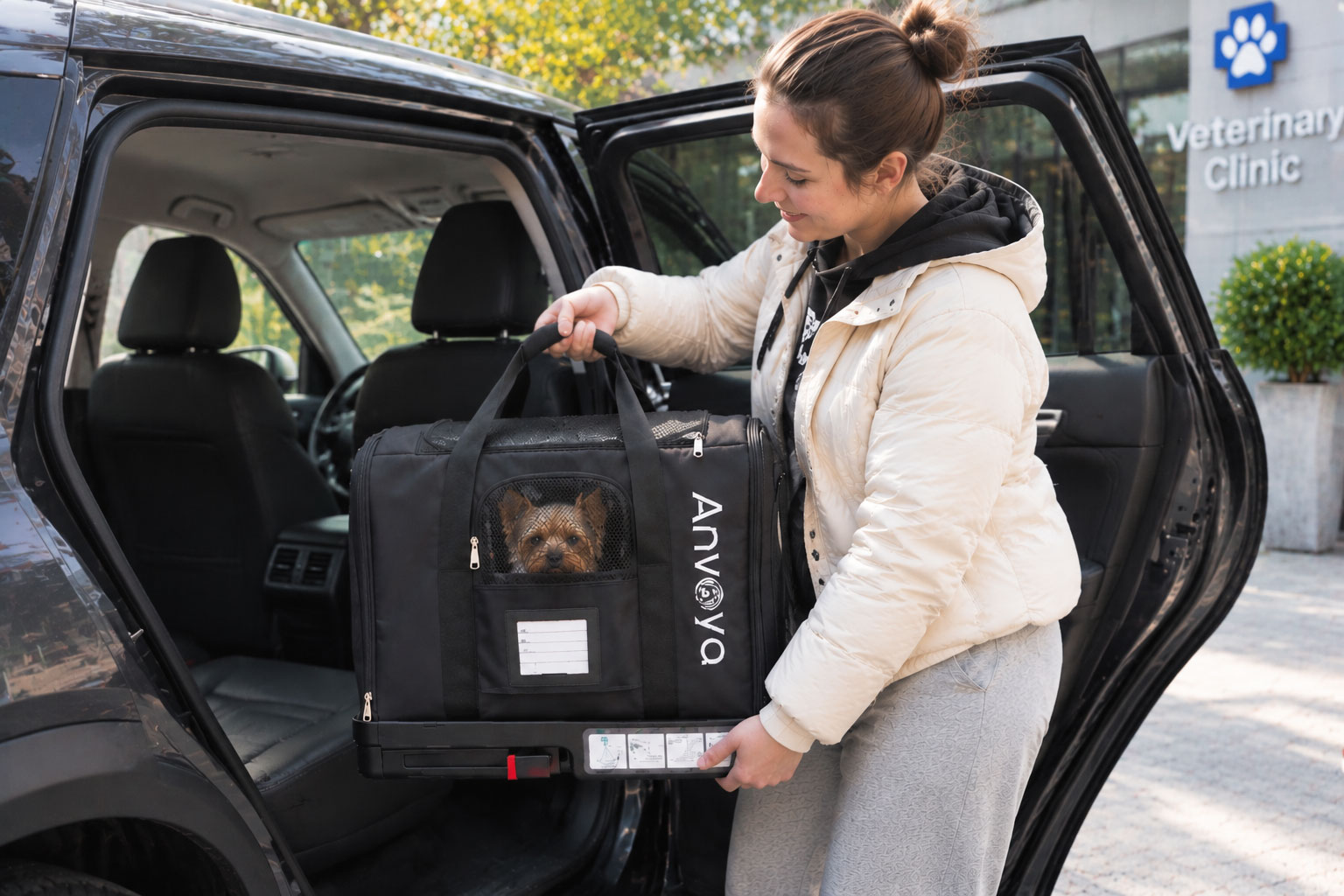
The carrier is enough when three things are true. The trip is short and familiar. The dog settles. And the carrier is secured — locked to something, not sitting loose on the seat. The test is the one we use for detachable carriers: the bag must lock on with a click you can hear and a tug that does not move it. If the carrier passes that test, it holds the dog for the trips it was built for.
A harness is enough on the same terms. A harness that is crash tested — independently, by the Center for Pet Safety — holds the dog on the seat and keeps it from becoming a projectile. A harness that has never been tested is a leash with extra straps, and a leash does not hold a dog in a crash. The difference is the test, not the label.
The carrier stops being enough in three situations. The drive is long, and the dog gets restless an hour in. The dog paces, stands, and presses against the window instead of settling. Or the car has nothing for the carrier to lock onto, so the carrier slides every time you brake. In those three situations, a car seat with a real anchor is the better buy, and a carrier is the wrong tool.
Size decides it too. A carrier fits a small dog — ours are built for pets up to 12 kg — and a small dog curls up in one. A large dog does not fit in a carrier, and a carrier that does not fit is not a restraint, it is a bag with a dog spilling out of it. A large dog needs a harness that is crash tested, or a crate that is secured to the cargo tie-downs. The carrier answer in this section is a small-dog answer. If your dog is over 12 kg, skip the carrier and go straight to the harness or the crate.
There is also a money point here, and it is worth saying plainly. A car seat you do not need is money spent twice: once on the seat, and once on the carrier you end up using anyway. Buy the car seat when the trips demand it. Until then, spend the money on a carrier that locks properly, and on a harness that has passed an independent test.
How do you pick one without paying twice?
The wrong seat costs twice: once when you buy it, once when you replace it. Five checks before you pay.
Check the anchor first, then the fit, then the washability, then the crash-test proof. A seat that locks to ISOFIX, fits your dog's real measurements, and comes apart for washing is the one you keep.
-
The anchor. Ask how the seat attaches, and listen for the word "lock". An ISOFIX seat clicks into the car's built-in anchor points with two rigid arms, and you hear it. A seatbelt-strapped seat does not lock; the belt stretches, and the seat moves. If the seller cannot tell you how it attaches, the seat has no anchor worth paying for.
-
The fit. Measure the dog, not the box. Body length from nose to base of tail, standing height with ears up, and weight. Then measure the inside of the seat, not the outside — padding and piping eat space, and a 50 cm outside can offer 42 cm inside. A small-pet system fits dogs up to 12 kg. A larger dog needs a different plan, and a seller who tells you otherwise is selling, not advising.
-
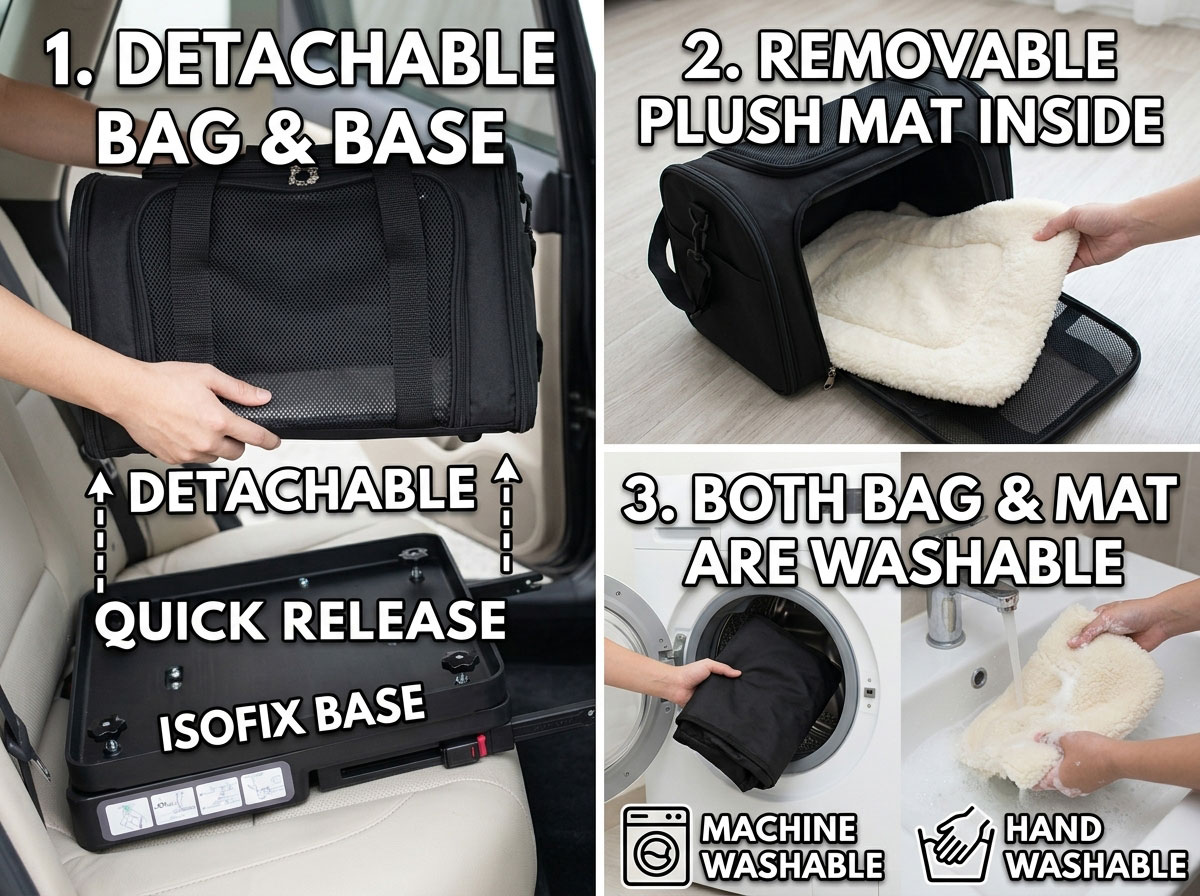
The washability. The liner comes off and washes. A dog seat gets mud, hair, and the occasional accident, and a seat you cannot clean is a seat you stop using. Check the zipper, check the liner, and check that the base stays put while the bag comes off.
-
The crash-test proof. Ask for the report. "Crash tested" without a report scope is a claim, not proof. An independent test — the Center for Pet Safety is the one that publishes its results, including the failures — is the proof that counts. Our guide to what "crash tested" means lists the five steps to check before you believe the label.
-
The whole trip. The same bag covers the car, the walk after you park, and the plane. That is the travel-system test, and it is the one that saves you from buying twice. AERO is the integrated version: the carrier, the ISOFIX base, and the stroller in one product, for small pets up to 12 kg. BASE-X is the modular version: a standalone ISOFIX base system whose carrier detaches for everyday use. Pick the one that matches how the dog actually travels, not the one with the longer feature list.
If you sell pet travel gear, the same five checks are the ones your buyers will ask you. Answer them with documents and measurements, not adjectives, and the sale takes care of itself.
Conclusion
A car seat is worth it when the dog rides often and the seat locks on. Otherwise, a carrier that locks properly is enough — and cheaper.