

Is a Cat Stroller Worth It — and Which One Fits Your Cat?
You buy a stroller for your cat, and the cat refuses to ride in it. The money is gone. The stroller gathers dust. This guide keeps that from happening.
A cat stroller is worth it when the cat cannot walk far — seniors, injured cats, anxious cats, and vet trips — and when the carrier detaches for the car. Measure the cat, not the stroller: the bag needs room for the cat to sit, turn, and lie down.
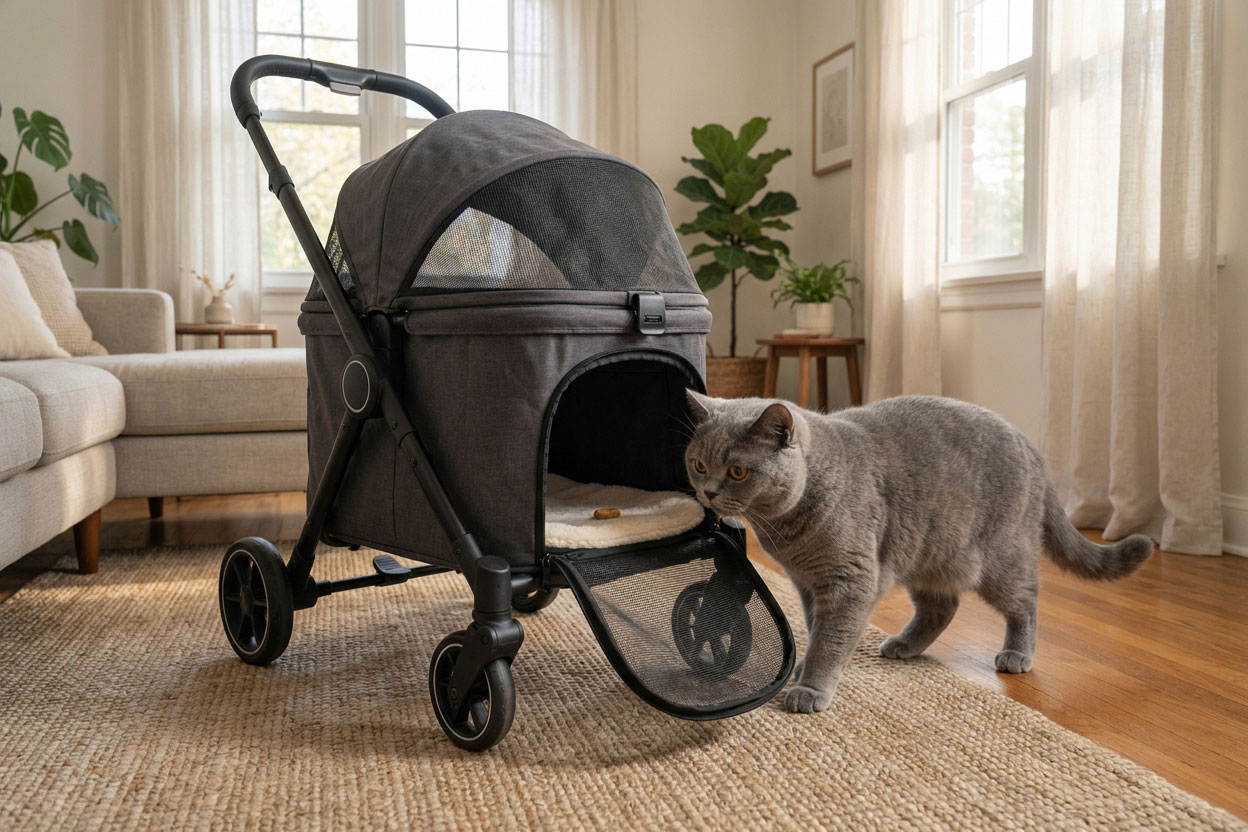
I read the best-selling roundup, the one that lists nine strollers and links to the shops, and I checked our own product records on 20 November 2026. The roundup tells you which models sell. It does not tell you whether your cat will ride in one, or how to measure the cat, or what happens when the walk ends and the car starts. Those are the questions this guide answers, in order.
Do cats actually like strollers?
A cat meets a stroller the way it meets anything new: with suspicion. Rush the first ride, and the cat decides the stroller is a trap.
Some cats love strollers, some never will. The cats that take to them are usually seniors, injured or anxious cats, and cats that already travel in a carrier. Start at home, door open, treats inside, and let the cat walk out on its own.
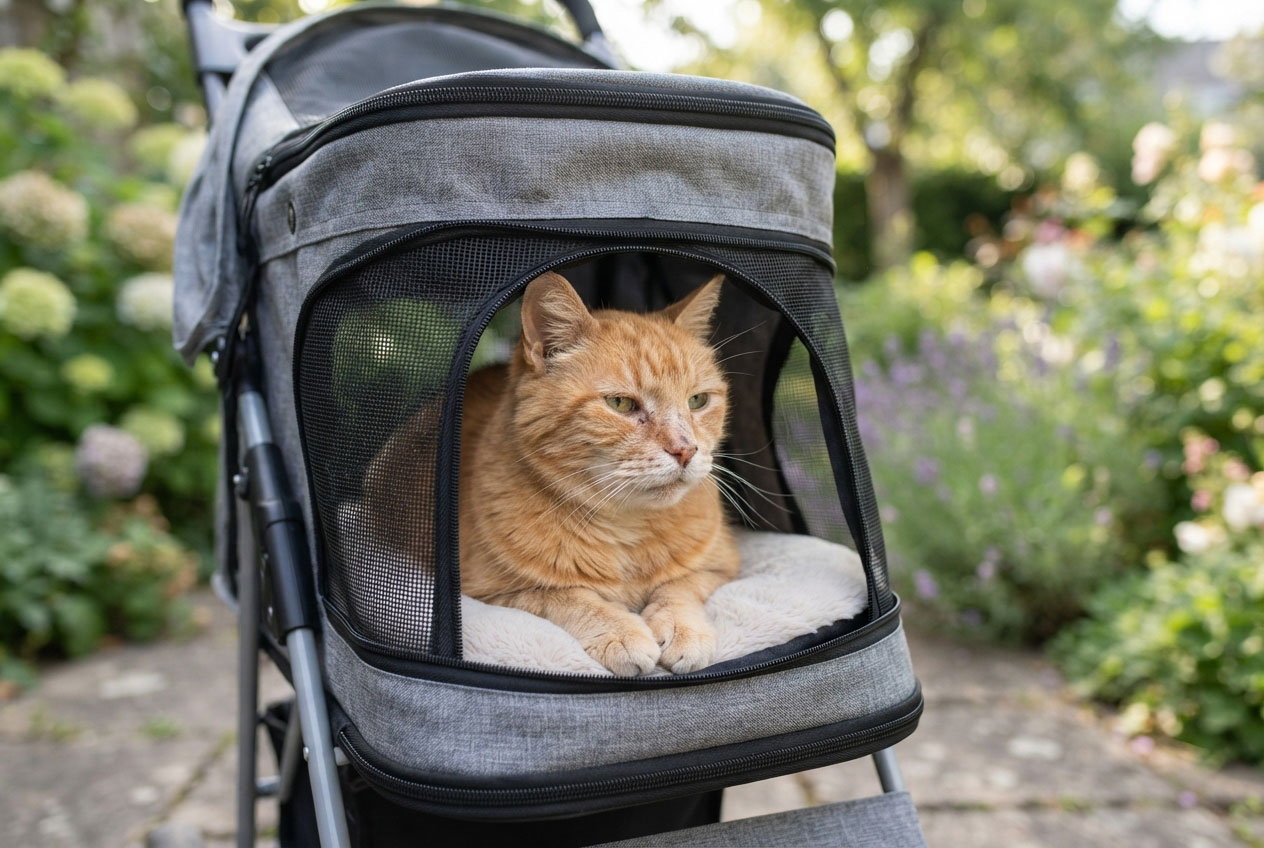
The cats that benefit most are the ones that cannot walk far. A senior cat with stiff joints still wants the garden, the sun, and the birds — it just cannot get there on foot. A cat recovering from surgery needs fresh air without the risk of jumping or running. An anxious cat that hides from visitors can watch the world from inside a closed bag, where nothing touches it. And the vet trip is the most common use of all: a cat that panics in a hand-carried box rides calmer in a stroller, because the ride is smooth and the cat sits low, near your legs, instead of swinging from your hand.
The introduction decides everything, and it starts at home, not on the street. Leave the stroller open in the living room for a few days, door open, a treat inside. Let the cat climb in, sniff, and climb out again, with no ride attached. Then close the door for a minute, still at home. Then wheel it to the garden. Then around the block. A cat that chooses the bag will ride in it. A cat that is shoved into it will fight the bag every time, and the stroller becomes a very expensive cupboard.
Watch for the signs. A cat that settles, looks out through the mesh, and kneads the cushion has accepted the ride. A cat that flattens its ears, yowls, or paws at the zipper has not, and pushing on teaches it only that the stroller is a trap. Some cats never accept one, and that is useful information too — it tells you to spend the money on a better carrier for the car, not on a stroller.
What makes a stroller good for a cat — and what makes it a dog stroller with a cat label?
Most pet strollers are dog strollers. The box says 'dog & cat', and the cat gets a dog stroller with a smaller tag. The difference shows on the first walk.
| Feature | Why it matters for a cat | What to check |
|---|---|---|
| Enclosure | A cat pushes, scratches, and looks for the gap | The closure holds when the cat pushes from inside |
| Mesh | A cat panics in a dark box; it calms down when it can see out | Mesh on at least two sides, and it stays open under pressure |
| Entry | A cat will not jump into a high narrow hole | A low, wide opening the cat can walk into |
| Interior space | A cat needs to sit, turn, and lie down | Internal dimensions, not the numbers on the box |
| Weight limit | Two cats add up fast, and so does bedding | The limit covers the cat plus bedding, and a second cat |
| Wheels and brakes | A rough ride scares a cat more than it tires a dog | Brakes that lock on a slope, wheels that roll smooth |
A good cat stroller is fully enclosed, escape-proof, and ventilated on at least two sides, with a low wide entry and room for the cat to turn around. A dog stroller with a cat label usually fails the enclosure and the entry.
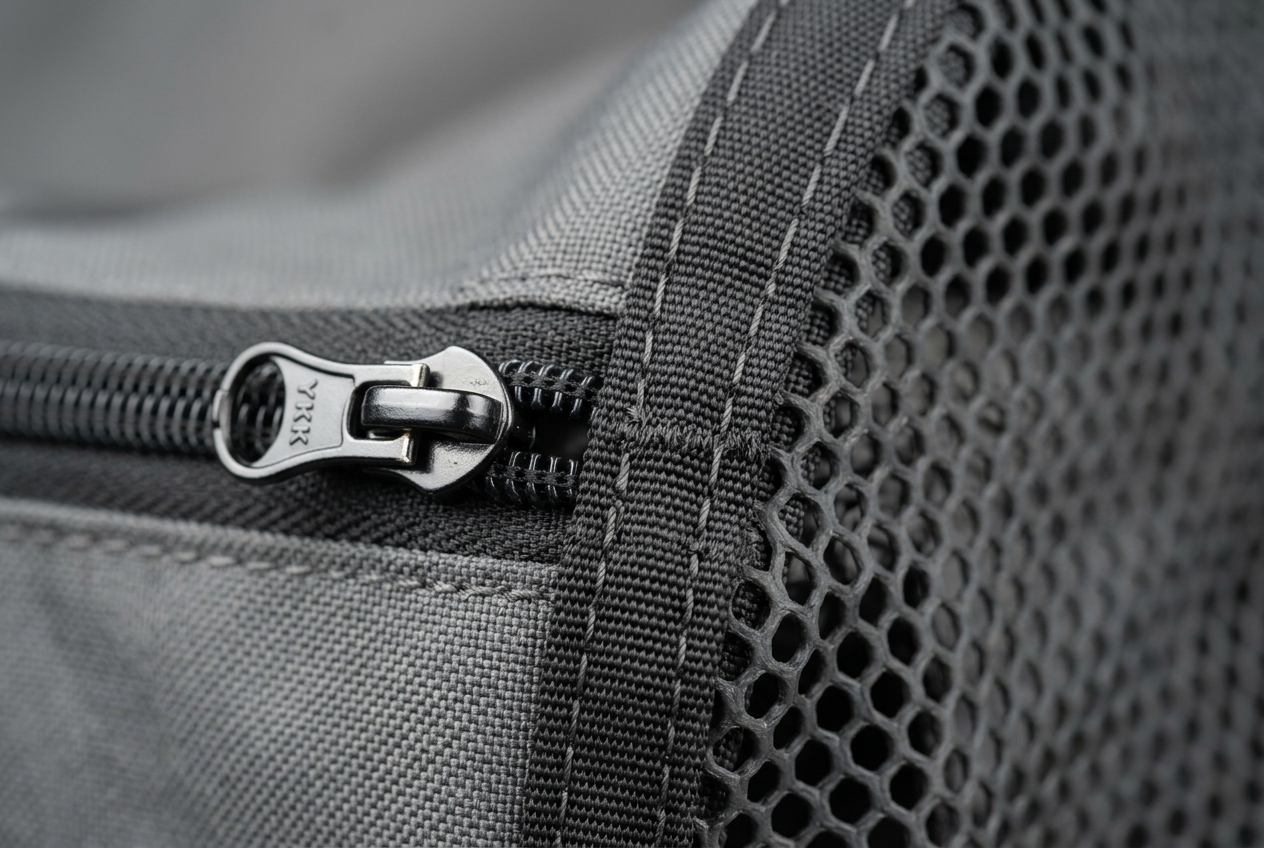
Start with the enclosure, because that is where a cat tests a stroller. A dog sits and waits. A cat pushes at the zipper, works a claw into the corner, and looks for the gap. A stroller that holds a dog can fail a cat on the first walk, and the failure happens on the street, not in the shop. Our own article on zippers and mesh failing when pets panic shows the same pattern in carriers: the closure is the weakest point, and a stressed animal finds it. Check the closure the way a cat would — push from inside, pull at the corners, and see whether the latch holds with one hand free.
Mesh is the second test. A cat that cannot see out panics faster than a cat that can, and a dark box turns a short walk into a long one. Two sides of mesh, at least, with the panels staying open when the bag is under pressure — not mesh that folds shut the moment the bag squeezes. The entry is the third test, and it is the one most dog strollers fail: a high narrow hole that a dog jumps into is a wall to a cat. The opening needs to sit low and open wide, so the cat walks in on its own. A cat that has to be lifted in is a cat that will resist the next ride.
The last two rows are numbers, and numbers need reading. Interior space is measured inside the bag, after the panels, the padding, and the docking parts take their share — the box prints the outside. And the weight limit is a frame limit, not a fit limit: it tells you what the wheels hold, and two cats plus bedding reach it faster than one cat alone.
How do you measure your cat for a stroller?
The box lists a weight limit. Your cat weighs four kilos and fits the limit. Then the cat cannot turn around inside, because weight is not size.
Measure the cat, not the box. The bag needs the cat's body length plus room to turn, and standing height with ears up. Weight limits tell you what the frame holds, not whether the cat fits.

Three measurements decide the fit, and none of them is weight.
- Body length: nose to the base of the tail, with the cat standing normally. The bag needs that length plus room for the cat to turn around — a cat that can only lie straight is a cat that cannot settle.
- Standing height with the ears up. A cat sits tall when it looks out, and a low roof presses the ears down, which is the fastest way to make a cat hate the ride.
- Shoulder width, for the entry: the opening needs to pass the cat's shoulders without a squeeze, or the cat will refuse the door before the ride starts.
Compare those three numbers to the inside of the bag, not the outside. Panels, padding, and docking parts take space from the inside, so a bag that measures 50 centimetres outside can offer 42 inside — and the cat lives in the 42. Our airline-carrier guide makes the same point about internal versus external dimensions, and it holds for strollers too: the cat fits the inside, not the box.
Two more cases catch people out. Two cats need the bigger cat's measurements plus room for both to lie down — the weight limit will not warn you, because two small cats can pass the weight test and still fail the space test. And a kitten grows: buy for the adult size, or the stroller fits for three months and then does not. The home test is simple. Put the cat in the bag at home, close the door, and watch. A cat that turns around inside and lies down fits. A cat that cannot turn fits the box, not the bag.
What does a travel-system stroller do that a plain stroller doesn't?
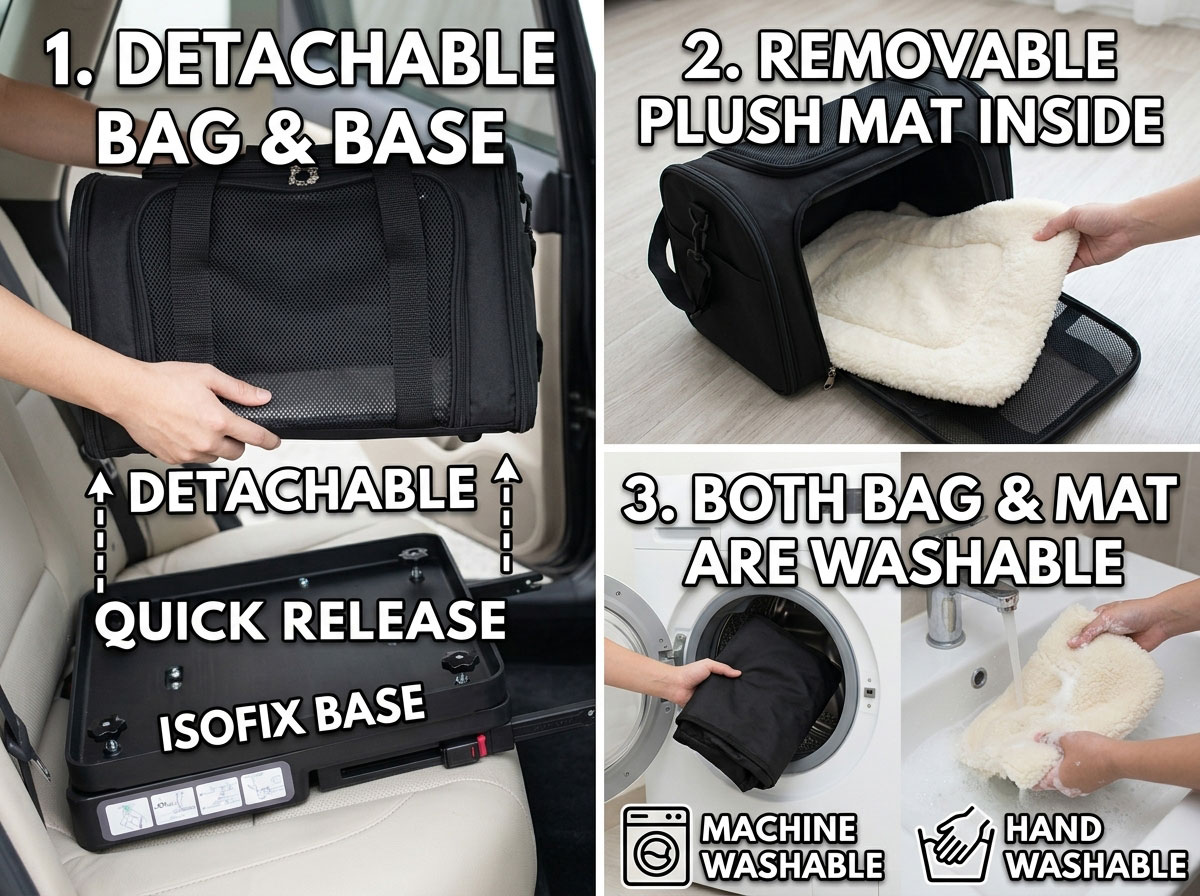
A travel-system stroller carries one detachable bag from the pavement to the car to the plane. The bag clicks off the frame and onto a car base, so the cat stays in the same carrier for the whole trip.
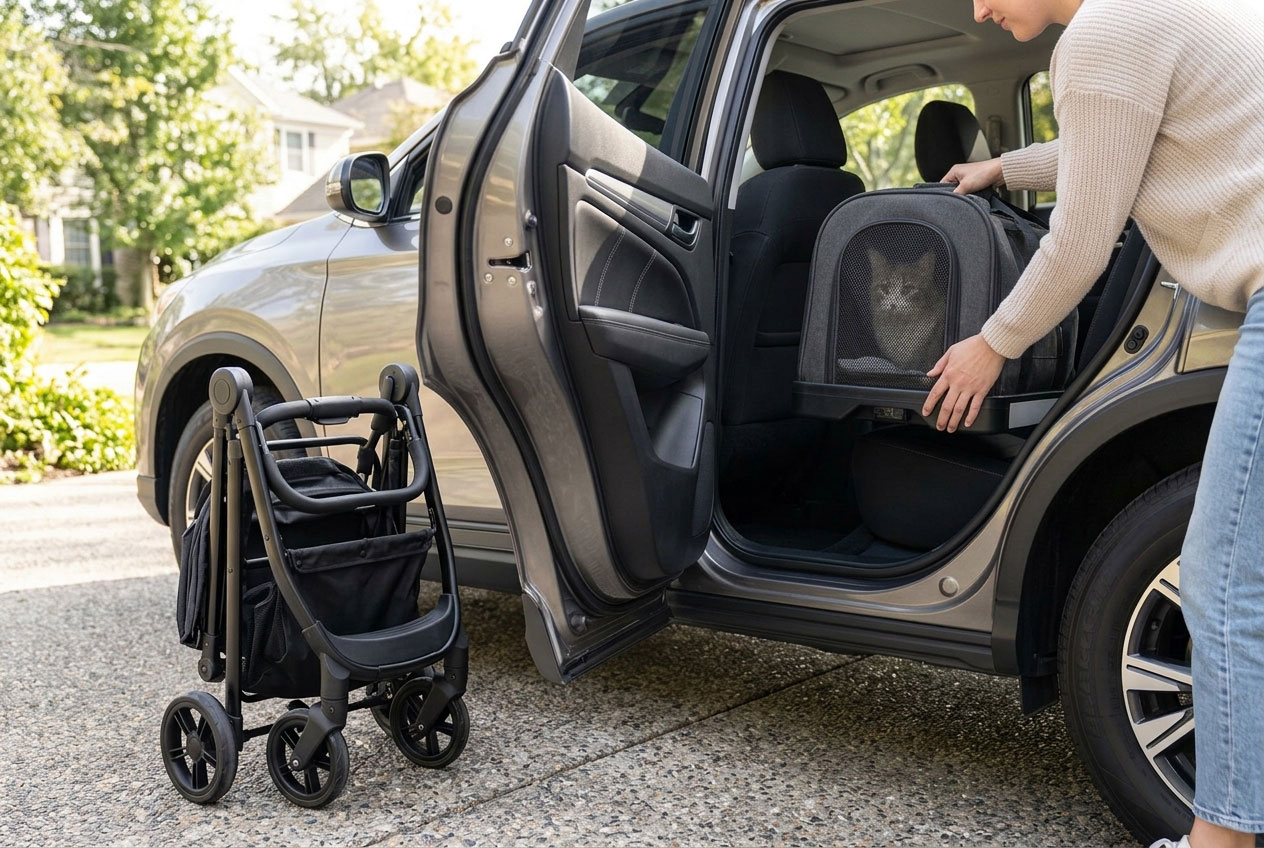
The walk ends at the car park. With a plain stroller, the trip splits in two: the stroller folds into the boot, and the cat moves into a separate car carrier. The cat is lifted out, carried across the car park, and put into a second box — twice the handling, twice the stress, and a second product to buy, store, and clean. With a travel system, the trip stays in one bag. The bag clicks off the frame and onto the car base, and the cat never leaves it. The frame folds flat on its own. At the other end, the bag clicks back onto the frame, and the walk resumes where it stopped.
The same bag goes further. On a flight, the bag that rode on the frame rides under the seat — our airline directory lists fourteen airlines and the size each one allows — so the cat travels in the carrier it already knows, not in a third box bought for the plane. That is the difference between a stroller and a system: a stroller solves the walk, a system solves the trip.
AERO is built this way — carrier, ISOFIX base, and stroller in one product, for small pets up to 12 kg. The carrier detaches from the frame, and the test is simple: the bag must lock onto the frame with a click you can hear and a tug that does not move it. If you want the full comparison between a stroller and a travel system, we wrote that out separately.
How Do You Pick the Right Stroller Without Paying for It Twice?
A cheap stroller costs twice: once when you buy it, again when you replace it. The second purchase hurts more, because by then you know what to check.
Check five things before you pay: the weight limit, the fold, the brakes, the wheels, and a liner you can remove and wash. Then check one more: whether the bag comes off, so a new bag costs less than a new stroller.
Before you buy
- [ ] Weight limit — covers the cat plus bedding, and a second cat if you have two.
- [ ] Folding — one hand, flat enough for the car boot.
- [ ] Brakes — lock on a slope, and stay locked.
- [ ] Wheels — size and material for your ground: pavement, park, gravel. Bigger wheels roll easier.
- [ ] Liner — removes and washes. Cats have accidents.
That list is the five checks. The sixth is the one that saves the second purchase: whether the bag comes off. It does on both kinds of system, and the difference is how often. On the integrated system, the bag stays connected to the ISOFIX base below in daily use — it comes off only to replace it or wash it. BASE-X is a standalone ISOFIX base system, built so the carrier detaches for everyday use. Either way, if you stop liking the bag, swap the bag, not the system. The base stays the same base, the frame stays the same frame, and the new bag is the lowest-cost refresh — a new bag, not a new stroller. Even the frame can be swapped later, on its own. A stroller you can refresh piece by piece is a stroller you keep, and the cheapest stroller is the one you never replace.
For buyers stocking strollers rather than buying one, the same checks apply at a different scale: our sourcing guide for premium strollers with a detachable carrier covers the sample, the spec, and the supplier questions. The logic is the same — buy the system, not the bag, and the bag is the cheap part to change.
Measure the cat, not the box. Buy the system, not the bag — and the cat rides in the same carrier from the pavement to the car to the plane.