
You buy a carrier marked 'airline-approved', then the gate agent shakes their head. The bag fits the shop shelf, not the seat. This directory shows the real numbers.
Most airlines take small pets in the cabin, but each one sets its own carrier size, weight limit, and fee. American, Delta, and United allow around 18×11×11 inches. Lufthansa, KLM, and Air France cap pet plus carrier at 8 kg. British Airways takes no pets in the cabin at all.
I checked all fourteen airlines in this directory against their own websites on 18 November 2026, and I linked each row to the page I read. Fees and rules change, so treat this as a starting point and confirm the number on the airline's own page before you book. The short version first: no single carrier fits every airline, and the next sections show why.
What does "cabin-approved" actually mean on your ticket?
A tag on a carrier says 'airline-approved'. The airline never wrote that tag. The maker did.
"Cabin-approved" means the airline lets your pet fly in the cabin on that ticket, in a carrier that fits under the seat in front of you. It is the airline's call, not the carrier maker's. A tag on the bag proves nothing by itself.
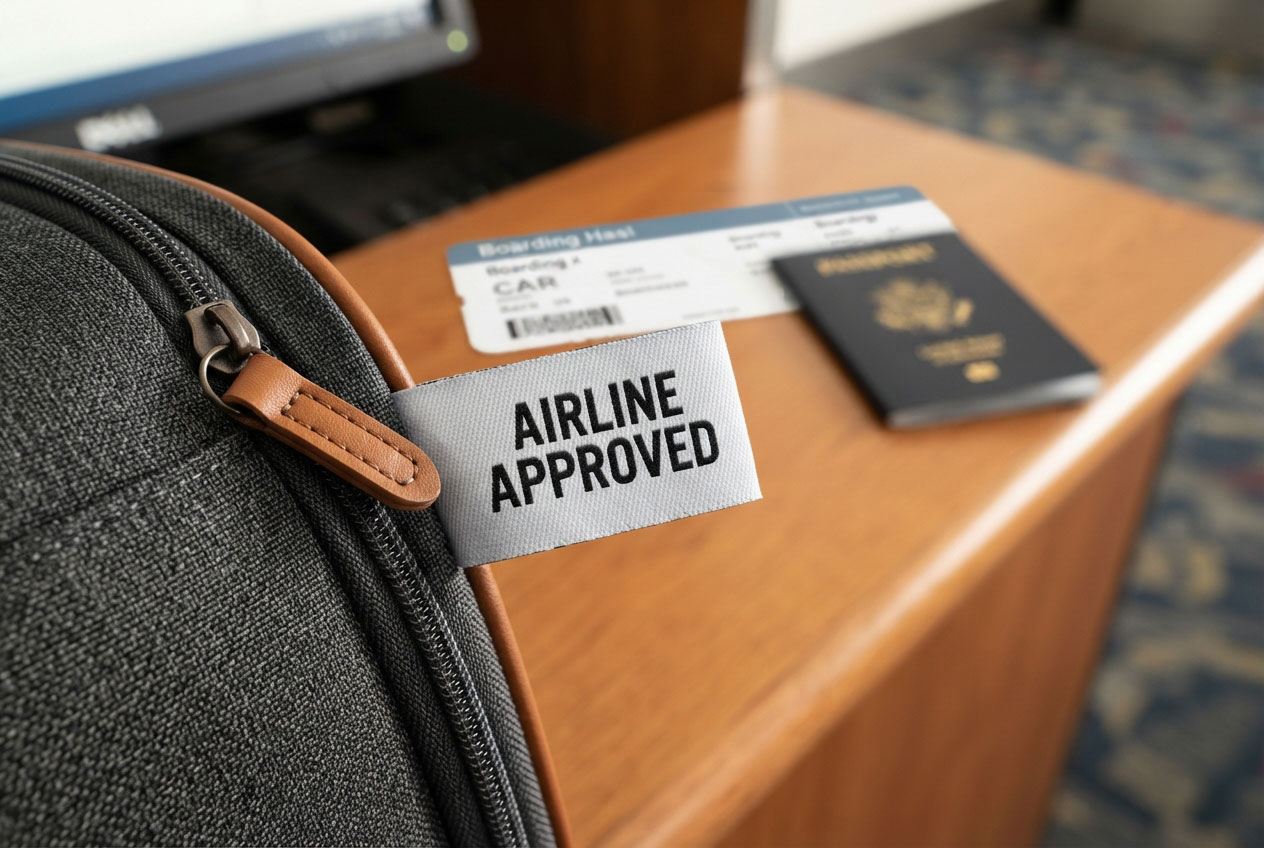
A pet can travel three ways, and the airline picks which ones exist on your route. Cabin means the pet rides with you, in a carrier under the seat. Hold means the pet rides in the baggage compartment, in a kennel, on the same flight. Cargo means the pet ships as freight, often on a different flight, with its own booking and its own rules. A carrier labelled 'airline-approved' says nothing about any of the three. No airline certifies carriers. No regulator stamps a bag. The words sit on the tag because the maker put them there.
What decides the trip is the airline's own pet page, plus the aircraft, plus the seat. The airline sets the size, the weight, the fee, and the number of pets per flight. The aircraft sets the space under the seat, and that space changes from one plane to the next. The seat sets the rest: exit rows and bulkheads take no pets on several airlines, and some cabins take none at all. Delta bars pets from Business and Delta One. KLM bars them from Premium Comfort and intercontinental Business. Air Canada bars them from Premium Economy. A ticket in the wrong cabin turns a good carrier into a refused one.
The booking matters as much as the bag. Most airlines cap cabin pets per flight, so the pet needs a reservation, not just a ticket for you. American lets you add the pet online and pay at the counter. Delta and Southwest want a phone call. United takes the booking on its website but not in its app. Alaska and Hawaiian want a chat or a call after you buy your ticket. Cabin fees run from $50 on Allegiant to $300 on Air France (US to the rest of the world) each way, and they change. I checked every number in this article against the airline's own site on 18 November 2026. Check it again before you fly.
How big can a cabin carrier be — and why do the numbers disagree?
Two carriers sit side by side on the shop shelf. One is soft, one is hard. Under a plane seat, only one of them gives.
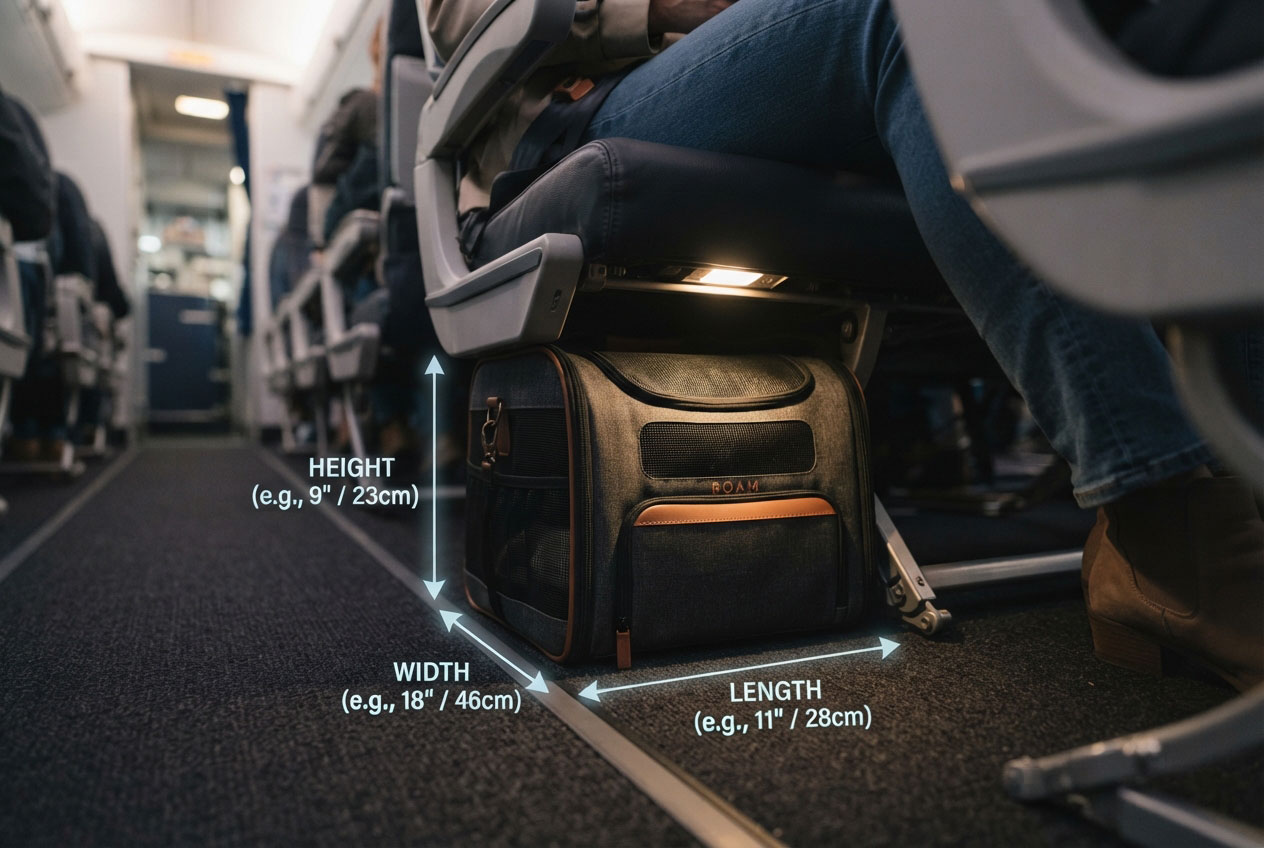
Soft carriers fit more seats than hard ones because they squash a little where the seat frame bites. Hard carriers hold their shape, so they need the full space. Measure the carrier closed, then check the airline and the aircraft.
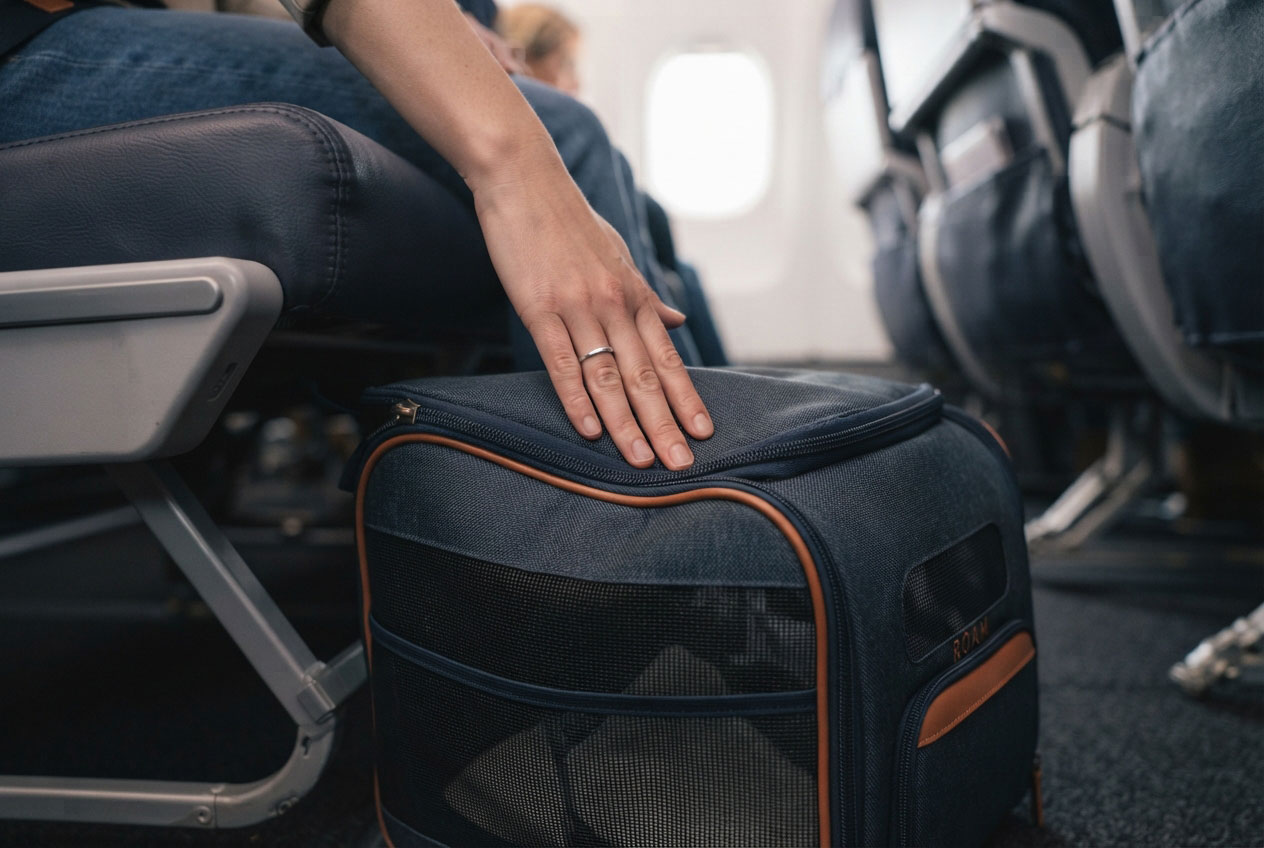
Soft vs hard under a seat
| Soft-sided | Hard-sided | |
|---|---|---|
| Gives under the seat | Yes, a little | No |
| Airline limits | Same size cap, more forgiving in practice | Same size cap, no give |
| Weight | Lighter, helps the 8 kg cap | Heavier, eats the cap |
The table looks even. The seat is not. Underseat space changes with the aircraft, the row, and the seat itself. Aisle seats give less room than window seats on some planes. Bulkhead rows give none at all. Air Canada prints three different size sets for three different aircraft groups, and a fourth for its Business cabins. Delta prints no fixed maximum at all: its page says the maximum 'is determined by the aircraft dimensions of your flight'. The same airline, the same route, a different plane on the day — the numbers move.
A customer sent me a table she had put together from the airlines' pages, and she told me how she solved the problem for her own bag. She had the top of her carrier made expandable, so it squashes flat under the seat and opens up once the bag is out. The idea is a good one. It works with the seat instead of against it: the tightest squeeze in the cabin is usually height — JetBlue allows 8.5 inches, Air Canada's main cabins allow 8 — and a top that folds down buys back exactly that space. American's page points the same way: soft-sided collapsible kennels are recommended, and a kennel 'can be slightly larger but still need to fit under the seat without having to excessively collapse the kennel'.
The catch is the word 'fully'. A top that folds solves the fit. It does not solve the rest. The rules differ in kind, not just in inches: Air Canada prints a different size for each aircraft group, the three European carriers cap pet plus carrier at 8 kg while most US carriers print no weight limit at all, and British Airways takes no cabin pets on any route. A bag can be right for the seat and wrong for the airline, right on one plane and wrong on the next. Full compliance with every airline at once is a hard target — the expandable top gets the bag under the seat, and the table in the next section does the rest.
I ran the numbers the other way too, looking for one bag that fits every airline in this directory. Take the strictest length, the strictest width, and the strictest height across all fourteen, and you get 16×8×8 inches. No pet travels well in that. Even the big-three cluster breaks apart: American, Delta, and United sit at 18×11×11, but JetBlue caps height at 8.5 inches and Southwest caps width at 10.5 inches. The honest answer is to pick the airlines you fly, then pick the bag — or pick a bag that gives a little, and know where it stops giving.
Which airlines take small pets in the cabin, and what do they allow?
Fourteen airlines, one row each. I checked every number against the airline's own site on 18 November 2026 — click the airline name for the page I read.
| Airline | Cabin pets? | Max carrier size | Max pet + carrier weight | Fee (one way) | Booking |
|---|---|---|---|---|---|
| American Airlines | Yes | 18×11×11 in, soft (recommended) | No limit stated; 20 lb on A321T premium | $150 | Add on aa.com or the app; pay at the counter |
| Delta Air Lines | Yes | 18×11×11 in recommended; max by aircraft | Not stated | $150 domestic; $200 international | Call Reservations as soon as possible |
| United Airlines | Yes | 18×11×11 in soft; 17.5×12×9 hard | No limit | $150 | Add on united.com; not in the app |
| Southwest Airlines | Yes, domestic only | Branded 15×10×10; other 18×10.5×10 | Not stated | $125 mainland; $35 interisland | Call to book; cannot book online |
| JetBlue | Yes | 17×12.5×8.5 in | Not stated | $150 | Add in Extras; max 6 per flight |
| Alaska Airlines | Yes | 17×11×9.5 in, soft only | Not stated | $100; $35 within Hawaii | Chat or call after booking |
| Hawaiian Airlines | Yes | 17×11×9.5 in, soft only | Not stated | $100; $35 within Hawaii | Chat or call after booking |
| Frontier Airlines | Yes, domestic only | 18×14×11 in soft; 18×14×8 hard | Not stated | $149 | Add at booking or in Manage Trip |
| Allegiant Air | Yes, 48 contiguous states | 18×12×11 in soft; 17×11×10.5 hard | Not stated | $50 per segment | No advance deadline stated |
| Air Canada | Yes | By aircraft: 17×16×8 main; 22×16×10 Dash 8/E175/CRJ900; 16×8×11 Business | Not stated (cabin) | $50–$60 Canada/US; $100–$120 intl* | Tell them in advance; agent check-in |
| Lufthansa | Yes | 55×40×23 cm (22×16×9 in) | 8 kg, pet + carrier | €65–145 / $80–165 by route | Register at least 72h before departure |
| KLM | Yes | 46×28×24 cm (18×11×9 in) | 8 kg, pet + carrier | €70–500 one way | Reserve at least 48h before departure |
| Air France | Yes | 46×28×24 cm (18×11×9 in) | 8 kg, pet + carrier | US–Europe €200/$225; US–elsewhere €250/$300 | Request at least 48h via My Bookings |
| British Airways | No — hold only | — | — | — | — |
*Air Canada's own page lists a second fee range ($105–$120.75 within Canada/US, $270–$318.60 international) in a lower table that reads as hold transport, not cabin. Confirm the cabin fee at booking. Fees and size limits change — the airline's own page is the final word, not this table.
American, Delta, and United take small pets in the cabin at around 18×11×11 inches and $150 each way. Lufthansa, KLM, and Air France allow 46×28×24 cm and 8 kg. British Airways takes no pets in the cabin. The rest sit in between — the table has the numbers.

Three things in that table catch people out. First, the weight. The three European carriers cap pet plus carrier at 8 kg, and they mean the two together. AERO and AERO Pro are built for small pets up to 12 kg, so the pet alone can pass the size test and still fail the weight test on a Lufthansa, KLM, or Air France flight — weigh the pet inside the carrier, not the pet on its own. Most US carriers state no cabin weight limit at all. United says so outright. Delta, Frontier, Allegiant, Southwest, Alaska, and Hawaiian print none. American caps it only in one cabin: 20 lb on the three-class A321T. No limit on the page does not mean the gate agent cannot refuse a bag that will not fit.
Second, the size that looks fixed and is not. Delta prints 18×11×11 inches, and half the internet repeats it as Delta's maximum. Delta's own page calls it a recommendation. The real maximum, in Delta's own words, is 'determined by the aircraft dimensions of your flight'. A reader who buys to 18×11×11 and boards a smaller regional jet can still get stopped. Air Canada goes the other way and prints a different size for each aircraft group, down to the cabin: Business Class on a 777 takes 16×8×11, while the same plane's main cabin takes 17×16×8. Same airline, same day, different seat — different bag.
Third, the row that is not a size. British Airways takes no pets in the cabin on any route. The pet flies in the hold, or it does not fly with BA. Assistance dogs ride free in the cabin on most flights. That is the whole row, and it belongs in the directory, because a reader planning London needs to know the answer is no before they shop for a bag.
What happens when the carrier fits the airline but not the aircraft?
You booked the right airline, and the carrier matches the airline's printed size. Then the airline swaps the aircraft. A 737 becomes an Embraer, or a wide-body becomes a narrow-body, and the underseat space shrinks by inches. Your bag did not change. The seat did. The gate agent measures the bag against the plane you are about to board, not the one you booked. Air Canada's three size sets exist for exactly this reason: the same carrier can be legal on a 777 and too big on a Dash 8. Delta's page says it plainly, even if nobody reads it: the maximum is determined by the aircraft on your flight. A swap can turn a legal bag into a refused one with no warning and no refund of the pet fee.
Check the aircraft type when you book, and check it again before you leave for the airport. The booking page shows the plane. The seat map shows the row. Avoid exit rows and bulkheads: several airlines in this directory bar pets there outright, and the underseat space is missing or blocked. If the gate agent refuses the bag, the options are thin: buy a smaller carrier at the airport shop if one exists, rebook the pet into the hold if the flight takes hold pets, or rebook the whole trip. None of that is cheap, and none of it is the airline's problem. Whether the pet fee comes back depends on the airline — Frontier and Allegiant call theirs non-refundable, Southwest refunds it if you cancel. The cheapest fix sits before the trip: a tape measure, the airline's page, and the aircraft on your booking.
The airline checks your carrier against the plane at the gate, not the one you booked. Check the aircraft type and your seat row before you travel, and carry a tape measure — a swap can make a legal bag too big.

How do you pick a carrier that survives the directory, not just one flight?
One flight is easy. A carrier that works next year, on another airline, is the real test.
Measure the carrier closed, check the airline and the aircraft, confirm the fee and the booking window, and buy for the smallest limit you fly — not the biggest bag you like.
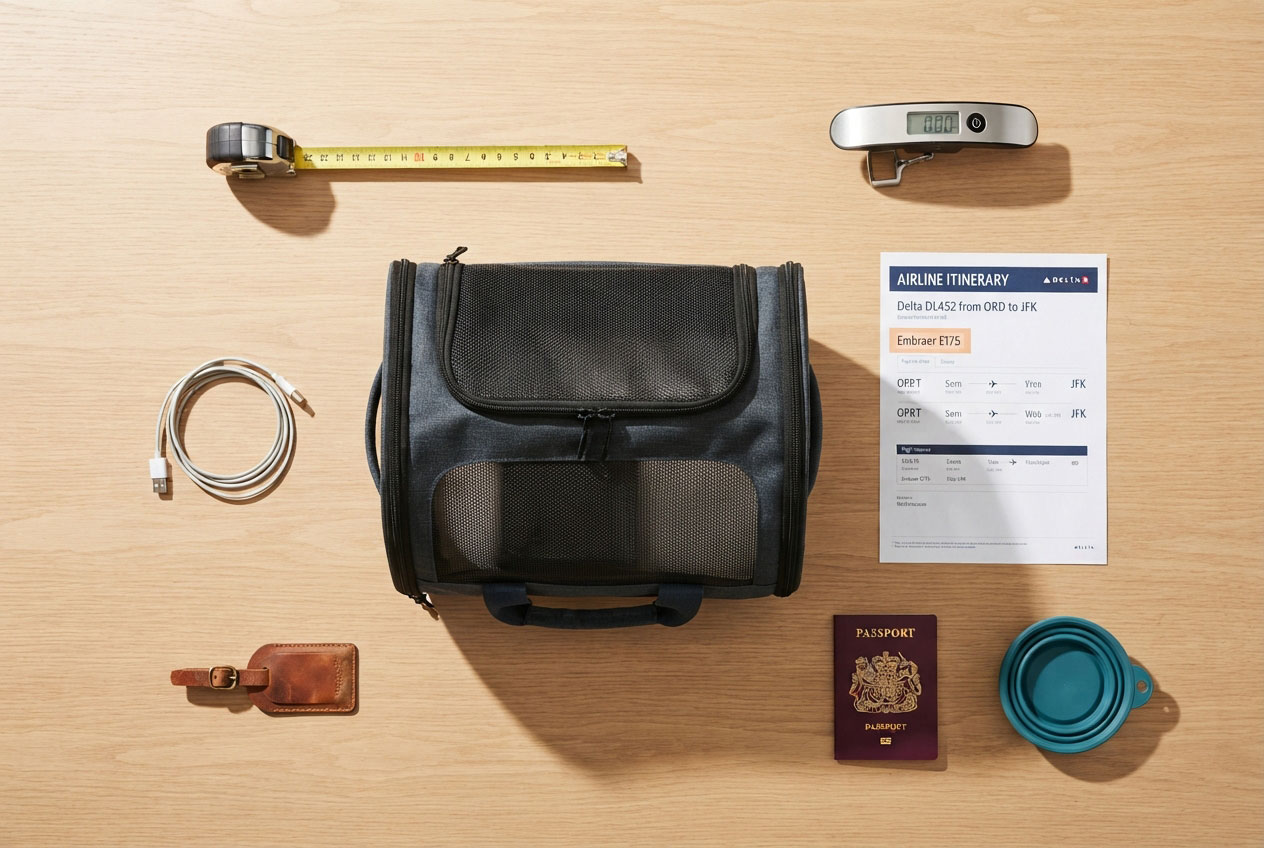
Before you buy
- [ ] Measure the carrier with the top closed, in inches and centimetres. The limit is measured closed.
- [ ] Write down the airlines you actually fly, and the smallest size among them. Buy to that number.
- [ ] Check the aircraft on your next booking, not just the airline. A regional jet can shrink the limit.
- [ ] Weigh the pet inside the carrier. On Lufthansa, KLM, and Air France the 8 kg cap counts both together.
- [ ] Confirm the fee and the booking window on the airline's own page. Fees in this directory were checked on 18 November 2026, and they move.
- [ ] Book the pet, not just your seat. Most flights cap cabin pets, and the cap fills up.
- [ ] Skip exit rows and bulkheads. Several airlines bar pets there, and the space is missing anyway.
That list reads like packing advice. For a shop or a brand, it reads like a buying spec. A carrier that clears the smallest limit in your customers' travel beats a carrier that clears one airline's page. The size, the weight, the fee, and the booking rule all sit in the table above, and they all come from the airlines' own pages. A buyer who stocks to the directory stocks one bag that works on the routes their customers actually fly, instead of five bags that each work somewhere.
The trip does not end at the airport. The carrier that flew in the cabin still needs a car at the other end, AERO and AERO Pro have an ISOfix on its base, so you can just switch to car seat mode or stroller mode in a second. The same carrier that rode under the seat clicks onto the base in the car, so the pet stays in one carrier from the airport to the hotel. Ask us about distribution or a private-label version if you stock carriers and want the car half of the trip covered too.
No one carrier fits every airline. Check the airline, check the aircraft, measure the bag closed — then book the pet, not just the seat.