

How to Fly With a Dog — and What to Pack in the Carrier
A dog in the cabin sounds simple until the airline, the aircraft, and the seat under it all disagree. Here is how the trip actually works.
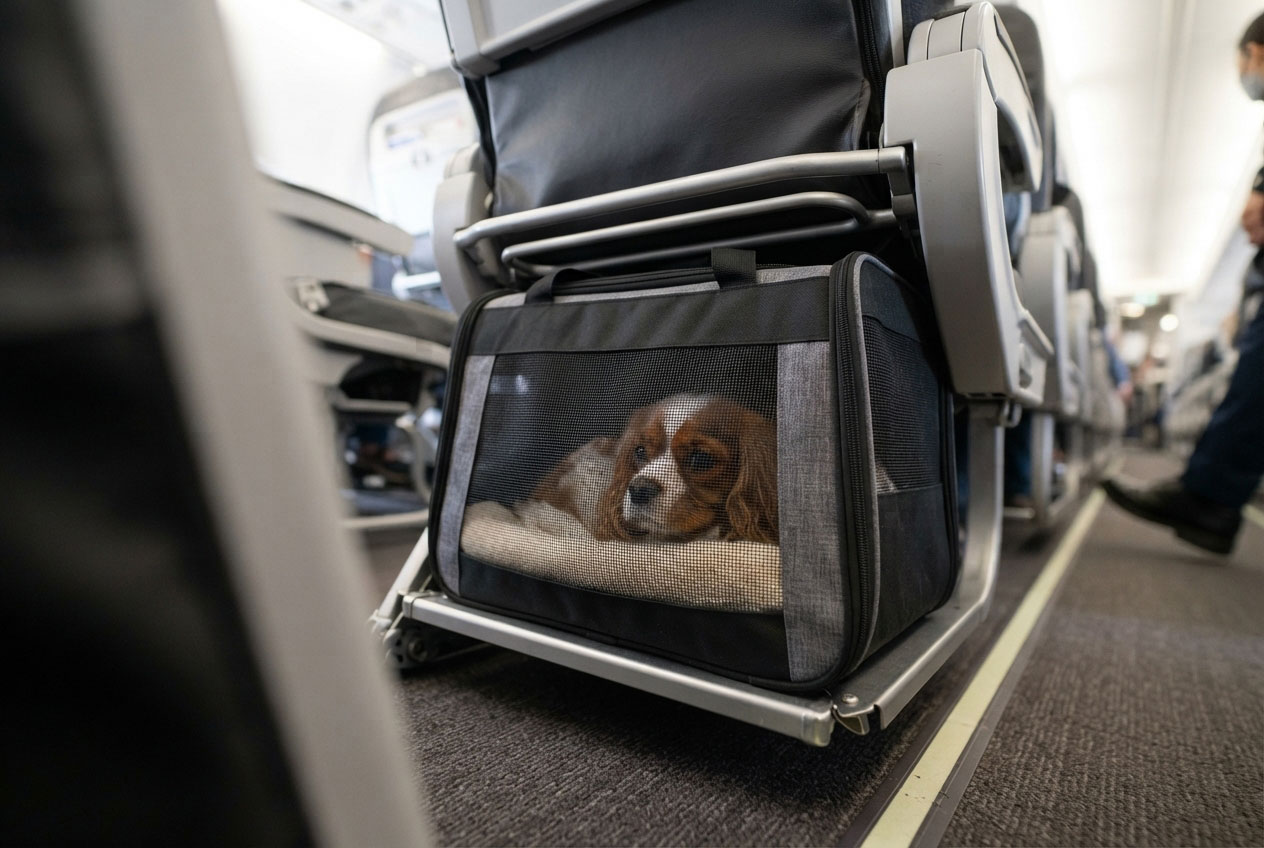
Most small dogs can fly in the cabin in a soft carrier that fits under the seat, if the airline allows it and the dog stays in the carrier. Check your airline's size, weight, and booking rules before you buy a ticket.
This is the question I hear most from buyers and owners. The answer is never just "buy this bag." The airline sets the rules, the aircraft sets the space, and the security checkpoint sets the routine. The steps below follow that order. The last section is the part I know from the product side — how one bag covers the car, the plane, and the walk after landing.
Can my dog fly in the cabin with me?
You picture your dog asleep under the seat. The airline pictures a policy, a weight limit, and a seat map. Those two pictures have to match before you book.
Small dogs usually fly in the cabin in a soft carrier under the seat, while larger dogs fly in the hold or as cargo. The airline sets the size, weight, breed, and pet-count rules for each route, so check the policy before you book.
A dog flies one of three ways. In the cabin, a small dog rides in a soft carrier under the seat in front of you. In the hold, a larger dog rides in a hard crate, in a pressurised and temperature-controlled part of the plane, booked with your ticket. As cargo, a dog travels separately from you, often through the airline's cargo team or a pet shipping company. The airline decides which of the three it offers, and for which dogs. No government hands out a single rule for all of them.
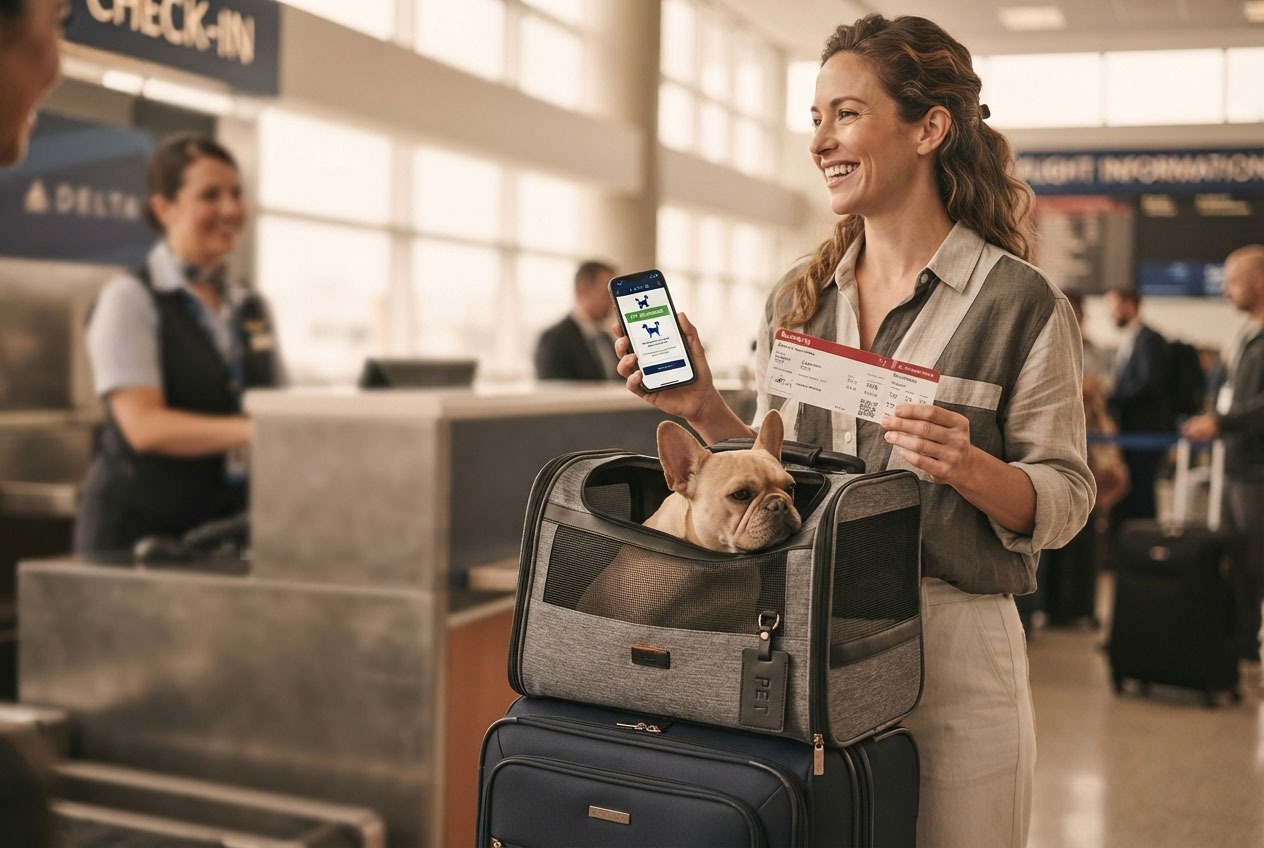
The airline also caps the number of in-cabin pets per flight. Most airlines allow only a few, and the spots go first-come, first-served. Book the pet's spot at the same time as your own ticket, or before it. If the cabin is full for pets, the dog does not fly in the cabin on that flight, even if the carrier fits.
Breed rules add another limit. Snub-nosed breeds — pugs, French bulldogs, boxers — face extra risk in the hold, because they struggle to breathe under stress and in heat. Many airlines bar them from the hold entirely, and some bar them from cargo too. A flat-faced dog needs a cabin plan, or a different trip.
Age matters as well. The International Air Transport Association (IATA) sets the baseline: a pet must be at least eight weeks old and fully weaned before flying. Many airlines and countries require older dogs for international travel, so the IATA line is the floor, not the whole rule.
One route breaks the cabin pattern completely. No airline on an approved UK route accepts pets in the cabin or as checked baggage. Every dog and cat flies as manifest cargo, booked through a cargo carrier, with a pet shipper on the UK side to clear customs. British Airways takes no pets in the cabin on any route — hold only, with assistance dogs free in the cabin. A trip to the UK is a cargo trip, not a cabin trip, and the planning starts months ahead. I cover the UK rules in detail in our airline directory.
International travel adds paperwork on top of the airline's rules. Leaving the US runs through USDA APHIS. Returning to the US runs through the CDC, with a Dog Import Form receipt. Entering the EU as a non-resident needs an EU animal health certificate rather than a pet passport. Different agencies, different forms — the paperwork for one direction does not cover the other.
What size carrier does my airline actually allow?
Every airline publishes a different number, and the number changes with the aircraft. A carrier that fits one flight can fail the next.
There is no single under-seat size. Check your airline's current in-cabin policy for your exact flight and aircraft, and measure the carrier's inside space — not just the label. Our directory lists fourteen airlines' limits; our under-seat guide covers the size detail.

Treat the size as a trip question, not a shopping question. Check it before you book. The number depends on the airline, the aircraft, and the seat — and the return flight may use a different aircraft from the outbound one. Check both directions, not just the way out.
The seat matters as much as the airline. Bulkhead, exit-row, and some premium-cabin seats have no ordinary under-seat storage. An aisle seat can offer less under-seat space than a middle or window seat. Read the seat map for your exact flight. A ticket brand tells you who sold the seat. It does not tell you who flies the plane. On a code-share flight, the operating carrier's pet policy applies, so check the airline that actually operates the flight.
The label on the bag does not settle it either. "Airline approved" is a marketing phrase, not a universal spec. An airline can refuse a carrier labelled "airline approved" if it does not meet that airline's own policy. Our flagship article explains what the phrase really means: What Does "Airline-Approved" Really Mean for a Pet Carrier?
The numbers themselves live in two places, and I will not repeat them here. Our airline directory lists fourteen airlines' cabin sizes, weight limits, and fees, each checked against the airline's own page. Our under-seat guide covers the buying detail — internal space against external size, soft against hard, and the features that hold up under a seat. The one thing to carry from this section: the height is where the airlines split most, so a tall carrier is the riskiest buy. Measure the inside of the bag, because padding, framing, and a thick bottom board all eat into the space the dog actually gets.
What goes in the carrier bag?
You packed the dog. Did you pack the papers? The checkpoint takes the dog out of the bag, and the airline wants the documents first.
Pack the health certificate and vaccination records, water, and a light pre-flight meal, and keep the carrier's zippers and tether in working order. At security, the dog comes out of the carrier and the empty carrier goes through the X-ray. Leave sedation out — IATA and most airlines discourage it.

Pack for the flight and for the checkpoint, because the two ask for different things. The list below is the short version. Keep it in the bag, not in the suitcase.
- Health certificate from a USDA-accredited veterinarian, for international travel and for any route that asks for one.
- Vaccination records, rabies first.
- Water — a small bowl or a bottle the dog can drink from before boarding.
- A light pre-flight meal. IATA recommends feeding a light meal about two hours before travel, and offering water until departure.
- A familiar blanket or pad, so the bag smells like home.
- Waste bags, for the airport and the other side.
- The carrier's tether and leash, in working order.
- The booking confirmation for the pet spot, on paper or on the phone.
International trips add documents. Leaving the US needs a USDA APHIS endorsement on the health certificate. Returning to the US needs a CDC Dog Import Form receipt. Entering the EU as a non-resident needs an EU animal health certificate. The forms come from different agencies, and the form for one direction does not cover the other. Start the paperwork weeks ahead — a titer test or a waiting period can add a month or more to the timeline, and the UK route needs four months or longer from a standing start.
At the security checkpoint, the routine is the same at most US airports. The dog comes out of the carrier. The dog is carried, or walked on a leash, through the metal detector. The empty carrier goes through the X-ray machine on the belt. Practice the routine at home first, so the dog is not startled by the noise and the crowd on the day.
In the air, the rule is simple and strict. The carrier stays under the seat for the whole flight, and the dog stays in the carrier. Flight attendants enforce it. A carrier that the dog can push open, or a zipper that slides on its own, is a problem at 35,000 feet — check the closures before you leave the house.
Leave sedation out of the bag. IATA and most airlines discourage sedating a dog for a flight, because of respiratory and temperature risks at altitude. A familiar blanket, a calm routine, and a bag the dog already knows do more than a pill. If the dog is anxious about travel, talk to the vet about the trip itself, not about a sedative.
One last habit: check the airline's site again in the days before departure, not just when you booked. Policies, aircraft, and seat assignments change. The return flight may use a different aircraft from the outbound one, and the size that fit on the way out may not fit on the way back.
What are the other ways to fly with a dog?
| Way to fly | Best for | The dog's experience | The catch |
|---|---|---|---|
| Soft cabin carrier | Small dogs that fit the size limit | Stays with you, in a familiar bag | The size limit is strict; the dog stays in the bag for the whole flight |
| Hard crate in the hold | Larger dogs that cannot fly in the cabin | A pressurised, temperature-controlled hold, but separated from you | The crate must meet the airline's size and ventilation rules; some breeds are barred |
| Cargo | Dogs that cannot fly cabin or hold on your flight | Travels separately, handled by the airline's cargo team | The most paperwork; temperature and seasonal embargoes apply |
| Pet shipping company | International moves and complex routes | The company handles the route, the paperwork, and the handover | The most expensive option; book well ahead |
| Staying home with a sitter | Anxious, elderly, or unwell dogs | No flight stress at all | You travel without the dog |
A soft carrier in the cabin is the gentlest option for a small dog that fits the size limit. A hard crate in the hold suits a larger dog. Cargo and pet shippers handle the rest — and for an anxious or unwell dog, staying home is often kinder.
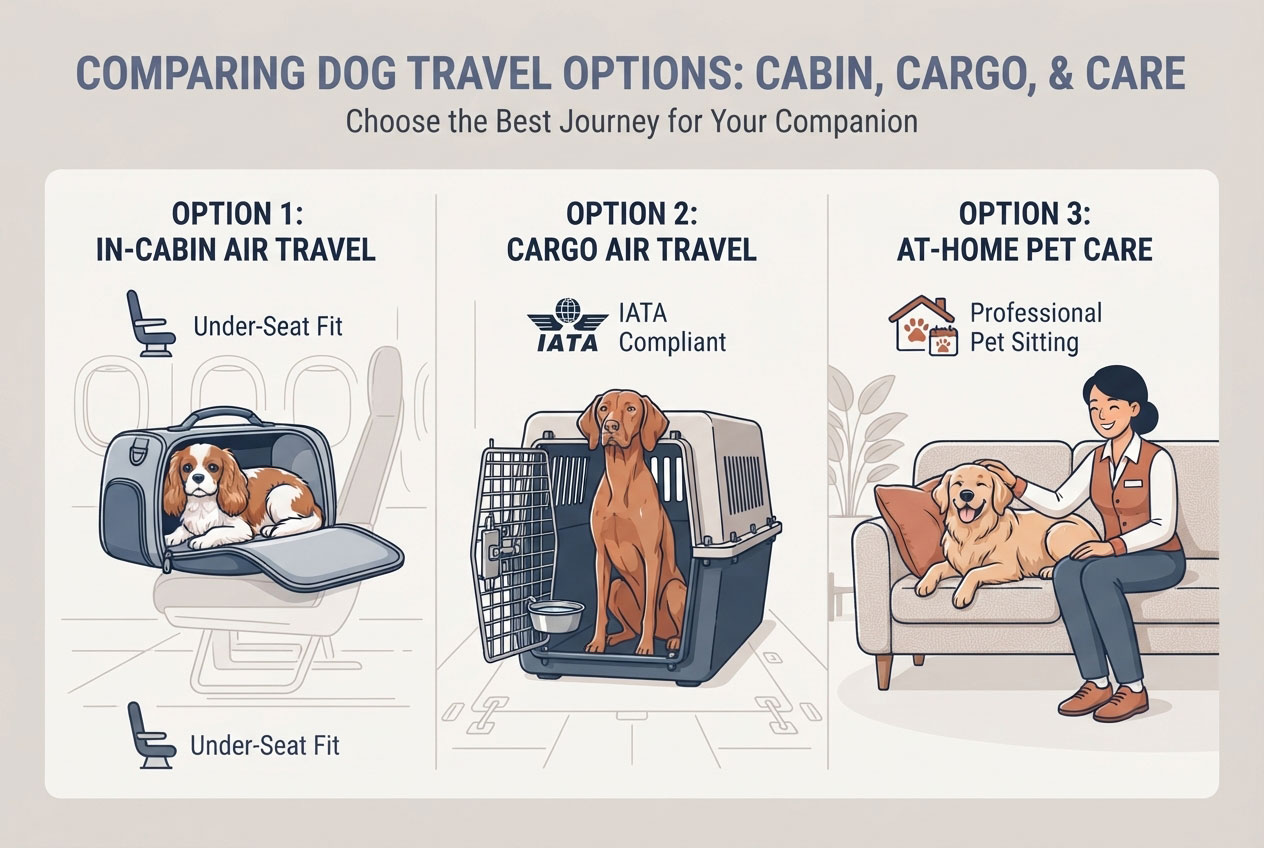
The soft carrier is the gentlest option, and it is also the most limited one. The dog stays with you, in a bag it knows, for the whole trip. The price of that comfort is the size limit and the confinement — the dog stays in the bag, under the seat, from takeoff to landing. A dog that cannot settle in a small space for hours will not enjoy the flight, and neither will the row around it.
The hard crate suits a larger dog that cannot fly in the cabin. The hold is pressurised and temperature-controlled, and the crate gives the dog room to stand, turn, and lie down. The trade is separation: the dog flies apart from you, and the crate must meet the airline's size and ventilation rules — IATA asks for ventilation on at least three sides. Snub-nosed breeds are often barred from the hold, so a flat-faced large dog may have no hold option at all.
Cargo covers the dogs that cannot fly cabin or hold on your flight. The dog travels separately, handled by the airline's cargo team, and the booking runs through cargo rather than the passenger desk. Temperature limits and seasonal embargoes apply, and the paperwork is heavier than a cabin booking. A pet shipping company takes the whole job — the route, the paperwork, the handover on the other side — at the highest price, and it needs booking well ahead.
Staying home is the option people skip, and it is the right one more often than the industry admits. An anxious dog, an elderly dog, a dog with heart or breathing problems, a very young puppy, or a heavily pregnant dog may not be fit to fly. Talk to the vet before you book, and let the vet's answer change the plan. A trusted sitter at home is often kinder than the flight, and it costs less than a cargo booking.
Whatever you choose, book a direct flight where you can. Changes and delays are hard on dogs, and a missed connection can change the aircraft — and with it, the size that fits. A direct flight removes one moving part from a trip that already has plenty.
How does one bag cover the whole trip — car, plane, and the walk after landing?
The trip is not one ride. It is a car, a terminal, a flight, and a walk on the other side. Most bags cover one of those.
One bag can cover the whole trip when the carrier clicks onto a car base, rides under the seat on the plane, and goes back on the stroller frame after landing. The stroller folds to carry-on size for the overhead bin. Check your airline's exact limit first.
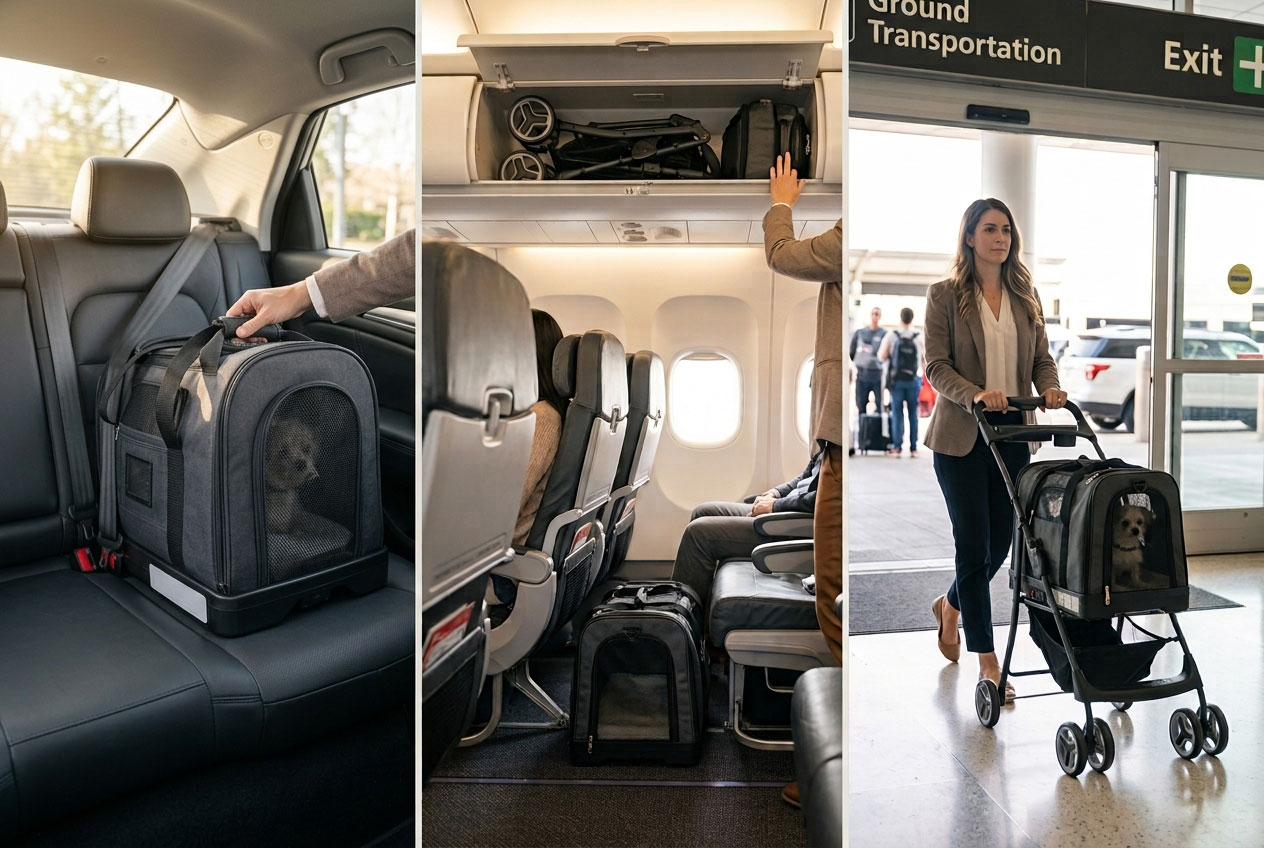
Walk the trip leg by leg, and the bag never changes. In the car, the carrier clicks onto the ISOFIX base. The dog rides in the carrier on the base — the same bag, not a different seat. The rigid anchor holds the bag in place instead of letting it slide across the seat. At the airport, the bag comes off the base and onto the stroller frame. The dog stays in the same bag. No transfer, no new container, no re-settling in a strange box. The stroller carries the bag through the terminal.
On the plane, the carrier goes under the seat, and the stroller folds in three and goes in the overhead bin. The stroller is built to fold down to carry-on size, so it rides with the cabin bags instead of going into the hold. The dog stays in the bag it already knows, under the seat, for the flight. After landing, the bag goes back on the frame and you walk out. The same bag, the same dog, no repacking at the baggage carousel.
The system I know best is AERO — one product that carries the ISOFIX base and the stroller with the bag. The stroller folds in three. The folded stroller is designed to the airplane carry-on standard, for the overhead bin. The carrier is designed for most mainstream airlines' cabin sizes. "Most" is the honest word here. Each airline sets its own limit, and no single carrier fits every airline — British Airways takes no cabin pets at all. Check your airline's exact limit in our directory before you book, and measure the carrier's inside space against it. The design goal is to satisfy the vast majority of mainstream airlines. The guarantee is not part of the design.
BASE-X is the same idea built as a standalone base system. The carrier detaches for everyday use, so the bag comes off the base whenever the trip ends and goes back on when the next one starts. The bag can be swapped while the base and the frame stay — a new bag is the lowest-cost refresh, and even the frame can be swapped later. One base, one frame, and a bag that changes when you want it to.
The limit is the dog. This system is built for small pets, up to 12 kg. A larger dog needs a different plan — the hold, cargo, or a shipper, from the table above. A bag that pretends to cover every dog covers none of them well. The right question is not whether the bag fits every airline. It is whether the bag fits your airline, your aircraft, and your dog — and whether one bag can carry all three legs of the trip without a transfer in the middle.
Check the airline, pack the carrier, and let one bag carry the trip — car, plane, and the walk after landing.