Why Pet Car Safety Is the Next Big Category for Pet Brands in 2025–2026
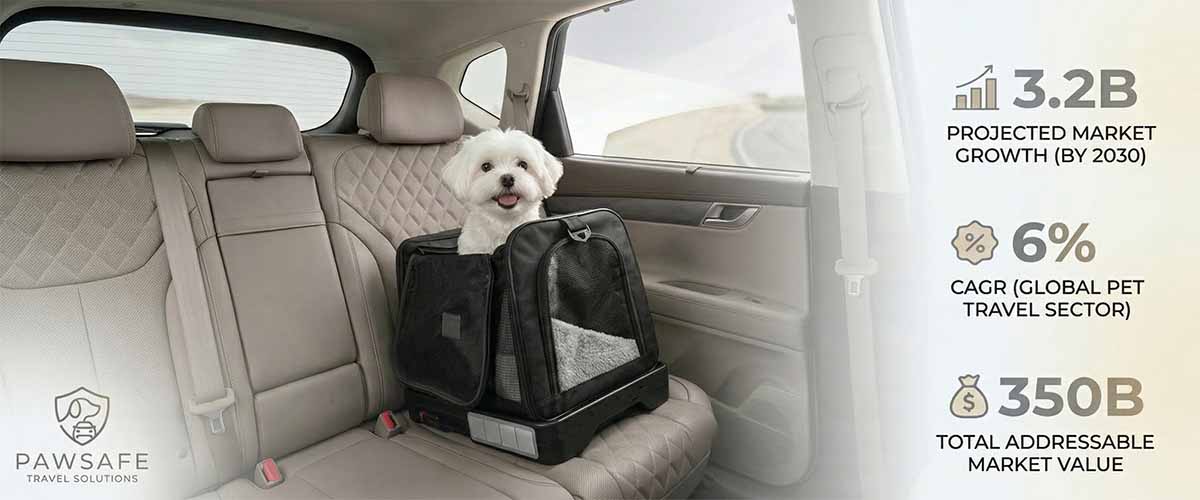
Three numbers every pet brand and distributor needs to see right now:
- 🌍 $350 billion — the size of the global pet economy today
- 🚗 $3.2 billion — the current pet car seat market alone
- 📈 6%+ CAGR — the growth rate that is outpacing most pet accessory categories
If your product catalog does not yet include an engineered pet car safety solution, you are already watching the early movers pull ahead.
Part 1: The Market Opportunity
The Pet Economy Is Booming — And Travel Safety Is Catching Up
The pet industry has quietly become one of the most recession-resistant consumer categories on the planet. Through economic downturns, supply chain disruptions, and shifting retail landscapes, pet spending has continued to climb — year after year, market after market.
But within that broader boom, one sub-category is accelerating faster than almost anything else: pet travel safety.
Global Pet Industry Spending Hits $350 Billion
Total global pet industry spending crossed $350 billion in 2024 and continues to grow. North America alone accounts for the largest share, with U.S. pet owners spending more per pet per year than almost any other country. European markets — particularly DACH, Scandinavia, and the UK — are not far behind, with premium pet product adoption growing rapidly among urban, affluent pet owners.
What is driving this? A fundamental shift in how people relate to their animals.
Pets are no longer just animals that live in the house. For a growing majority of owners — particularly millennials and Gen Z — pets are family members. They sleep in beds, attend social events, and travel everywhere their owners go. And as that relationship deepens, so does the willingness to spend on products that keep them safe.
For a deeper look at what makes a genuinely safe pet travel product, read our guide: What Makes a High-Quality Pet Travel System?
Why the Pet Car Seat Segment Is Outpacing the Broader Market
Within the pet travel category, pet car seats and restraint systems are growing faster than the overall market. The reasons are structural, not cyclical:
- Awareness is rising — high-profile studies on distracted driving from loose pets (including Volvo's widely covered research) are reaching mainstream media audiences
- Legislation is expanding — more jurisdictions are introducing or discussing pet restraint requirements
- Consumer expectations are shifting — pet owners who spend $150 on an orthopedic dog bed are now asking why their pet car seat costs $30 and has no crash-test data
This is a category that is being pulled upward by genuine consumer demand, not manufactured marketing trends. That makes it fundamentally different from flash-in-the-pan pet accessories that spike and disappear.
North America Leads, but Europe and Asia-Pacific Are Accelerating Fast
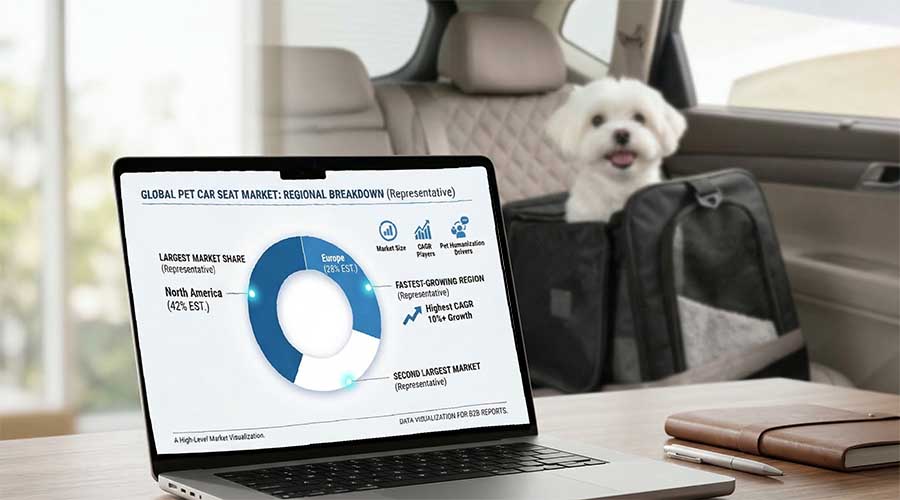
Geographically, the pet car seat market breaks down as follows:
- North America holds approximately 40% of global revenue — the largest single market, driven by high car ownership, long commuting distances, and strong pet humanization trends
- Europe is the second-largest market, with particular strength in Germany, the UK, and Scandinavia where road safety culture and premium product preferences align perfectly with high-end pet car seat positioning
- Asia-Pacific is the fastest-growing region, with rising pet ownership in China, Japan, South Korea, and Australia creating a rapidly expanding first-time buyer pool
For distributors and brands evaluating where to build their pet car safety business, the timing in Europe is especially compelling. The regulatory environment is already ahead of the U.S. — several European countries already treat unrestrained pets as a traffic violation — and consumers in key markets like Germany actively respond to engineering credentials and automotive-standard language.
Pet Car Seat Market Size, Growth & Forecast (2025–2031)
Let's put specific numbers on the opportunity.
Key Market Size Data and CAGR Breakdown
| Metric | Value |
|---|---|
| Global pet car seat market (2025 estimate) | ≈ $3.2 billion USD |
| Projected market size (5–7 year horizon) | > $5 billion USD |
| Overall market CAGR | > 6% per year |
| Narrower "pet car safety seat" segment (2024) | $256 million USD |
| Projected segment size by 2031 | $416 million USD at 7.2% CAGR |
| North America market share | ≈ 40% of global revenue |
| Fastest-growing region | Asia-Pacific |
These numbers tell a clear story. This is not a speculative emerging category — it is a multi-billion dollar market already in motion, with a growth rate that makes it one of the most attractive entry points in the pet accessory space right now.
"The pet travel safety category is at the same inflection point that the orthopedic pet bed market was a decade ago. The brands that enter now with a credible, differentiated product will define the category standard for the next ten years."
— Senior Analyst, Global Pet Industry Research Group
Which Product Categories Are Growing Fastest?
Not all pet car safety products are growing at the same rate. Within the broader category, the fastest-growing segments are:
- ISOFIX-compatible rigid base systems — benefiting from automotive ISOFIX standardization reaching more vehicle models globally
- Modular 3-in-1 travel systems (car seat + stroller + carrier combos) — driven by premium buyers who want a single ecosystem rather than multiple separate products
- Airline-approved hybrid carriers — growing alongside the broader pet-friendly travel trend in aviation
The slowest-growing segment is basic fabric booster seats — the category is becoming commoditized and margin-compressed, largely due to low-cost manufacturing flooding online marketplaces.
What Is Driving Demand Right Now?
Four demand drivers are converging simultaneously:
1. Distracted driving awareness — the Volvo-commissioned study showing unrestrained pets double dangerous driving incidents received global media coverage and directly converted pet owners into first-time buyers
2. Premiumization — the same consumer who buys a $300 pet stroller is now asking for a car seat that matches that quality and price expectation
3. Regulatory tailwinds — even where laws are not yet mandatory, the threat of future legislation is pushing category-aware distributors to stock up now
4. ISOFIX vehicle penetration — as ISOFIX anchor points become standard across vehicle lines globally, the addressable market for ISOFIX-compatible pet bases expands every year
Part 2: Why NOW Is the Right Time to Enter
Three Forces Making Pet Car Safety Explode Right Now
Market size alone does not create a business opportunity. What creates an opportunity is timing — and right now, three structural forces are aligning to make pet car safety one of the best-timed category entries available in the pet industry.
Force 1 — Pet Humanization Is Reshaping Spending Priorities
The humanization of pets is not a trend anymore. It is a permanent behavioral shift that is restructuring how consumers allocate discretionary spending.
Consider what has already happened in adjacent categories:
- Pet food went from basic kibble to grain-free, raw, and fresh-cooked — with premium brands commanding $15+ per pound
- Pet healthcare went from annual vet checkups to pet insurance, physiotherapy, and specialist oncology
- Pet furniture went from a cushion on the floor to orthopedic memory foam beds with washable covers at $200+
Pet travel safety is next in line for this premiumization wave. The consumer logic is identical: "I would never put my child in a car without a proper car seat. Why would I do anything less for my dog?"
This mindset shift is already visible in search behavior, social media content, and retail buy patterns. The consumer is ready. The question is whether the supply side — brands and distributors — will meet them with a credible product.
Want to understand exactly what today's consumer is looking for when they search for a pet car seat? Read our comprehensive consumer guide: Pet Car Seat: The Complete Safety Guide for Dogs & Cats
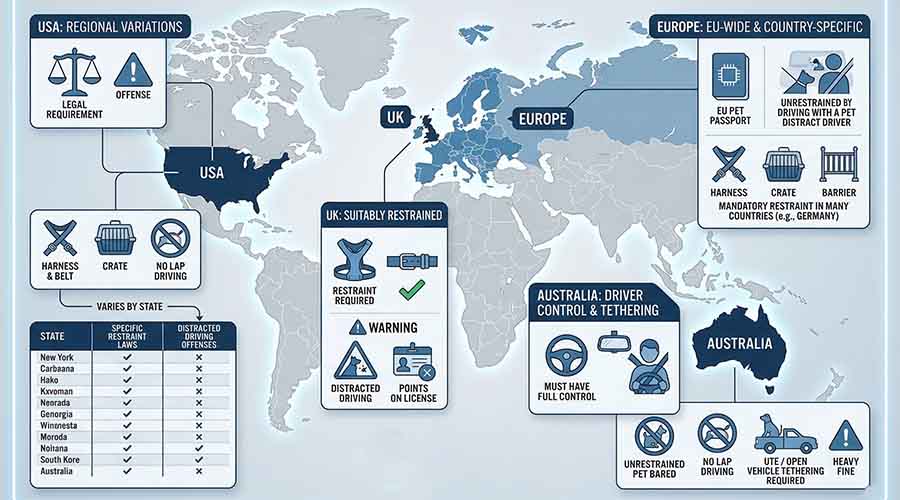
Force 2 — Distracted Driving Legislation Is Pushing Restraint Adoption
Governments and road safety bodies worldwide are paying increasing attention to in-vehicle distractions. Phones were the first target. Pets are becoming the next.
Key regulatory developments to watch:
- Rhode Island (U.S.) already mandates pet restraint in vehicles
- UK Highway Code requires animals to be suitably restrained — non-compliance can result in fines and license points
- Multiple European countries treat unrestrained animals in vehicles as a traffic violation under animal welfare or distracted driving statutes
- Australia — several states have provisions addressing pets in vehicle cabins
The direction of travel is clear. Restraint requirements are expanding, not contracting. For distributors building a catalog, this means pet car safety products are not just a margin opportunity — they are an increasingly mandatory category that retail buyers will need to stock regardless of consumer pull.
Force 3 — ISOFIX Technology Is Finally Reaching the Pet Market
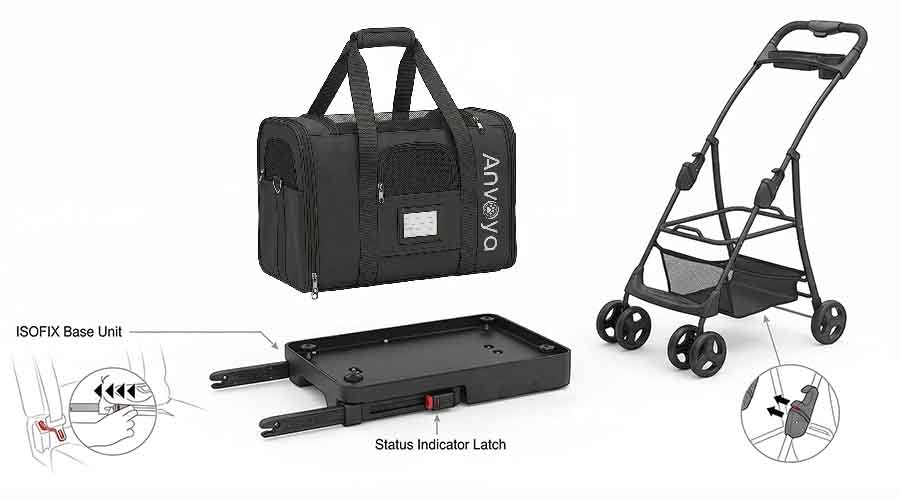
ISOFIX has been the gold standard for child car seat installation since the late 1990s. It offers rigid, play-free chassis anchoring that dramatically outperforms seat-belt-only installation in crash scenarios. Today, ISOFIX anchor points are standard in the vast majority of new vehicles sold globally.
Until recently, no pet travel brand had successfully brought genuine ISOFIX engineering into a mass-market pet product. The technical barrier — requiring actual automotive tooling capability, injection-molded polymer bases, and chassis-engineering expertise — kept most pet accessory companies out.
That barrier is exactly where Anvoya sits. With over a decade of building ECE-certified child car seats in Ningbo, Anvoya's engineering team has the injection molding tooling, HDPE/PP polymer expertise, and automotive DFM protocols needed to produce genuine ISOFIX pet bases — not imitations. The BASE-X ISOFIX Pet Car Seat Base is the direct product of this capability.
For distributors and brand partners, this matters enormously. It means access to a genuinely differentiated product that cannot be replicated overnight by a fabric-bag manufacturer.
The White Space: Why Most Pet Brands Are Still Behind
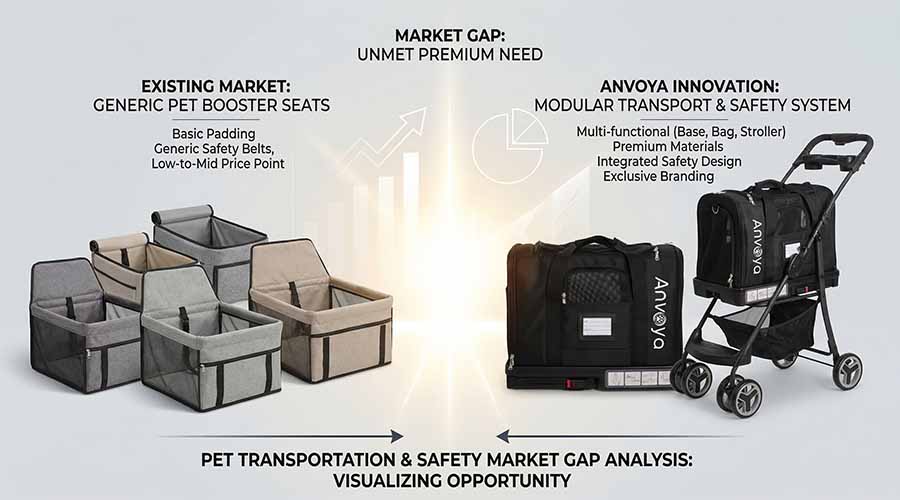
Understanding the opportunity requires understanding the current competitive landscape honestly. And honestly — the current pet car seat market is mostly undifferentiated, under-engineered, and under-branded.
The Current Market Is Flooded With Low-Quality, Unengineered Products
Walk into any major pet retailer or scroll through Amazon's pet travel section. What you will find is a sea of:
- Fabric booster seats with single-strap anchoring and no crash-test data
- Soft carriers marketed as "car seats" with no rigid base and no tether system
- Products listing "safety" in the title but providing no certification information
- Identical ODM designs from multiple brands, differentiated only by color and price
The consumer is becoming aware of this. Review sections on major retail platforms are increasingly filled with complaints about seats that tip over, straps that snap, and tethers that are too long to provide real restraint. The quality gap between what the consumer is being sold and what they actually need is widening — and that gap is a business opportunity.
No Dominant Global Brand Owns This Category Yet
Here is the most important competitive insight: there is no Nike of pet car seats. There is no globally recognized, engineering-credible brand that owns the pet car safety category the way Graco or Britax owns child car seats.
This category is wide open at the premium end. The brands that move now — with genuine engineering credentials, verifiable crash-test positioning, and strong distribution — have a realistic opportunity to define the category standard before a dominant player emerges.
Category-defining windows do not stay open indefinitely. The child car seat market had its window in the 1980s and 1990s. The premium pet food market had its window in the 2010s. Pet car safety's window is open right now.
The Premium Safety Gap — And Who Fills It First Wins
The current market offers two things: cheap unengineered products at $30–60, and expensive lifestyle-branded products at $150+ that look premium but have no more engineering behind them than the cheap ones.
The gap is a credible, mid-to-premium product ($80–200) that can back up its safety claims with real engineering data. That is the position that a well-supported distributor or retail brand can own — and it is the position that Anvoya's manufacturing platform is built to support.
Part 3: What Winning Brands Will Look Like
What Separates a Category Leader From Just Another Pet Seat
In a commodity-flooded market, the brands that will win are the ones that can answer a simple question with real evidence: "How do you know this is safe?"
Most current pet car seat brands cannot answer that question convincingly. The category leaders of the next five years will be the ones who build their entire brand identity around that answer.
Engineering Credibility — Why Automotive Standards Matter
The most powerful positioning available in pet car safety is a direct connection to automotive engineering standards. Consumers — especially in Europe and among premium U.S. buyers — respond to language like:
- "Built to ECE child seat standards"
- "ISOFIX chassis-docking system"
- "HDPE energy-absorbing polymer base"
- "Engineered by automotive chassis engineers"
These terms are not just marketing language. They are verifiable technical claims that create a credibility gap between your product and every fabric-bag competitor on the shelf next to it.
"In the European market specifically, automotive safety language carries enormous weight with consumers. If you can say your product was engineered by the same people who build child car seats — and prove it — you have a story that no lifestyle pet brand can replicate."
— Regional Purchasing Director, European Pet Distribution Group
This is Anvoya's core positioning: Automotive-Grade Precision. Child-Grade Safety. It is not a tagline — it is a manufacturing reality backed by over a decade of ECE-certified child seat production.
To understand exactly how these engineering standards translate into specific product features and buying criteria, see our detailed B2B guide: How to Choose the Right Pet Car Seat: A B2B Gear and Compatibility Guide
Certification and Crash-Test Data as a Marketing Asset
In the current market, crash-test certification is so rare that having it is an immediate differentiator. The Center for Pet Safety (CPS) in the U.S. is the leading independent crash-testing body for pet restraints. CPS certification:
- Validates excursion distance performance in simulated crashes
- Confirms hardware integrity under crash-load conditions
- Disqualifies products with dangerous design features like extension tethers
- Provides a third-party credibility signal that no amount of copywriting can replicate
For retail buyers at boutique stores, pet specialty chains, and online platforms, CPS certification is increasingly becoming a prerequisite for shelf placement in the premium tier. Brands that can point to independent crash-test validation will close distribution conversations faster and command better margin structures.
ISOFIX Modular Systems vs. Fabric-Only Products
The product architecture itself communicates engineering credibility. When a buyer or consumer sees a rigid ISOFIX base with a structured polymer shell versus a fabric seat with velcro straps, the quality signal is immediate and visceral.
Modular systems — where a single rigid base accepts multiple soft-carrier configurations — also create a platform business model rather than a one-time sale. A distributor who sells the base sells the carrier accessories, the replacement soft-goods, and the next generation upgrade. This is the same business logic that made ISOFIX child seat bases so valuable for brands like Maxi-Cosi and Cybex.
The Anvoya AERO ISOFIX Pet Stroller & Car Seat Combo is built on exactly this modular logic — a single ISOFIX base that integrates with a premium soft carrier for car travel and converts for stroller use. It is a platform, not just a product.
The Business Case — Margins, Differentiation & Retail Pull
Beyond the consumer story, the business case for entering pet car safety has to work on paper. Here is why it does.
Why Pet Car Safety Commands Premium Pricing
Premium pet car seats built on genuine engineering platforms command retail prices of $150–$350 — significantly above the $30–80 commodity tier. The pricing premium is justified by and communicated through:
- Verifiable engineering credentials (ISOFIX, ECE standards, polymer spec)
- Crash-test certification or independent safety validation
- Modular platform value (one base, multiple configurations)
- Brand story rooted in automotive safety heritage
Consumers who are already spending $200 on a pet stroller or $150 on a pet carrier are not price-sensitive when the safety case is made clearly. The barrier is not price — it is the absence of a convincing safety story from most current brands.
How ISOFIX-Based Systems Unlock 55%+ Distributor Margins
The margin structure in premium pet car safety is fundamentally different from the commodity tier. Here is a simplified comparison:
| Product Tier | Typical Retail Price | Distributor Margin |
|---|---|---|
| Commodity fabric seat | $35–60 | 20–30% |
| Mid-market belt-anchor seat | $80–120 | 35–45% |
| Premium ISOFIX system | $150–350 | 50–60%+ |
The premium tier delivers margins that can absorb the marketing investment needed to educate consumers on the safety story — which is exactly the investment that builds long-term category leadership.
For regional distributors building a catalog in markets like DACH, Scandinavia, or the UK, a 55%+ margin on a $200 retail product creates meaningful revenue per unit with healthy room for retailer margin, marketing spend, and warranty reserve.
Retail Pull: What Boutique Buyers and Mass-Market Buyers Want Differently
The pet car safety category serves two distinct retail channels, each with different buying motivations:
Boutique & specialty retailers (think high-end pet stores, lifestyle boutiques) want:
- A compelling visual product that works in a premium store environment
- A brand story their staff can tell on the floor ("engineered by child safety experts")
- Exclusivity or limited distribution to protect their premium positioning
- Low minimum order quantities to test the category (10–20 units)
Mass-market & online retailers (pet specialty chains, major e-commerce) want:
- Competitive pricing at scale with consistent quality
- Compliance documentation and liability coverage
- Proven sell-through data before expanding SKU count
- White-label or OEM flexibility to protect their own brand equity
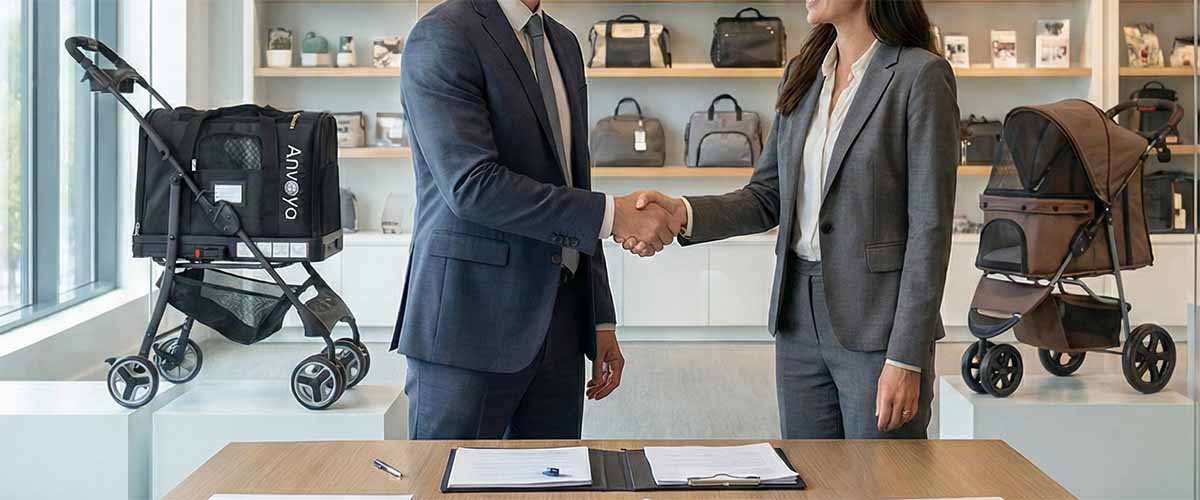
Anvoya's manufacturing platform serves both channels — through direct brand distribution for boutique partners and full turnkey ODM and custom OEM programs for larger brand partners. This flexibility means a distribution partner can address both retail segments from a single manufacturing relationship.
Part 4: Three Business Models for Entering Pet Car Safety
There is no single right way to enter the pet car safety category. The best model depends on your existing business, your target market, and your appetite for brand investment. Here are the three primary entry paths.
Model 1 — Brand Distribution With Exclusive Territory Rights
Best for: Regional distributors with existing retail networks in key markets (DACH, UK, Scandinavia, North America)
In this model, you distribute an established, engineered pet car safety brand — like Anvoya — under an exclusive territory agreement. You bring the retail relationships and market knowledge; the manufacturer brings the product, tooling, compliance documentation, and supply chain.
Key advantages:
- Fast to market — no product development time required
- Exclusive territory rights protect your investment in building the brand locally
- Engineering and safety credentials are pre-built into the product
- Margin structure typically 50–60%+ at premium price points
What to negotiate:
- Geographic exclusivity (by country or region)
- Minimum order volumes that are realistic for your market size
- Marketing support and co-op funding from the manufacturer
- Right of first refusal on new product lines within the territory
Model 2 — Turnkey ODM (Ready-to-Sell, Zero Tooling Cost)
Best for: Pet brands looking to expand their travel category quickly without R&D investment
In a turnkey ODM arrangement, you select from an existing, ready-to-produce product line and apply your own branding. The tooling is already developed, the product is already compliance-tested, and the supply chain is already operational. You can go from signed agreement to product on shelf in as little as 60–90 days.
Key advantages:
- Zero tooling cost — the manufacturer absorbs all capital expenditure
- Speed to market — no 12–18 month development cycle
- Proven product designs with existing quality data
- Flexibility to test the category before committing to custom development
What to watch:
- Exclusivity terms — in a pure ODM model, other brands may sell the same base product
- Customization limits — colors, fabrics, and branding are flexible; structural changes are not
- MOQ requirements — understand minimum order volumes before committing
Model 3 — Custom OEM & Co-Development With Your Own Branding
Best for: Major pet brands looking to own a proprietary pet car safety platform
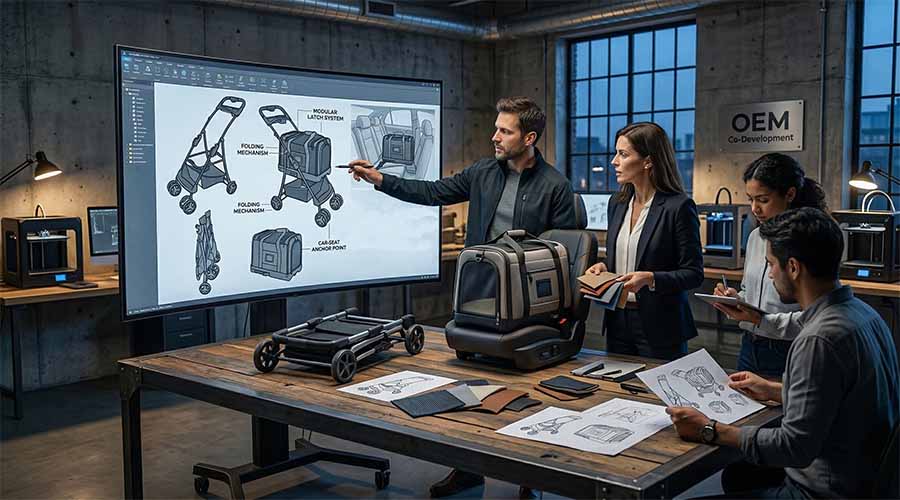
This is the highest-investment, highest-return model. In a co-development partnership, you work directly with Anvoya's engineering team to develop a custom ISOFIX base or modular travel system that integrates with your existing product ecosystem — your soft bags, your carrier designs, your brand aesthetics.
Anvoya opens new tooling specifically for your product, giving you a proprietary design that no competitor can replicate. You get:
- A genuinely unique product platform
- Full IP ownership of the custom tooling
- Integration with your existing soft-goods designs
- The engineering credibility of ECE-standard manufacturing behind your brand
Timeline and investment:
- Tooling development: typically 90–180 days depending on complexity
- Tooling investment: negotiated based on volume commitment
- Result: a proprietary ISOFIX pet travel platform under your brand, manufactured to automotive-grade standards
"For a brand that is serious about owning the pet car safety category under their own name, co-development is the only path to a defensible product position. Everything else is a commodity play."
— Anvoya Business Development Team
What to Look for in a Manufacturing Partner
Choosing the right manufacturing partner for a safety-critical product category is not the same as sourcing a pet toy or a collar. The stakes are higher — and the due diligence needs to reflect that.
Factory vs. Trading Company — Why It Matters
The pet accessories import market is full of trading companies — intermediaries who source products from multiple factories and resell them without owning any manufacturing capability. For commodity products, this is fine. For a safety-critical product like a pet car seat, it is a significant risk.
A trading company cannot:
- Guarantee consistency of materials or components across production runs
- Make engineering changes to accommodate new vehicle models or safety standards
- Provide genuine crash-test documentation tied to their specific production process
- Take accountability for tooling quality or structural integrity
A direct-source factory like Anvoya can do all of these things — because they own the injection molding equipment, the tooling, the quality control process, and the engineering team. When you need a change, you talk to an engineer, not a middleman.
The Role of Automotive-Grade DFM in Mass-Production Feasibility
DFM — Design for Manufacturing — is the engineering discipline of designing products specifically for consistent, high-volume production. It is standard practice in automotive component manufacturing. It is almost unheard of in pet accessories.
DFM matters for pet car seats because:
- Structural consistency — every unit off the line must perform identically under load
- Material specification control — HDPE and PP polymer grades must be consistent to maintain energy-absorption performance
- Tolerance management — ISOFIX connector dimensions must meet precise tolerances to engage correctly with vehicle anchor points
- Failure mode analysis — potential failure points are engineered out before mass production begins, not discovered after returns start coming in
Anvoya's decade of child seat manufacturing means DFM is embedded in every product development process — not an afterthought applied to pet accessories.
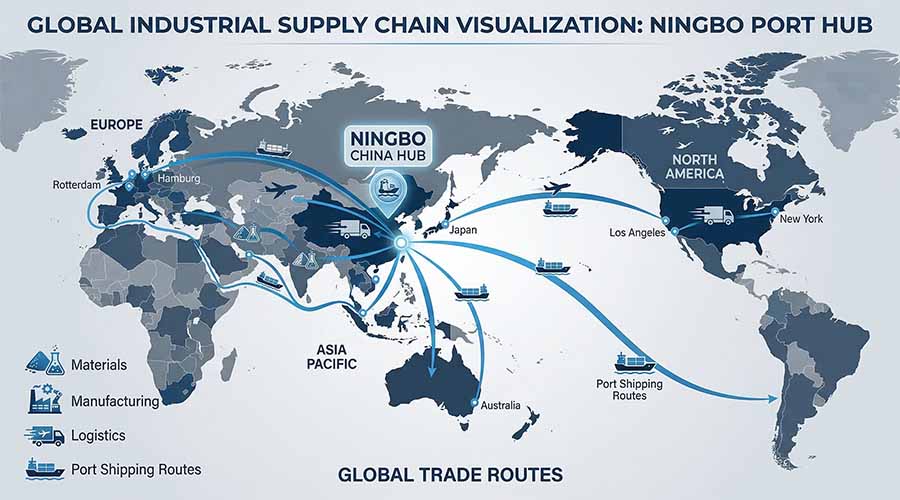
Why Ningbo's Manufacturing Ecosystem Gives Anvoya an Edge
Ningbo is one of China's premier advanced manufacturing hubs, with particular strength in:
- Injection molding and blow molding — the core processes for ISOFIX base components
- Polymer materials supply chain — local access to automotive-grade PP and HDPE at scale
- Automotive component manufacturing — a deep local talent pool of automotive engineers
- Port logistics — Ningbo-Zhoushan port is one of the world's busiest, with direct shipping lines to Europe, North America, and Asia-Pacific
This means faster tooling development, better material sourcing, shorter lead times, and more competitive pricing — all without sacrificing the engineering quality that makes Anvoya's products genuinely different.
Part 5: The Window Is Open — But Not Forever
Act Now: First Movers in Growing Categories Win Disproportionately
Category leadership is not distributed evenly across time. In any growing market, the brands that establish credible positioning early capture a disproportionate share of long-term revenue — because they get to define what "good" looks like before the market sets its expectations.
This pattern has repeated itself across every major pet category:
- Premium pet food — the brands that entered the grain-free and raw segment early in the 2010s built category-defining equity that late entrants have never fully closed
- Pet insurance — early movers like Nationwide and Trupanion built network effects and brand trust that new entrants struggle to compete with even a decade later
- Orthopedic pet furniture — Casper-style premium pet beds went from niche to mainstream in under five years, with early movers capturing most of the retail shelf space
Pet car safety is at the early-mover stage right now. The consumer awareness is building. The regulatory environment is tightening. The technology — ISOFIX modular systems — is ready. And the dominant brand has not yet emerged.
The distributors, retailers, and OEM brands that build their pet car safety position in 2025 and 2026 will be the ones writing the playbook that everyone else follows in 2028 and beyond.
Before you finalize your sourcing decision, make sure you are evaluating the right technical criteria. Our B2B compatibility guide covers everything your buying team needs: How to Choose the Right Pet Car Seat: A B2B Gear and Compatibility Guide
And if you want to understand exactly what engineering standards separate a genuine pet travel system from a commodity product, this is required reading: What Makes a High-Quality Pet Travel System?
Conclusion: Your Next Category Is Already Moving — Are You?
The pet car safety market is not waiting for anyone. Consumer demand is building. Legislation is expanding. ISOFIX technology is ready. And the category-defining brands of the next decade are being decided right now.
The question is not whether pet car safety will become a major retail category. It already is. The question is whether your brand or distribution catalog will be part of the premium tier that captures the majority of the value — or whether you will be watching that position solidify around your competitors.
Anvoya brings something that almost no other pet travel manufacturer can offer: a decade of automotive-grade child seat engineering, directly applied to pet mobility products. Our ISOFIX bases, polymer expertise, and ECE-standard manufacturing discipline are not marketing claims — they are the foundation of every product we build.
Whether you are a regional distributor looking for a category-killer product, a boutique retailer wanting a brand story your customers will love, or a global pet brand looking to add a proprietary ISOFIX travel platform under your own name — we are ready to build this with you.
👉 Explore Anvoya's Distribution & OEM Partnership Programs →
External Resources & Further Reading
- 🔗 Grand View Research — Global Pet Care Market Report — Comprehensive global pet industry market sizing and forecasts
- 🔗 Center for Pet Safety — Crash Test Research & Certified Products — Independent crash-test certification for pet travel products
- 🔗 UNECE — ECE R129 Child Restraint Systems Standard — The European child seat engineering standard that informs Anvoya's manufacturing protocols
- 🔗 AAA Foundation — Distracted Driving Research — Data on in-vehicle distraction risk including pets
- 🔗 Pet Industry Joint Advisory Council (PIJAC) — U.S. pet industry trade association with regulatory and market updates