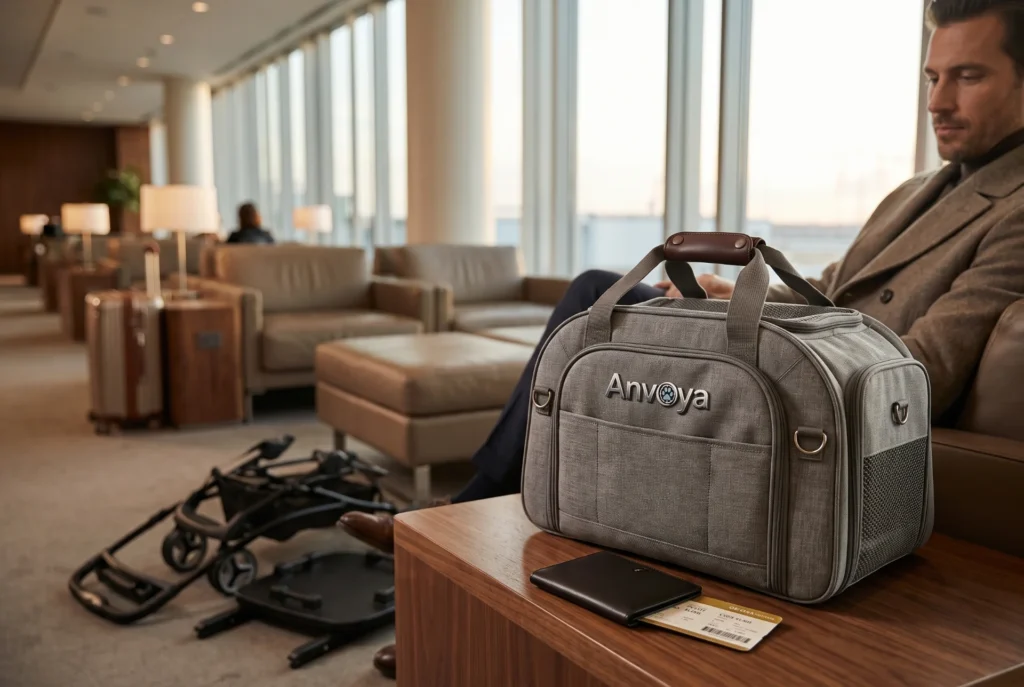
Pet carrier brands often reach a point where a best-selling carrier has strong demand, but the next growth step feels risky. Starting a new car seat from zero can waste tooling, slow launch plans, and confuse loyal buyers. A smarter route is to evaluate whether the existing pet carrier can become part of a structured car seat system.
Pet carrier brands can turn best-sellers into car seat systems by adding a reliable base, vehicle-facing connection, and repeatable carrier interface instead of redesigning the whole product. The goal is not to “add a strap,” but to assess whether the carrier shape, bottom structure, locking points, and real vehicle use can support a stable modular travel system.
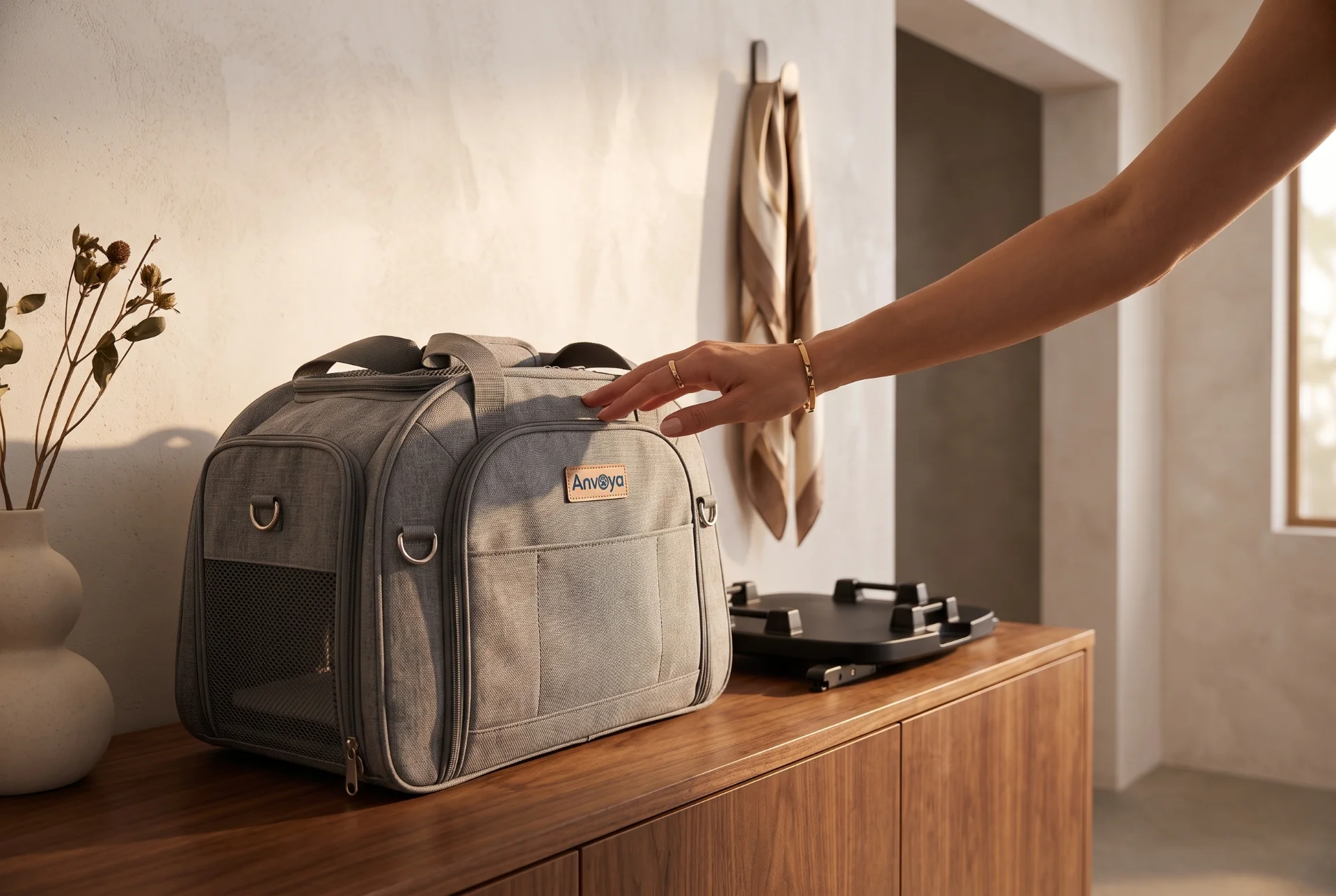
This decision is mainly an engineering and product-line question. A popular carrier already has market proof. The real work is to check whether it can connect to a base, sit correctly on a vehicle seat, and operate safely and consistently for end users.
A Pet Carrier Is Not Automatically a Car Seat?
A pet carrier may look secure in a vehicle, but appearance can mislead buyers and brands. If the carrier only sits on the seat or is held by a loose strap, the system may not manage movement well. That gap creates product risk, customer confusion, and weak differentiation.
A pet carrier becomes part of a car seat system only when the carrier, base, vehicle seat, anchoring method, and user operation are designed to work together. The upgrade depends on stable support, repeatable locking, controlled movement, and clear misuse prevention.
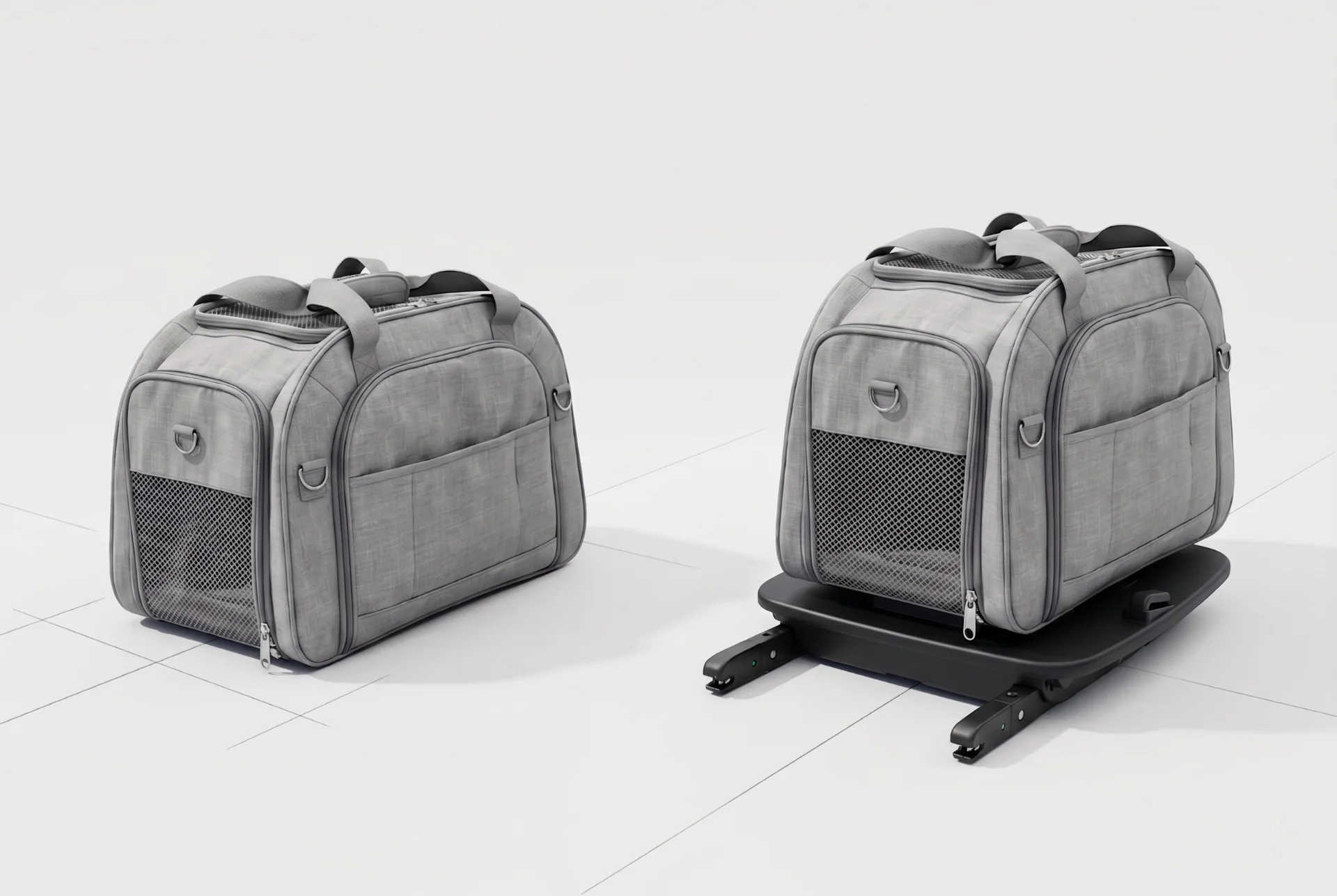
A basic carrier solves one problem: moving a pet by hand. A vehicle-ready system solves a different problem: holding the pet and carrier in a defined position inside a moving car. Those two jobs may overlap, but they are not the same.
In our OEM/ODM discussions with carrier brands, this is often the first misunderstanding. Many teams ask, “Can we add a car strap?” The better question is, “Can this carrier become one part of a controlled vehicle-use system?”
A strap may reduce casual sliding in some situations, but it does not automatically create a car seat system. A structured system needs several layers of judgment:
- Carrier structure: Can the shell, textile body, or frame accept load through a planned path?
- Bottom geometry: Can the base support the carrier without rocking, twisting, or local stress?
- Locking interface: Can users attach and detach the carrier in the same way every time?
- Vehicle connection: Can the base or structure connect to the vehicle seat in a stable way?
- User behavior: Can the system reduce wrong installation and unclear operation?
| Item | Simple Holding Method | Structured Car Seat System |
|---|---|---|
| Main function | Keeps carrier from obvious movement | Connects carrier, base, and vehicle-facing structure |
| User operation | Often flexible or unclear | Defined attachment and release process |
| Load path thinking | Usually limited | Planned through carrier, interface, base, and vehicle contact |
| Upgrade value | Low to moderate | Higher commercial and product-line value |
| Development risk | Looks easy but can hide problems | Requires assessment but creates a clearer solution |
This does not mean every carrier must be rebuilt like a child restraint. Pet car seat products do not follow the same unified mandatory crash-test regulations as child car seats.[^1] Brands should be careful with claims. Crash testing can be a useful engineering tool, but it should not be described as proof of absolute safety.
For pet carrier brands, the practical takeaway is simple: do not define the upgrade by the accessory. Define it by the system. If the carrier cannot connect repeatably, sit stably, and guide the user clearly, then the upgrade may need interface redesign before it becomes commercially credible.
Why a Best-Selling Pet Carrier Is Worth Upgrading?
A best-selling pet carrier already carries consumer trust, proven styling, existing tooling, and known market fit. Replacing it too quickly can create unnecessary cost and launch risk. The challenge is that brands often see car-use expansion as a separate product instead of a modular upgrade opportunity.
A best-selling pet carrier is worth upgrading because it can protect existing product value while opening a higher-value travel system category. If compatibility is strong, a base and interface upgrade may shorten development time, preserve brand recognition, and reduce the risk of launching an unproven new car seat.
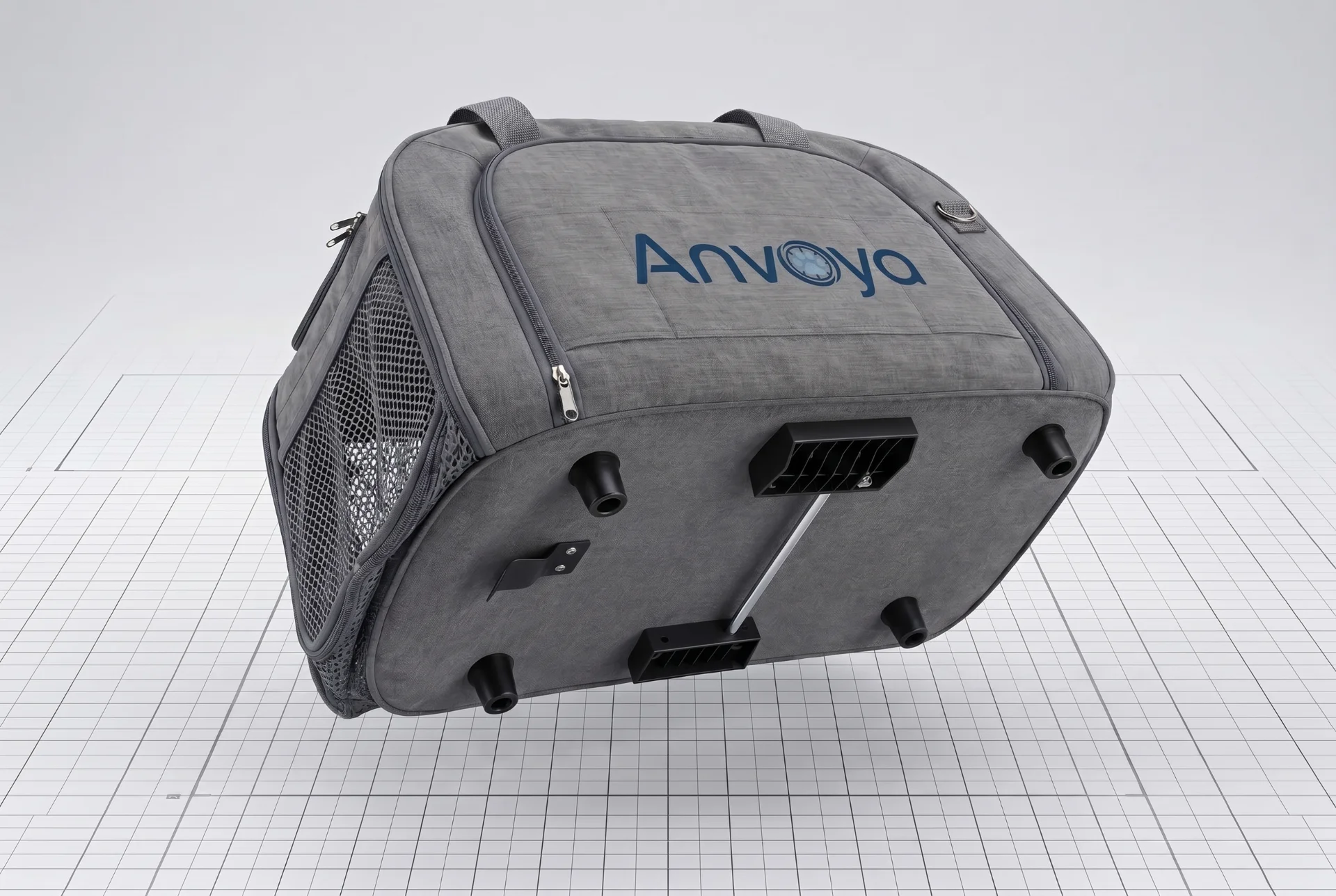
A successful carrier is not just a product. It is a package of commercial assets. It may include molds, fabrics, supplier relationships, packaging dimensions, review history, retailer acceptance, and consumer recognition. When pet carrier brands start from zero, they may give up these assets before checking whether they can be extended.
A modular upgrade approach asks a more disciplined question:
“Can the existing best-seller become the upper unit of a vehicle-ready system?”
That question matters because development resources are limited. A full new product can involve new industrial design, structural development, sampling rounds, tooling, packaging, instructions, retail education, and sales testing.[^2] An upgrade may still require serious engineering work, but it starts from a stronger commercial base.
Why brands should not waste proven product-market fit
A best-selling carrier often has already answered several hard questions:
- Do consumers like the size and look?
- Does the pet fit comfortably for the target use case?
- Can the brand sell it through current channels?
- Does the price point work?
- Does the supply chain already understand production quality?
If the answer is yes, the next step is not automatically a replacement. The next step can be a compatibility review.
What value can an upgrade add?
An upgraded pet carrier can help brands move from a single SKU to a system-based product line. For example, one carrier may connect with:
- A vehicle base
- A stroller frame
- A home stand
- A wheeled travel frame
- Replacement liners or accessories
This creates a platform strategy instead of a one-time product launch. It also gives retailers and distributors a stronger story. They can sell not only a carrier, but a travel ecosystem.
For procurement teams, this matters because a modular line may improve SKU planning.[^3] For product managers, it helps protect brand continuity. For private-label customers, it may reduce the risk of entering a more technical category without abandoning an existing winner.
However, the upgrade must still pass practical checks. A weak carrier bottom, unstable shape, or poor locking area can make the idea unsuitable. In that case, a partial redesign may be smarter than forcing a poor fit.
How an Upgraded Pet Carrier Creates a Higher-Value Product Line?
A single pet carrier can reach a sales ceiling when competitors copy its look or price. If the product stays only in the carry category, differentiation becomes harder. Brands may feel pressure to discount instead of building stronger value.
An upgraded pet carrier creates a higher-value product line by turning one familiar product into a modular travel system. The carrier can remain recognizable, while the base, interface, stroller, and accessories expand use cases and raise perceived value for retailers and end users.
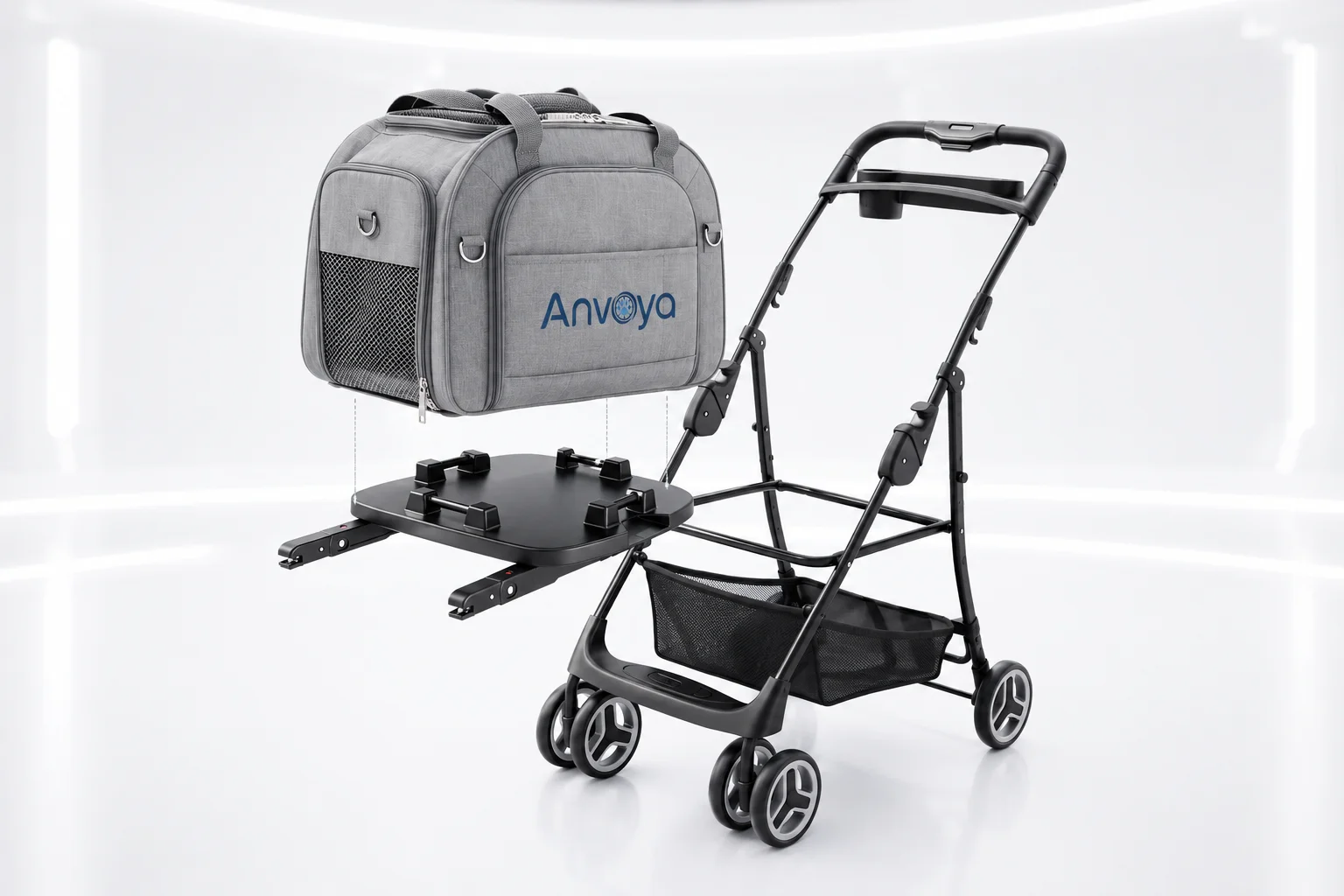
A higher-value product line does not only mean a higher retail price. It means the product has more reasons to exist, more ways to sell, and more room for future expansion. This is where modular pet travel systems can become powerful for pet carrier brands.
When a carrier works only as a hand-carry product, the sales message is narrow. The brand talks about comfort, fabric, ventilation, storage pockets, or style. Those details still matter, but many competitors can say the same things.
When the same carrier becomes part of a car, carry, and stroller system, the sales message changes. The brand can now talk about:
- Daily travel convenience
- Vehicle organization
- Reduced pet movement in the cabin
- One carrier across multiple scenarios
- A growing system instead of a single item
From product SKU to platform
A platform gives brands more commercial options. The table below shows the difference.
| Development Model | Typical Result | Commercial Limitation | Upgrade Potential |
|---|---|---|---|
| Standalone carrier | One main SKU | Easy to compare by price | Limited |
| New car seat from zero | Separate product | Higher cost and longer validation | Moderate |
| Carrier-to-base system | Modular system | Needs interface assessment | High |
| Full travel platform | Car + carry + stroller | Requires stronger planning | Highest |
A modular approach may also help brands keep existing retail momentum. If a carrier is already known in the market, a car-use upgrade gives retailers a reason to relaunch it without saying, “This is completely different.”
Why interface quality controls product value
The interface is the hidden value driver. Consumers may notice the fabric first, but procurement teams should look at how the carrier attaches. A good interface should feel clear, stable, and repeatable.
Important interface qualities include:
- Audible or tactile feedback when locked
- Clear release operation
- Low chance of reverse installation
- Stable support under normal driving conditions
- No obvious shaking during handling
- No sharp contact points that damage textile or shell materials
At Anvoya, we often describe this as “system thinking.” The carrier, base, and vehicle-facing structure should not behave like three separate parts. They should behave like one planned system during installation, travel, and removal.
This is also where child car seat engineering experience helps as a thinking method. Concepts such as anchoring, structural load paths, misuse reduction, tooling accuracy, and production consistency can inform pet travel development. Still, brands should avoid saying the pet system has the same certification status as a child restraint unless specific, verifiable documents support that claim.
What Pet Carrier Brands Should Check Before Starting the Upgrade?
Pet carrier brands can lose time if they jump into sampling before checking basic compatibility. A beautiful carrier may have weak bottom support, no locking area, or a shape that fights the vehicle seat. These issues can appear late and become expensive.
Before starting the upgrade, pet carrier brands should check carrier shape, bottom structure, locking potential, base stability, vehicle-seat fit, user operation, material strength, production consistency, and claim strategy. This early review helps decide whether to upgrade, partly redesign, or develop a new system.
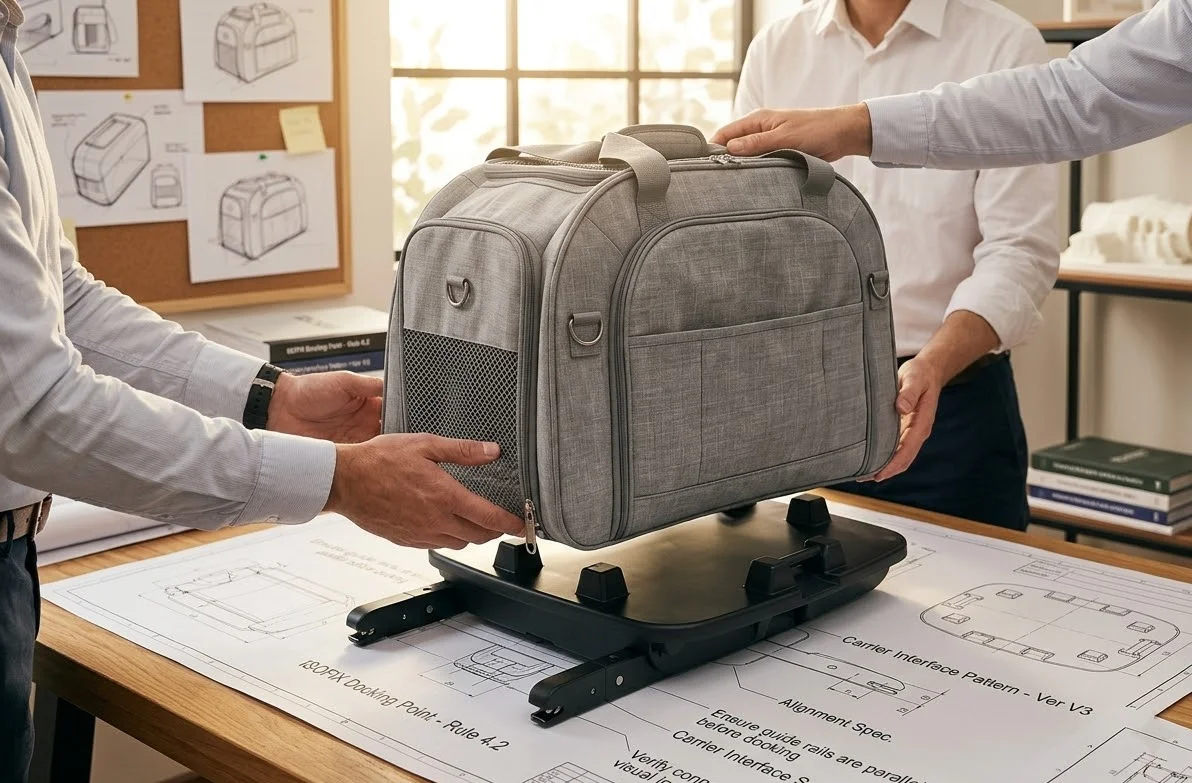
The first assessment should be practical, not theoretical. A brand does not need to answer every engineering question on day one. However, it should know whether the product has a realistic upgrade path.
We usually encourage teams to start with five review areas.
1. Carrier geometry
The carrier’s shape affects how it sits on a base and inside a vehicle. A soft, curved, or flexible bottom may feel comfortable by hand, but it may not support stable positioning.
Key checks include:
- Is the bottom flat enough for base support?
- Does the carrier rock when placed on a rigid surface?
- Does the side wall deform under normal handling?
- Is the center of gravity too high?
- Does the carrier fit common vehicle seat angles?
2. Bottom structure and load path
The bottom is often the most important part of the upgrade. If the base connects to a weak panel, the system may feel unstable. If the structure has no reinforced area, adding a lock may create stress concentration.
Brands should check:
- Material type and thickness
- Reinforcement options
- Existing ribs or frame parts
- Sewing or bonding areas
- Possible metal or plastic insert points
3. Interface and locking potential
The interface must be easy for consumers and reliable for manufacturing. A clever lock that requires perfect alignment may fail in real use. A simple lock with good guidance may perform better commercially.
Good interface questions include:
- Can the carrier be installed with one clear movement?
- Can users see or feel that it is locked?
- Can the lock be released without awkward force?
- Can the product prevent incorrect orientation?
- Can the interface survive repeated use during the product’s expected life?
4. Vehicle-facing base design
The base is not only a stand. It is the bridge between the carrier and the vehicle environment. It must consider seat cushion angle, seat belt routing or anchoring strategy, vehicle space, and user installation.
Some systems use vehicle seat belts. Some may use ISOFIX-style anchoring where market expectations and vehicle compatibility support it. Buyers should verify technical documents, supplier statements, test reports, and market compliance requirements before making claims.
5. Manufacturing quality control
A system upgrade is only useful if production can repeat it. Small tolerance problems can make locking feel loose or too tight.
Procurement teams should ask suppliers about:
- Tooling control
- Incoming material inspection
- Locking part tolerances
- Assembly checks
- Finished product inspection
- Instruction manual control
- Batch traceability
This is where supplier selection becomes critical. A factory that can sew a good carrier may not automatically manage a vehicle-facing modular system. Brands should look for partners who understand both pet product usability and mechanical interface development.
How Anvoya Supports Carrier-to-System Development?
A carrier-to-system project can become messy when design, tooling, vehicle connection, and production planning are handled separately. Brands may receive nice renderings but no clear judgment on whether the existing carrier can truly work with a base.
Anvoya supports carrier-to-system development by reviewing the existing pet carrier, judging base and interface feasibility, developing modular connection concepts, and supporting OEM/ODM production planning. Our role is to help brands reduce development risk while preserving best-selling product value where possible.
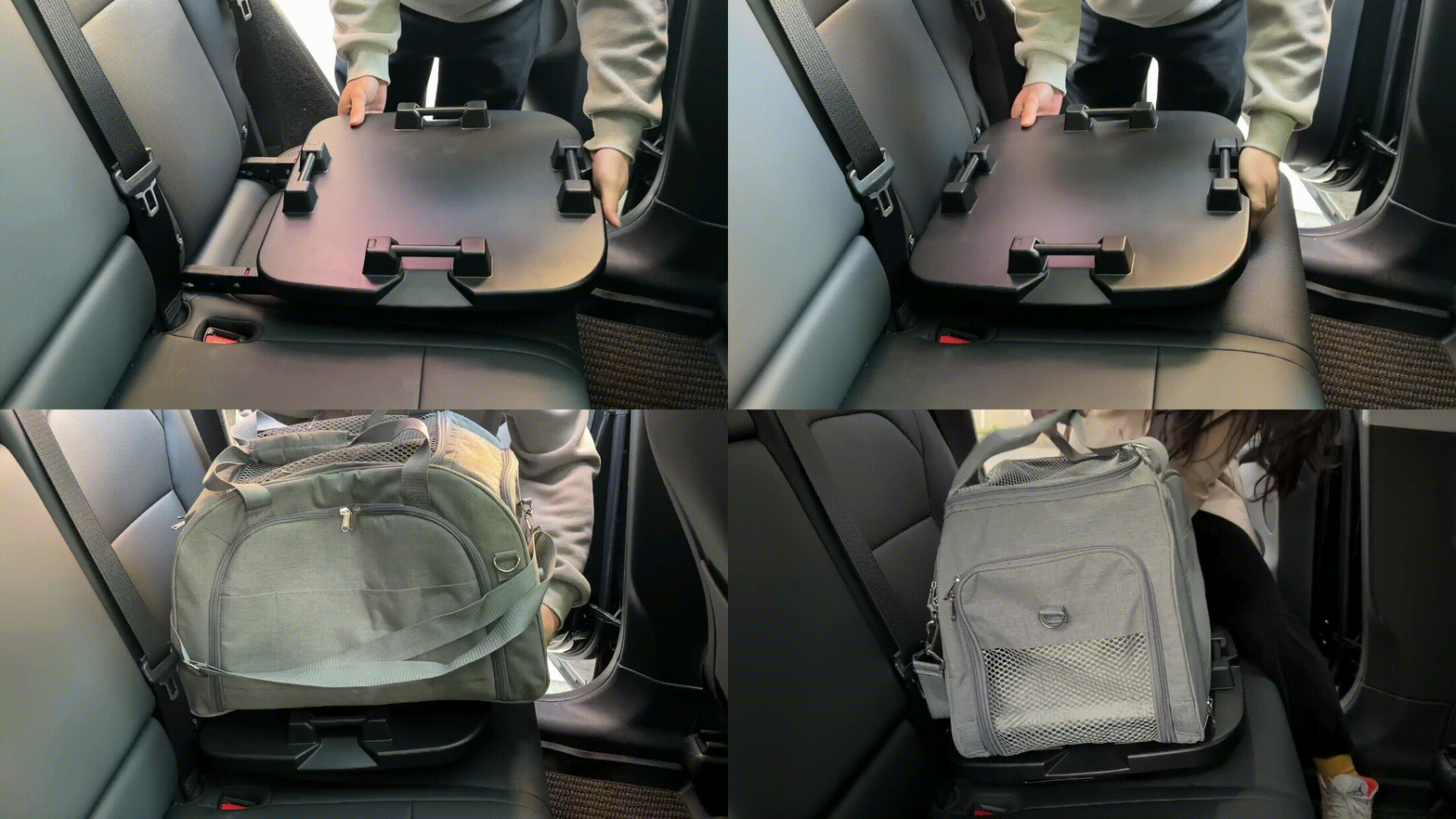
Anvoya works as a Ningbo-based B2B manufacturer and OEM/ODM product development partner for modular pet travel systems. Our background includes European child car seats and automotive safety products, and we apply that engineering discipline to pet carriers, pet car seats, ISOFIX bases, and stroller systems.
That background shapes how we look at an upgrade. We do not treat a pet carrier as a fashion item only. We look at how the pet, carrier, base, vehicle seat, and user operation interact.
Our development conversation usually starts with assessment
Before recommending a new mold or full redevelopment, we prefer to review the existing best-seller. The goal is to avoid unnecessary replacement.
A typical early review may include:
- Product photos and dimensions
- Carrier weight and pet weight range
- Bottom material and structure
- Existing tooling status
- Target markets and channels
- Intended vehicle-use claim level
- Packaging and price expectations
- Possible stroller or travel-system expansion
After that, we can discuss whether the product is suitable for:
- Direct base upgrade
- Partial bottom reinforcement
- New interface part
- New carrier shell based on the original design language
- Full modular system development
BASE-X and modular thinking
Anvoya’s BASE-X concept reflects this modular logic. It is a vehicle-facing ISOFIX pet car seat base designed to help upgrade suitable carriers into vehicle-ready systems. The key idea is not to force every carrier onto one base. The key idea is to evaluate whether a carrier can connect to a stable platform through a reliable interface.
Anvoya’s AERO system also reflects our product direction: smart, easy, and safety-minded travel systems for car, carry, and stroller use. For brands, the wider opportunity is to build expandable product lines rather than isolated products.
What we do not claim
We stay careful with technical claims. Pet car seat systems do not currently operate under the same unified mandatory crash-test regulations as child restraint systems. Crash testing can help development teams understand dynamic behavior, but it should not be presented as absolute safety proof.
For application-specific decisions, brands should involve qualified engineers, compliance consultants, and market-specific professionals. Buyers should also verify test reports, certificates, material documents, and quality-control records before making procurement decisions.
Our practical value is in development judgment: Can this carrier become a system? If yes, what must change? If no, what is the lowest-risk next product path?
FAQ
Can any pet carrier be upgraded into a car seat system?
No. A pet carrier needs suitable bottom structure, stable geometry, interface potential, and vehicle-seat compatibility. Some carriers can be upgraded with a base and locking system. Others need reinforcement or redesign. A technical review should happen before tooling or sampling begins.
Is adding a strap enough to create a pet car seat?
No. A strap may help hold a carrier in place, but it does not automatically create a structured car seat system. A real system should consider carrier support, base stability, vehicle connection, locking operation, and misuse prevention.
Why should brands upgrade a best-selling carrier instead of developing a new one?
An upgrade can protect existing tooling, consumer recognition, sales history, and product-market fit. If the carrier is compatible, a modular base or interface can help the brand enter the car-use category faster and with lower commercial risk than starting from zero.
What should buyers verify when sourcing pet carrier car seat systems?
Buyers should verify product drawings, material specifications, quality-control processes, test reports, claimed certifications, instruction manuals, and supplier production capability. They should also check whether claims match local market requirements and consult qualified professionals for application-specific decisions.
Does an ISOFIX pet base mean the product is equivalent to a child car seat?
No. ISOFIX-style connection can be useful as an anchoring method, but pet car seat systems are not automatically equivalent to certified child restraint systems. Brands should avoid overstated safety claims and verify all technical documents before using them commercially.
Conclusion
A best-selling pet carrier should not be abandoned too quickly when a brand wants to enter the car-use category. The better first step is to ask whether the pet carrier can connect to a reliable base, interface, and vehicle-facing structure. This approach can protect existing value, reduce development risk, and create a stronger modular product line. If your team is evaluating a carrier-to-system upgrade, Anvoya can help review feasibility and develop an OEM/ODM solution that fits your product strategy.
[^1]: "Interpretation ID: 09-004697 213 - NHTSA", https://www.nhtsa.gov/interpretations/09-004697-213. NHTSA materials on FMVSS No. 213 describe mandatory federal performance requirements for child restraint systems; this supports the regulatory distinction from pet car seat products, which are not certified under the same child-restraint standard. Evidence role: historical_context; source type: government. Supports: A source should show that child restraint systems are subject to defined mandatory safety standards, while pet car seats are not treated as equivalent certified child restraints under that framework.. Scope note: This support is strongest for the United States regulatory context and does not establish the rules in every target market.
[^2]: "Navigating new product development: Uncovering factors and ...", https://pmc.ncbi.nlm.nih.gov/articles/PMC10788447/. Standard product-development texts describe new product development as a staged process involving design, engineering, prototyping, production preparation, documentation, and launch planning, supporting the article’s description of full-product development complexity. Evidence role: general_support; source type: education. Supports: A source should outline standard new product development stages that include design, prototyping, production preparation, documentation, and launch activities.. Scope note: The source would support the general process rather than the exact sequence or cost for pet carrier products.
[^3]: "A procedure for reducing stock–keeping unit variety by linking ...", https://www.sciencedirect.com/science/article/abs/pii/S1755581722000232. Operations and product-architecture research links modularity and component commonality with more manageable product variety, supporting the claim that a modular product line may improve SKU planning. Evidence role: general_support; source type: paper. Supports: A source should show that modular product architecture and component commonality can help manage variety, product families, or inventory complexity.. Scope note: The evidence is general to product and operations management and may not quantify the effect for pet carrier assortments.