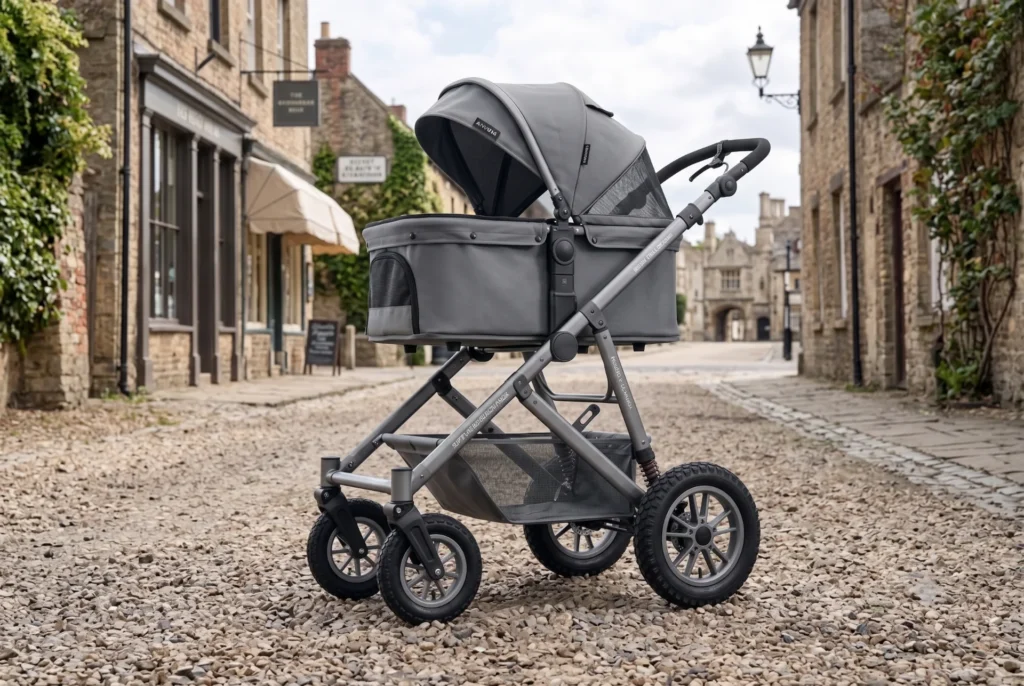
A pet stroller can look perfectly suitable on a smooth showroom floor and feel completely different once it reaches a gravel path, wet pavement, or a snowy curb.
That difference matters in Nordic markets.
Pet stroller products developed for Denmark, Sweden, Norway, Finland, and nearby northern markets are often grouped into the wider European category. Visually, that may make sense. Black, grey, brown, and other restrained colors remain common.
Structurally, however, Nordic use can demand something very different.
Customers may walk through parks, uneven residential roads, gravel paths, wet ground, and changing weather. In these situations, a compact urban stroller with small wheels may look clean and modern but struggle where it matters most.
A clean European pet stroller is not automatically ready for Nordic use.
For Nordic product development, wheel size, frame balance, suspension, carrier stability, weather-ready materials, folding, and replacement parts all need to work together.
Nordic Markets Need a Different Product Strategy
A typical urban pet stroller may be designed mainly for:
- shopping malls
- cafés
- smooth sidewalks
- apartment elevators
- short city walks
- indoor retail spaces
Those scenes still exist in Nordic countries, but they are not the whole picture.
Many customers also expect the stroller to handle:
- uneven pavement
- gravel
- wet leaves
- park trails
- curb transitions
- damp ground
- light snow
- longer outdoor walks
This changes the product priorities.
In a general European city model, compact folding and low weight may come first. In a Nordic outdoor-oriented model, the buyer may accept a little more size and weight in exchange for better stability and road handling.
The design can remain clean and understated, but the structure needs to support a more demanding route.
Nordic styling may look simple. Nordic product performance should not be.
Why Larger Wheels Matter
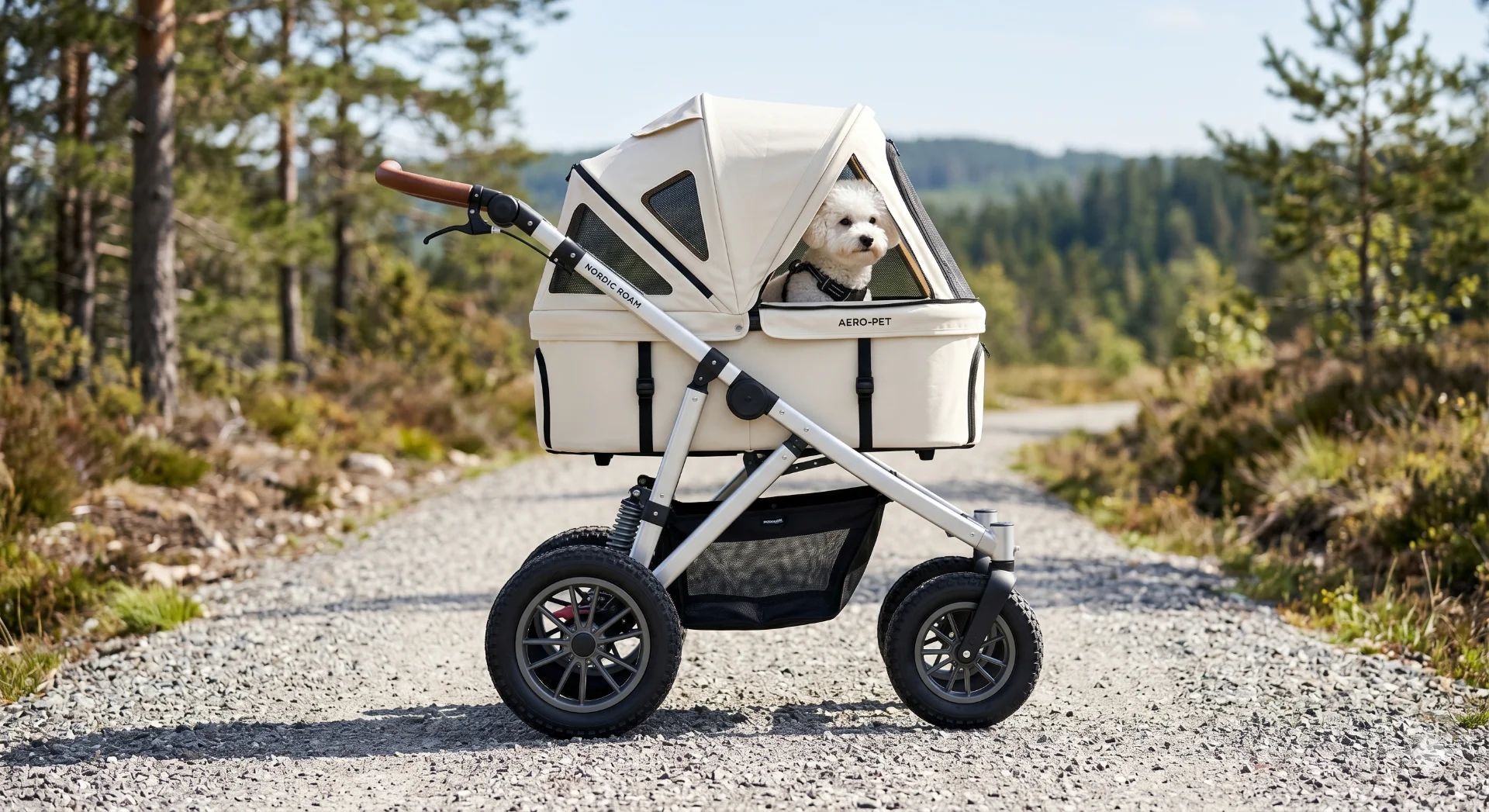
Larger wheels are one of the most visible features of Nordic-style pet strollers.
But they should not be treated as decoration.
Larger wheel diameter can help the stroller:
- move over small obstacles
- handle pavement gaps
- cross gravel more smoothly
- improve curb transitions
- reduce the feeling of vibration
- maintain better stability on uneven surfaces
- perform more confidently on wet ground
Small wheels can work well indoors and on flat roads. On rougher surfaces, they are more likely to catch, shake, or make the stroller feel difficult to control.
That does not mean the biggest wheel is always the best wheel.
Wheel size must be matched with:
- pet weight
- carrier size
- frame height
- wheel width
- stroller balance
- steering design
- folded dimensions
- target carton size
A large wheel attached to a poorly balanced frame does not create a good all-terrain stroller.
Wheel size should solve a road condition, not only create an outdoor look.
Urban Wheels and Nordic All-Terrain Wheels Are Built for Different Routes
Neither urban wheels nor larger all-terrain wheels are universally better.
The right choice depends on where the stroller will actually be used.
| Product Point | Urban Pet Stroller Wheels | Nordic / All-Terrain Wheels |
|---|---|---|
| Wheel diameter | Small to medium | Medium to large |
| Best surface | Smooth pavement and indoor floors | Gravel, wet ground, uneven roads |
| Obstacle clearance | Limited | Better |
| Product weight | Usually lower | Often higher |
| Packing volume | More compact | Larger |
| Stability | Suitable for normal city use | Better on rougher surfaces |
| Steering | Easy in tight indoor spaces | Requires better frame balance |
| Retail position | Daily urban use | Outdoor or premium all-terrain use |
| Replacement cost | Usually lower | Usually higher |
An urban model may be the right choice for a customer living in central Copenhagen who mainly visits cafés and shopping areas.
A larger-wheel model may be more suitable for a customer who regularly walks through parks, gravel routes, or mixed terrain.
The right wheel is the one that matches the customer’s real route.
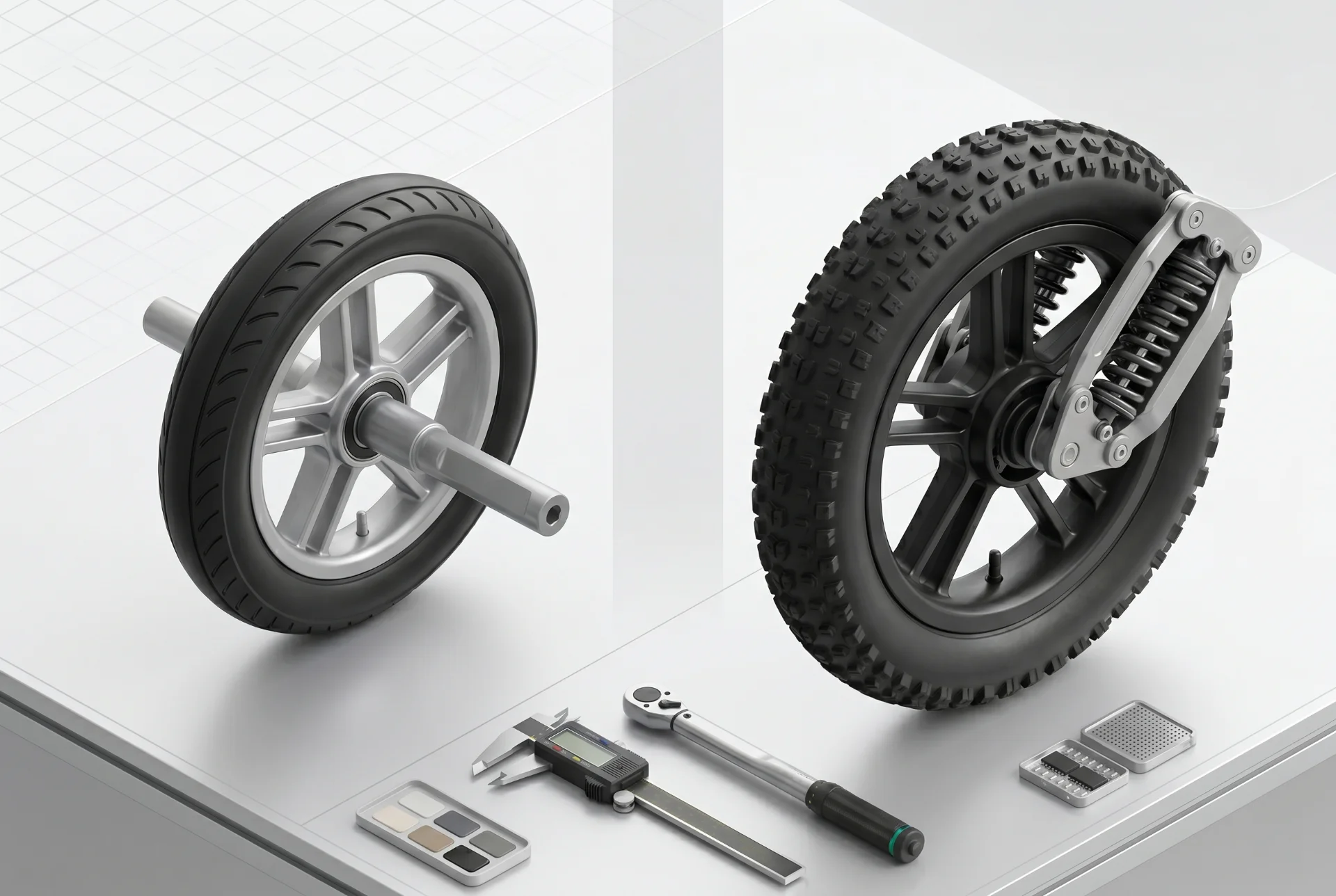
High-View Frames Offer More Than Premium Appearance
High-view frames are common in premium pet strollers, including products developed for Japan and Korea.
In Nordic markets, however, a higher carrier position can provide practical value as well.
It can:
- keep the carrier farther from wet or dirty ground
- bring the pet closer to the owner
- reduce the need to bend down
- create better proportions with larger wheels
- improve interaction during longer walks
- give the stroller a more stable visual profile
A high-view frame can work particularly well for small dogs, cats, senior pets, and pets that feel calmer when positioned closer to their owner.
But height also creates engineering questions.
It affects:
- center of gravity
- tipping resistance
- steering
- frame strength
- brake performance
- folded size
- carton volume
The frame cannot simply be made taller and placed on larger wheels.
The full structure has to be recalculated and tested as one product.
A high-view frame works only when height, wheel size, and stability are designed together.
For Nordic Buyers, Performance Often Creates the Premium Feeling
Premium value is not understood in the same way in every market.
In Japan and Korea, the premium impression may come from:
- fuller cushions
- soft neutral colors
- metal badges
- leather labels
- refined handles
- semi-structured carrier bodies
Nordic buyers may still appreciate good materials and clean details, but the product often earns its premium position through performance.
The buyer may care more about:
- whether the frame shakes
- whether the wheels track properly
- whether the stroller crosses a curb smoothly
- whether the carrier remains level
- whether the brakes feel reliable
- whether the stroller can handle a heavier pet
- whether the product remains stable on uneven ground
| Premium Signal | Soft-Luxury Market | Nordic Outdoor Market |
|---|---|---|
| Full cushion | Strong visual value | Useful, but must remain practical |
| Metal badge | Supports brand image | Secondary |
| Leather-look handle | Adds visual warmth | Helpful, but not central |
| Large wheels | Adds visual presence | Core functional feature |
| Frame stability | Expected | Major purchase reason |
| Suspension | Optional upgrade | Important product value |
| Weather protection | Useful | More central |
| Road handling | Basic requirement | Premium differentiator |
This is an important point for OEM buyers.
A product does not need excessive decoration to look premium in the Nordic market. Good movement, stable construction, and confidence on rougher roads can create a stronger premium impression than another logo trim.
For Nordic buyers, performance often creates the premium feeling.
Larger Wheels Need the Right Suspension and Steering
Large wheels alone do not guarantee better outdoor handling.
The stroller may also need:
- front-wheel swivel
- optional front-wheel locking
- suspension
- stable rear wheels
- reliable brakes
- controlled steering
- suitable wheel width
- sufficient frame stiffness
Front-Wheel Swivel
Swivel wheels are useful for:
- shops
- cafés
- smooth pavements
- apartment entrances
- tight city turns
Front-Wheel Lock
A locking function can be useful for:
- gravel paths
- rougher roads
- longer straight routes
- greater directional stability
Poor steering design can cause:
- front-wheel shaking
- difficult turning
- uneven tire wear
- unstable pushing
- reduced customer confidence
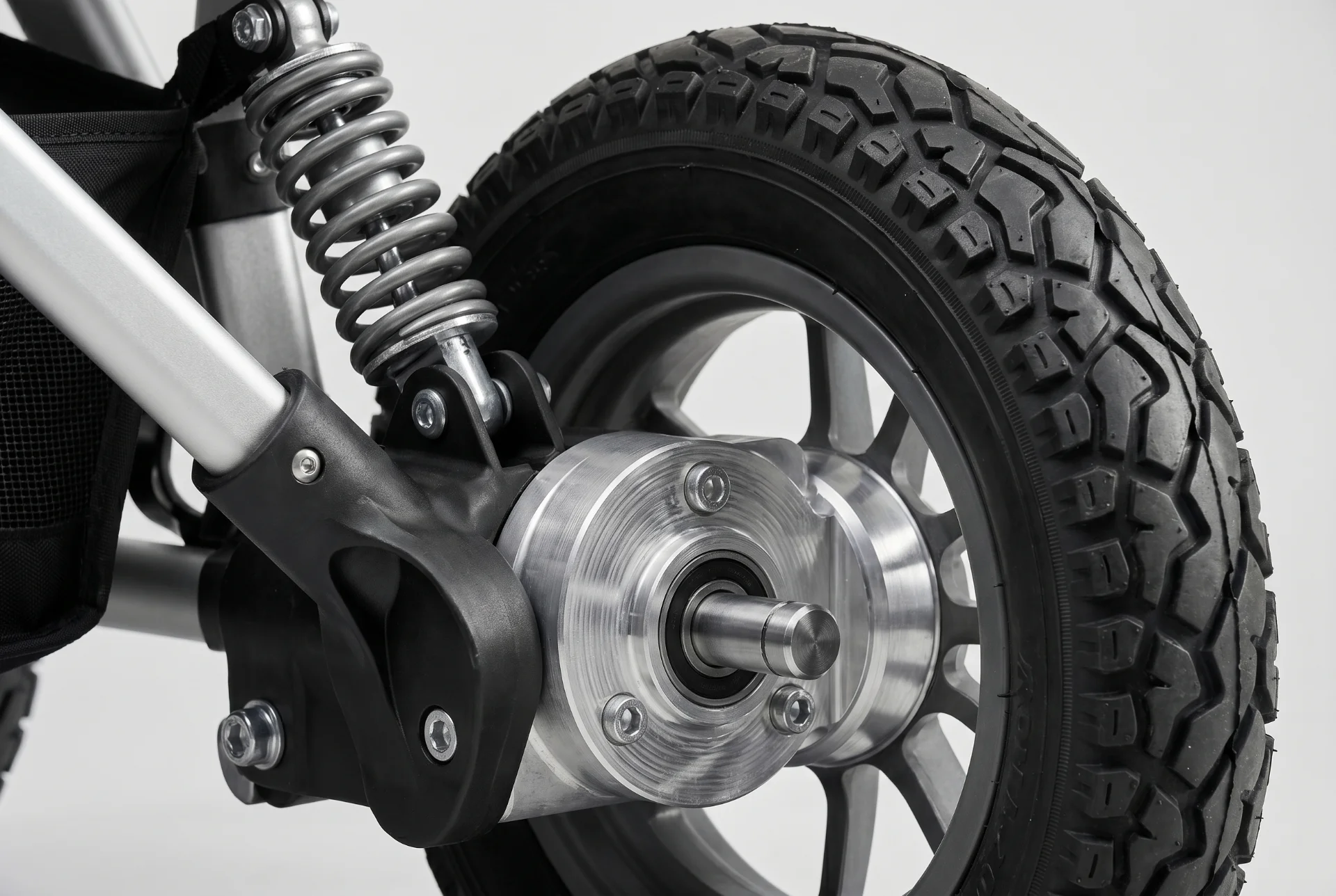
The frame, wheel, axle, suspension, and steering mechanism should be developed together.
Outdoor performance comes from the wheels, suspension, steering, and frame working as one structure.
Weather-Ready Design Is More Useful Than an Unsupported “Waterproof” Claim
Nordic pet strollers may face:
- light rain
- wet pavement
- mud
- damp grass
- snow
- cold wind
- humid storage conditions
This makes material selection important.
The product does not need to be described as fully waterproof unless the construction and testing support that claim.
A more realistic product direction is weather-ready.
Useful features can include:
- water-repellent outer fabric
- wipe-clean carrier bottoms
- removable cushions
- washable liners
- wind-protective canopies
- corrosion-resistant hardware
- easy-to-clean wheels
- quick-drying materials
- ventilation panels that can be adjusted or covered
The balance is important.
Too much mesh may offer good airflow but weak protection against wind. Too much enclosure may feel warm but reduce ventilation.
A good Nordic carrier should balance:
- airflow
- warmth
- visibility
- cleaning
- wind protection
- pet comfort
Weather-ready design is not only about keeping rain out. It is about making the stroller easier to use and clean after outdoor travel.
Carrier Stability Matters as Much as Wheel Performance
A stroller can have excellent wheels and still feel unsafe if the carrier moves too much on the frame.
Uneven surfaces increase the importance of:
- reinforced carrier bottoms
- stable support points
- controlled side movement
- clear docking positions
- reliable locking mechanisms
- balanced pet placement
OEM buyers should check:
- Does the carrier remain level on uneven ground?
- Does the bottom deform under pet weight?
- Does the carrier move when the stroller changes direction?
- Can the user hear or feel when the carrier is locked?
- Is the release mechanism still easy to operate?
- Does the carrier remain stable after repeated installation?
A loose basket placed on a large-wheel frame is not a complete outdoor travel system.
Large wheels cannot compensate for a carrier that is loosely connected to the frame.
This is where Anvoya’s experience in soft-goods and hardware integration becomes useful. The carrier body, reinforced bottom, docking components, stroller frame, and vehicle-use structure can be developed together rather than treated as separate products.
Outdoor Performance Creates a Packing Trade-Off
Features developed for Nordic use often increase product size and cost.
These may include:
- larger wheels
- wider wheelbases
- stronger frame tubes
- suspension components
- high-view carrier positions
- weather-protective canopies
- more durable fabrics
- reinforced carrier bottoms
| Outdoor Feature | Product Value | Business Trade-Off |
|---|---|---|
| Larger wheels | Better rough-road handling | Higher carton volume |
| Wider wheelbase | Better stability | Larger folded size |
| Stronger frame | Greater durability | More weight |
| Suspension | Smoother movement | More parts and higher cost |
| High-view carrier | Better interaction and ground clearance | Higher center of gravity |
| Weather-ready canopy | Better outdoor protection | More fabric and structure |
| Reinforced carrier bottom | Better carrier stability | Added material and weight |
For a price-sensitive market, these trade-offs may be difficult to support.
For Nordic customers who are willing to pay for real outdoor performance, they may be justified.
That does not mean every feature should be added.
Each component should still support the intended route, pet size, target retail price, and brand position.
The lowest freight cost is not always the best product decision when outdoor performance is the main selling point.
Compact Storage Still Matters
An outdoor-ready stroller still needs to come home.
Nordic customers may live in apartments, own compact cars, or use shared storage spaces.
The product should therefore balance performance with:
- manageable folding size
- removable wheels
- standing fold
- car-trunk fit
- easy indoor storage
- simple wheel installation
- clear folding steps
Useful development questions include:
- Can the rear wheels be removed?
- Can the stroller stand when folded?
- Can the canopy compress without losing shape?
- Does the frame fit a typical car trunk?
- Are the wheels easy to reinstall?
- Does folding require too many steps?
- Can one person fold the stroller while managing the pet?
An outdoor stroller still needs to fit in the car and store without becoming a daily burden.
This balance can also vary by market. A Nordic outdoor model may accept larger wheels, while a Japanese urban model may prioritize a more refined silhouette, and a European e-commerce model may prioritize a smaller carton.
Anvoya can help buyers adjust the frame, wheels, carrier structure, soft goods, and packing method according to the actual target market rather than forcing one specification into every region.
Replacement Wheels Are Part of the Product Plan
Outdoor use increases wear.
Common wheel-related after-sales issues may include:
- tire wear
- damaged bearings
- mud or debris
- brake wear
- lost wheel components
- axle damage
- suspension wear
Retailers and distributors may need access to:
- replacement front wheels
- replacement rear wheels
- bearings
- brake parts
- axle components
- suspension parts
- maintenance instructions
Replacement parts can:
- extend product life
- reduce full-product returns
- improve retailer confidence
- create repeat orders
- support premium positioning
For an outdoor pet stroller, replacement wheels are not an optional accessory. They are part of the original product strategy.
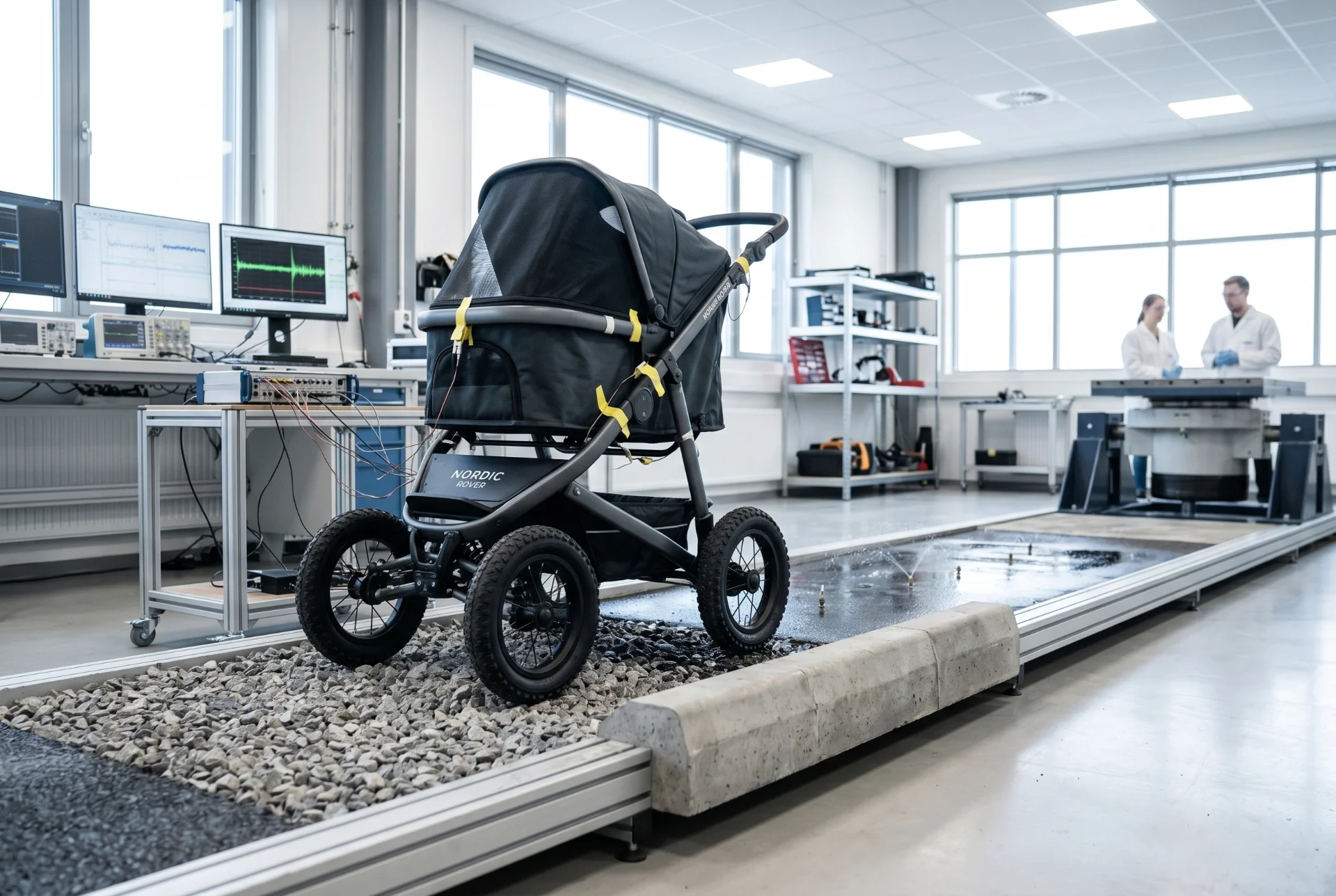
Nordic Products Should Be Tested on Realistic Surfaces
A stroller that performs well on a factory floor has not yet proven that it is suitable for Nordic use.
Testing should include realistic conditions such as:
- smooth pavement
- uneven pavement
- gravel
- curb transitions
- wet surfaces
- inclined roads
- repeated turning
- braking
- carrier loading
- repeated folding
- wheel removal and installation
The purpose is not only to test whether the stroller moves.
It is to understand:
- how much vibration reaches the carrier
- whether the frame twists
- whether the stroller remains stable
- whether the wheels shake
- whether the brakes hold
- whether the carrier stays locked
- how the structure performs after repeated use
A Nordic sample should be tested on the road it is expected to handle, not only on the factory floor.
What Nordic OEM Buyers Should Confirm Before Sampling
A clear brief is more valuable than asking a factory to “make the wheels bigger.”
| Question | Why It Matters |
|---|---|
| Which Nordic country is the main market? | Weather, terrain, and sales channels differ |
| What surfaces will the stroller use most? | Guides wheel and suspension choices |
| What is the target pet weight? | Affects frame and carrier stability |
| What wheel diameter is required? | Affects handling and carton size |
| Should the front wheel lock? | Useful for rougher routes |
| Is suspension required? | Affects comfort, cost, and structure |
| What frame height is preferred? | Changes balance and proportions |
| What is the maximum folded size? | Protects storage and car-trunk use |
| Are removable wheels acceptable? | Improves packing but adds assembly |
| Which weather-ready materials are needed? | Affects fabric and hardware |
| Are replacement wheels required? | Supports after-sales service |
| Is the carrier removable? | Affects modular product development |
| Is vehicle compatibility required? | Affects carrier bottom and docking |
| What is the target retail price? | Controls the final specification |
A practical development sequence is:
- Define the target country and customer.
- Identify the main road and weather conditions.
- Confirm pet size and maximum load.
- Select the wheel diameter and wheel type.
- Design the frame around the wheel configuration.
- Confirm steering, suspension, and braking.
- Match the carrier and docking structure.
- Select weather-ready fabrics and cushions.
- Calculate folded size and carton volume.
- Test the complete system on realistic surfaces.
A good Nordic sample should prove the full route, not just the appearance.
Common Mistakes in Nordic Pet Stroller Development
Adding Large Wheels Without Adjusting the Frame
Larger wheels affect the center of gravity, steering, frame height, brake position, and folded size.
Using a Frame That Is Too Flexible
Lightweight design can be valuable, but the frame still needs enough stiffness for uneven roads.
Focusing on Rugged Appearance Instead of Steering
A wheel can look outdoor-ready and still shake, turn poorly, or create excessive resistance.
Ignoring Folded Size
Larger wheels and high frames can create storage, freight, and e-commerce delivery problems.
Forgetting Replacement Parts
Outdoor products need stronger after-sales planning.
Using Small Wheels Only to Improve Container Loading
Better loading efficiency may remove the product’s main Nordic selling point.
Calling a Product “All-Terrain” Without Real Testing
Marketing language should match actual performance.
Treating Nordic Markets as General Europe
The colors may be similar, but the structural priorities can be very different.
A stroller does not become Nordic-ready because it looks rugged. It becomes Nordic-ready when the structure performs outdoors.
How Anvoya Supports Nordic and Regional Product Development
Anvoya does not approach regional development by changing only the fabric color.
Different markets may need different combinations of:
- frame height
- wheel size
- carrier structure
- cushion volume
- materials
- folding design
- docking interfaces
- vehicle-use functions
- logo details
- packaging
For Nordic-focused projects, Anvoya can support:
- larger wheel configurations
- high-view frame options
- frame and carrier balance
- suspension planning
- front-wheel swivel and lock functions
- weather-ready soft goods
- reinforced carrier bottoms
- stable docking interfaces
- compact folding adjustments
- carton optimization
- replacement parts planning
- private label development
- vehicle-ready extensions
The same development platform can be adjusted differently for other markets.
For example:
- Japan and Korea may prioritize softer colors, fuller cushions, and light-luxury details.
- Mainstream European markets may prefer cleaner structures and stronger price-value balance.
- Nordic markets may need larger wheels and outdoor stability.
- Price-sensitive markets may require simpler specifications and better packing efficiency.
Regional development is not about making one product look different. It is about making the structure, function, appearance, and cost fit the market together.
FAQ
Q: Why do Nordic pet strollers need larger wheels?
A: Larger wheels can improve obstacle clearance, stability, and movement over gravel, wet ground, uneven pavement, and curb transitions.
Q: Are larger wheels always better for pet strollers?
A: No. Wheel size should match the pet weight, carrier height, frame structure, steering design, folding size, and intended road conditions.
Q: What is the difference between urban and all-terrain pet stroller wheels?
A: Urban wheels are usually smaller and more compact, making them suitable for smooth roads and indoor spaces. All-terrain wheels are larger and better suited to gravel, uneven roads, wet ground, and outdoor use.
Q: Why are high-view frames useful in Nordic markets?
A: A high-view frame can keep the carrier farther from wet ground, bring the pet closer to the owner, and create better proportions with larger wheels. The frame still needs careful stability control.
Q: Does a Nordic pet stroller need suspension?
A: Not every model needs the same suspension level, but suspension can improve comfort and handling on uneven surfaces. It should be selected according to the intended route and retail price.
Q: Should the front wheel have a locking function?
A: A swivel wheel helps in shops and tight spaces, while a locking function can improve directional stability on gravel or rougher routes.
Q: What fabrics are suitable for Nordic weather?
A: Water-repellent outer fabrics, washable cushions, wipe-clean bottoms, corrosion-resistant hardware, and quick-drying materials are useful for weather-ready products.
Q: Can a pet stroller be described as waterproof?
A: Only when the complete product construction and testing support that claim. In many cases, “weather-ready” or “water-repellent” is more accurate.
Q: Why is carrier stability important on uneven roads?
A: Rougher surfaces create more movement. A stable carrier bottom, reliable docking points, and controlled side movement help keep the carrier properly positioned.
Q: How do larger wheels affect packing volume?
A: Larger wheels usually increase carton size and may reduce container loading quantity. Removable wheels and improved folding structures can help control this trade-off.
Q: Are replacement wheels important for outdoor pet strollers?
A: Yes. Outdoor use increases wheel wear, so replacement wheels, bearings, brakes, and axle parts should be planned before the product launches.
Q: What should OEM buyers confirm before sampling?
A: Buyers should confirm the target country, road conditions, pet weight, wheel size, suspension, frame height, folded dimensions, materials, replacement parts, vehicle compatibility, and retail price.
Q: How can Anvoya support Nordic private label development?
A: Anvoya can help adjust wheel configurations, frames, soft goods, carrier structures, suspension, folding, packing, replacement parts, branding, and vehicle-ready docking according to the target market.
Conclusion
Nordic pet stroller development should begin with the road, not the product photograph.
Larger wheels can improve outdoor use, but only when the frame, steering, suspension, carrier, folding structure, and materials are developed around them.
A stronger outdoor specification may increase cost and packing volume. When that performance matches the customer’s real route, the trade-off can be worthwhile.
The right Nordic pet stroller is not the one that looks most rugged. It is the one that remains stable, manageable, and trustworthy when the road stops being smooth.