

When cats refuse pet carriers, the problem can feel personal, stressful, and oddly urgent. The cat hides, the appointment time gets closer, and the owner starts negotiating with a creature under the bed. A better answer starts by separating behavior, past experience, and carrier design.
Cats often refuse pet carriers because they associate them with stressful events, unfamiliar smells, unstable surfaces, or forced handling. Carrier design can also make the problem worse when entrances are narrow, floors flex, doors collapse, zippers are slow, or the cat can escape before closure is complete.

Most advice focuses on training the cat. That matters. But from a product development point of view, I also look at the carrier itself. A carrier is not just a box with a handle. It is a handling system used under pressure, often by one person, with an animal that may resist every step.
Why Cats Refuse to Enter Their Carriers?
A cat that refuses to enter a carrier creates an immediate handling problem. The owner may try treats, towels, or gentle pushing, but each failed attempt can make the next one harder. The carrier becomes part of a negative routine before the trip even begins.
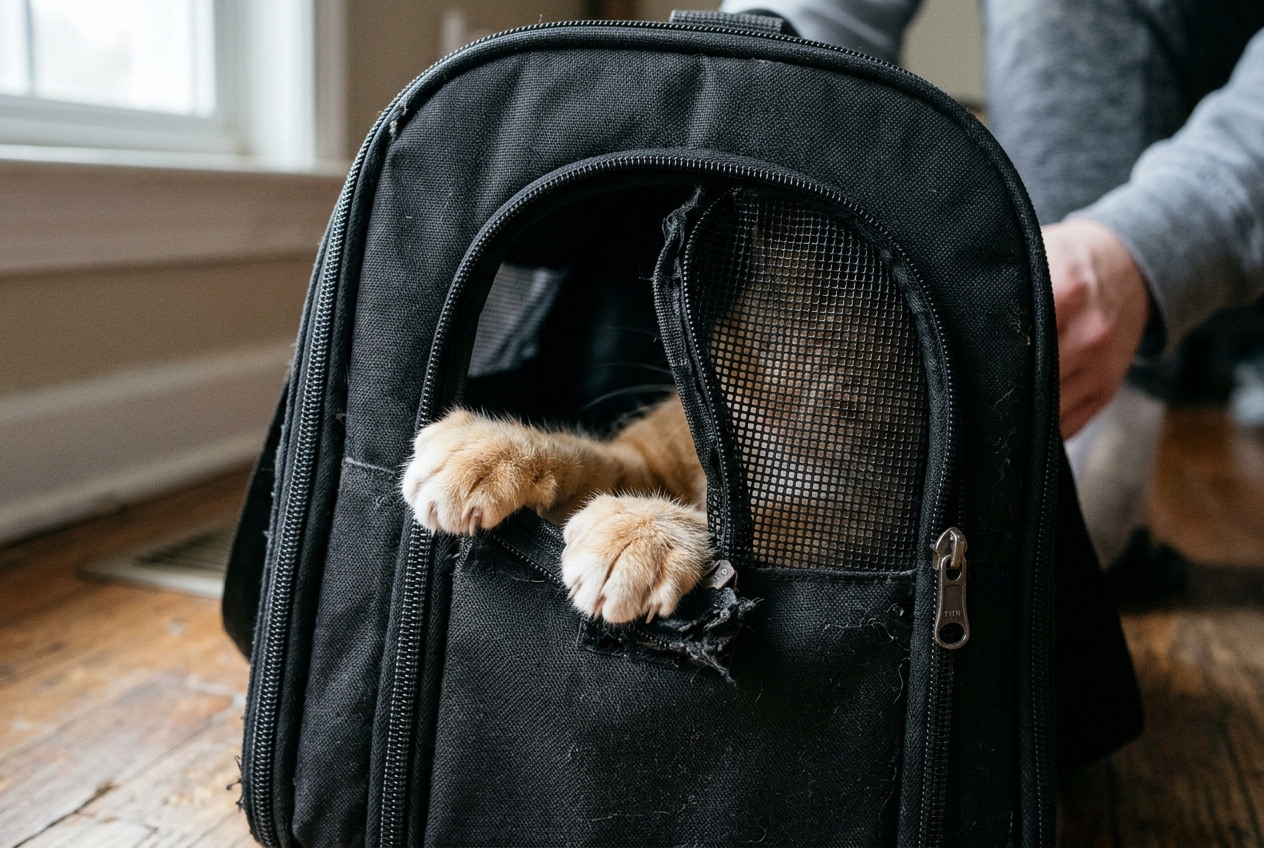
Cats refuse to enter carriers for many reasons: fear of travel, previous veterinary stress, unfamiliar scent, unstable footing, poor visibility, or an entrance that feels too confined. Product design cannot remove every behavioral cause, but it can reduce avoidable friction during entry.
What usually happens before refusal?
In many homes, the carrier appears only before something unpleasant happens. The cat sees the carrier, hears the owner moving with unusual urgency, and connects the object with a car ride or clinic visit. That pattern builds quickly.
Common behavior-related reasons include:
- Negative association with veterinary visits or car travel
- Unfamiliar smell from storage areas, garages, or closets
- Loss of control when the cat is pushed or lifted
- Noise sensitivity from zippers, buckles, or plastic doors
- Individual temperament, especially in cats that dislike confinement
Design-related reasons can sit underneath those behaviors. I have seen otherwise good carrier concepts lose usability because the entry angle was awkward, the floor flexed, or the door swung back into the cat’s face.
Where design can help
A carrier cannot “cure” a frightened cat. That claim would be irresponsible. But it can remove obstacles that make handling worse.
| Refusal trigger | Product factor to evaluate |
|---|---|
| Cat stops at the entrance | Opening height, width, angle, and visibility |
| Cat backs out quickly | Closure speed and remaining escape gap |
| Cat avoids stepping inside | Floor stability and bedding texture |
| Cat resists being pushed through | Front access geometry and door stiffness |
| Cat panics at zipper sound | Zipper quality, routing, and puller design |
For brands, the commercial lesson is simple but often missed: entry is not one moment. It includes approach, inspection, first paw contact, full body entry, and closure. If a design only looks good in a product photo, it may fail in the owner’s hallway five minutes before a vet appointment.
The Hardest Part May Be Closing the Carrier, Not Getting the Cat Inside?
Many owners describe a frustrating scene: the cat enters halfway, the owner reaches for the zipper, and the cat reverses out instantly. The carrier looked accessible, yet the real failure happened during closure. That moment deserves more attention in pet carrier development.
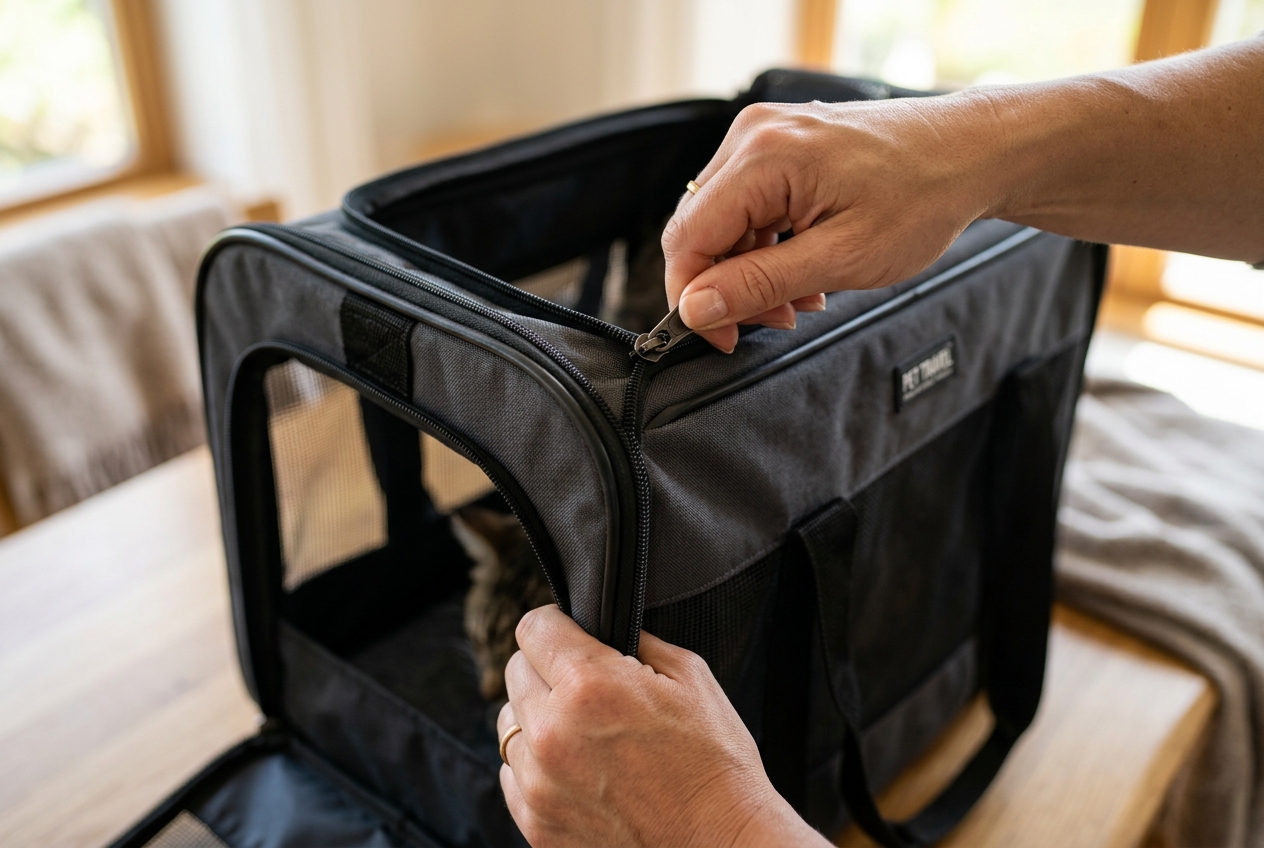
The hardest part may be closing the carrier before the cat escapes. A large entrance or friendly interior does not guarantee usable containment if the zipper is slow, the lid collapses, the gap stays open too long, or one person cannot control both cat and closure.
Why closure is its own design problem
Many product descriptions emphasize:
- Large opening
- Easy access
- Soft bedding
- Multiple entrances
- Foldable storage
Those points matter, but they do not answer a more practical question:
Can one person close the carrier quickly and securely while the cat is trying to leave?
That question changes how I evaluate a carrier. A beautiful wide opening may create a long zipper path. A flexible mesh panel may fold inward. A top lid may need one hand to hold it open and another hand to zip it shut, leaving no hand to manage the cat.
Closure details worth testing
For OEM buyers and product teams, a simple usability test can reveal a lot. Put the carrier on a normal floor, not a studio table. Use one person. Keep the opening fully open. Then simulate a cat entering and turning around.
Evaluate:
- Does the opening stay open by itself?
- Can the user reach the zipper naturally?
- Does the zipper move smoothly around corners?
- Does the panel collapse into the opening?
- How much escape space remains during the last 20% of closure?
- Can the user confirm the zipper is fully closed?
The last point is important. A near-closed carrier is not the same as a secure carrier. A small gap can be enough for a determined cat’s nose, paw, or head.
In product development, I prefer to treat closure as a measurable action rather than a marketing phrase. Time-to-close, hand position, zipper travel distance, and panel stability all affect the owner’s real experience.
Front-Loading vs. Top-Loading vs. Dual-Opening Carriers?
Choosing between front-loading, top-loading, and dual-opening carriers sounds simple until a cat refuses to cooperate. Each format solves one handling problem and may create another. A buyer needs to evaluate the full use sequence, not only the access style.
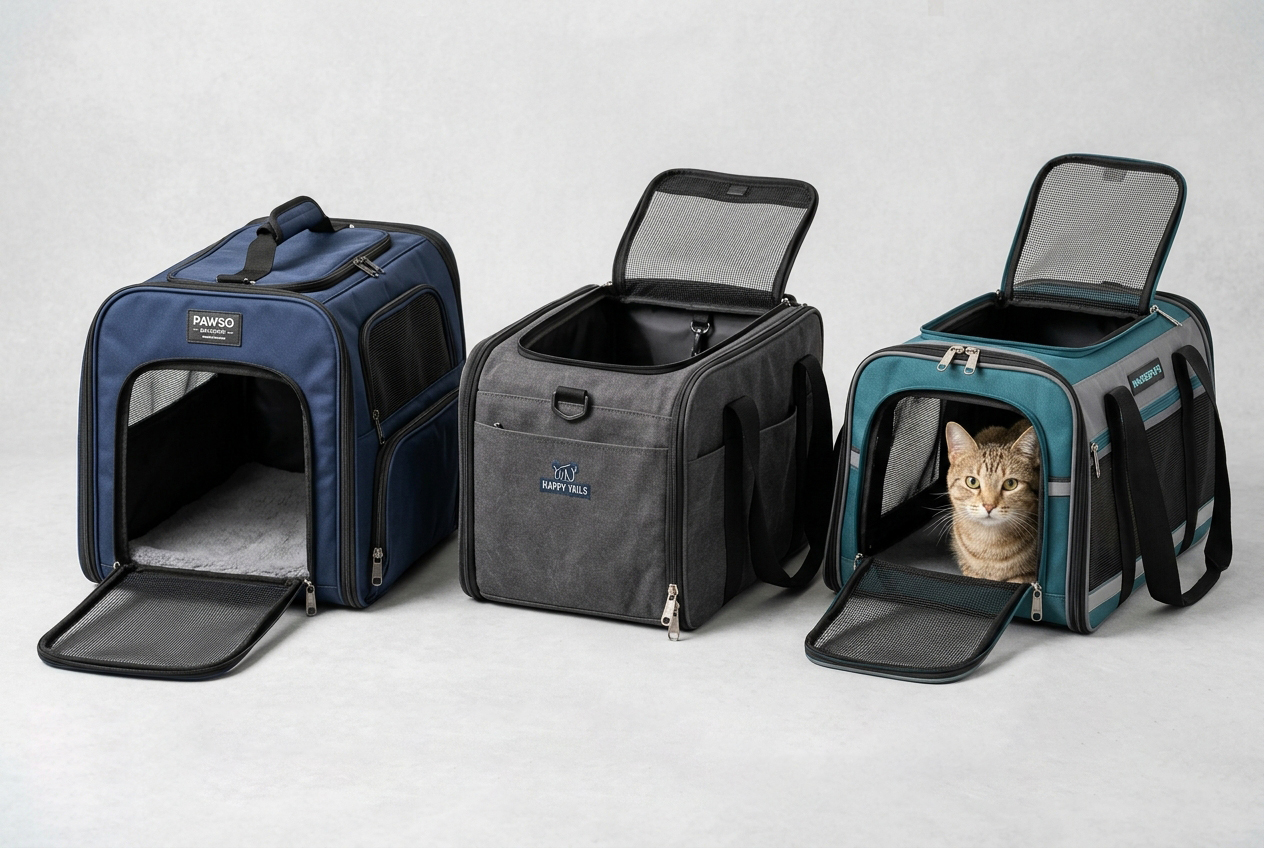
Front-loading carriers work well for cats that walk in voluntarily. Top-loading carriers can help when owners need to lower a cat inside. Dual-opening carriers offer flexibility, but they also add seams, zippers, and structural complexity that must be controlled carefully.
How each opening style behaves
Different access styles create different owner movements. The best choice depends on the cat, the product category, and the intended retail promise.
| Carrier type | Main advantage | Common risk | Best evaluated by |
|---|---|---|---|
| Front-loading | Familiar entry path; good for home familiarization | Cat may resist being pushed forward | Entrance angle, door control, floor stability |
| Top-loading | Easier to lower cat into carrier | Lid may collapse or require two hands | Lid support, zipper path, top reinforcement |
| Dual-opening | Flexible access for home and clinic use | More parts can reduce structure or add cost | Sewing accuracy, reinforcement, closure security |
Front-loading carriers
Front-loading carriers are common because they match the natural shape of many bags and crates. Cats can inspect the space before entering. Owners can leave the front door open at home, which may help the cat treat the carrier as a resting place.
However, front entry becomes difficult when the cat plants its legs, spreads its body, or reverses out. A small or low entrance makes that worse. The bottom also matters. If the carrier shifts when the cat puts weight on the front edge, the cat may refuse the next attempt.
Top-loading carriers
Top access is often recommended for cats that resist front entry. The owner can lower the cat into the carrier rather than push it through a narrow door. Veterinary teams may also appreciate top access when a nervous cat refuses to exit.
Still, a top opening is not automatically practical. A large soft lid may sag. A curved zipper may require two hands. A frightened cat may push upward while the owner is still closing the panel.
Dual-opening carriers
Dual-opening designs give owners more options. They also create more engineering work. Each opening affects fabric tension, reinforcement placement, ventilation panels, and structure. For soft-sided products, that can change how the carrier holds its shape.
A dual-opening carrier works best when both openings feel intentional. If the second opening is only added for a feature list, owners may discover that one access point is useful while the other feels flimsy or awkward.
Why a Larger Opening Doesn't Always Make a Better Carrier?
Oversized openings look attractive in product images. They suggest comfort, visibility, and easy access. But cats move quickly, soft panels deform, and owners rarely have perfect control. A larger opening can become harder to manage if the structure is weak.
A larger opening does not always make a better carrier because usability depends on geometry, support, zipper travel, closure direction, and owner hand position. A moderately sized opening with stable edges may be easier to control than a large flexible panel.

The opening is more than a dimension
Many specifications list opening size in centimeters or inches. That is useful, but incomplete. Two carriers with similar dimensions can feel completely different during use.
Imagine two designs:
| Feature | Carrier A | Carrier B |
|---|---|---|
| Opening size | Very large | Moderate |
| Panel support | Flexible | Reinforced |
| Zipper path | Long curved route | Shorter controlled route |
| Lid behavior | Needs to be held | Stays open |
| Escape risk during closure | Higher | Lower |
| Owner effort | Two hands often needed | One-hand closure more realistic |
Carrier A may win in a product photo. Carrier B may win in a real hallway.
Details that decide usability
When I review carrier access, I pay attention to small mechanical behaviors:
- Opening geometry: A rectangular opening can behave differently from an arched one.
- Zipper travel distance: Longer paths increase closure time.
- Door stiffness: A floppy panel can fall into the cat’s path.
- Panel memory: Some materials do not return to shape after folding.
- Closure direction: Pulling toward the cat may feel harder than pulling away.
- Remaining gap: The final opening space matters when a cat is pushing out.
A larger opening can also reduce side-wall stiffness. In a soft-sided carrier, mesh panels, fabric edges, piping, foam, and reinforcement all work together. If too much structure is cut away for access, the carrier may twist or sag.
This is especially relevant for premium carriers where buyers expect both comfort and control. Retail customers may ask for “bigger openings,” but the deeper request is usually less struggle. Those are not always the same thing.
Easy Entry Means Nothing Without Secure Closure?
A cat carrier can feel successful for three seconds. The cat walks in, the owner relaxes, and then the animal slips out before the zipper reaches the corner. That experience turns “easy entry” into a weak claim unless closure is equally reliable.
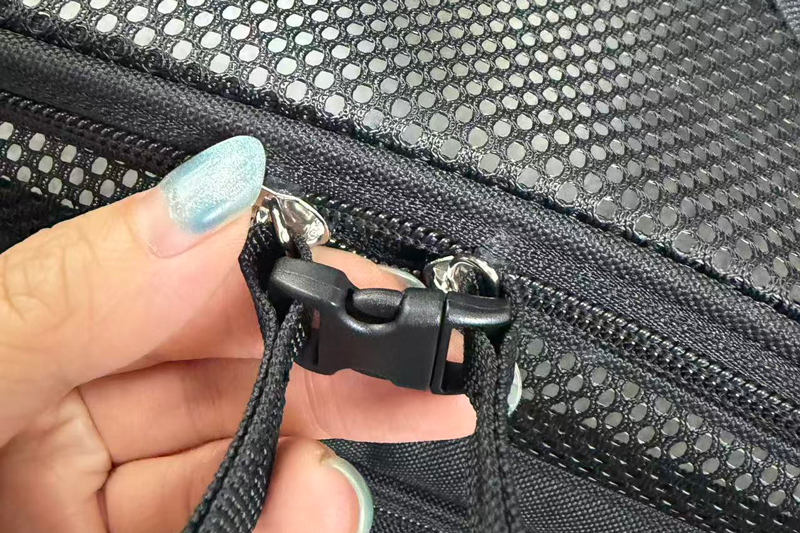
Easy entry means little without secure closure because containment depends on the full sequence: entry, door control, zipper movement, final locking position, and resistance to pushing or pawing. A carrier must remain manageable until the opening is completely secured.
Secure closure is a performance requirement
For consumer-facing marketing, “easy entry” is simple and appealing. For product teams, it is only one part of the handling cycle.
A more useful development question is:
Can the owner complete the transition from open carrier to secured carrier without losing control?
That transition involves material choice, zipper quality, stitching accuracy, puller position, and panel stiffness. A small mismatch can create a frustrating experience.
What secure closure involves
A closure system has several layers:
-
Opening control
The door or lid stays where the owner expects it to stay. -
Smooth zipper routing
The zipper does not catch mesh, lining, piping, or loose fabric. -
Short practical closing path
The owner can close the access point before the cat reverses or pushes out. -
Clear end position
The owner can see or feel that the carrier is closed. -
Resistance to pressure
The closure can handle pushing, pawing, and body movement within reasonable product limits.
For soft carriers, zipper routing deserves special care. Mesh near the zipper may improve ventilation, but it can also catch if the fabric lacks control. Curves can look elegant, yet they may increase friction. A double zipper can improve access, but it can also create a small center gap if the pullers are not positioned correctly.
From a manufacturing view, secure closure must also survive production variation. A sample made by the best sewing operator may perform well. A production run needs consistent tape alignment, tension, seam allowance, and reinforcement. Buyers evaluating a supplier can ask for closure testing across multiple samples, not only the golden sample.
Can Better Carrier Design Help Cats Feel More Comfortable at Home?
Many cats meet the carrier only when something unpleasant is about to happen. That pattern makes refusal more likely. Owners can train around it, but the product also needs to fit normal home life instead of staying hidden in a closet.
Better carrier design can help cats feel more comfortable at home by making the carrier usable as a familiar resting space. Features like a stable base, open front door, removable bedding, retained shape, and easy cleaning support gradual familiarization without claiming to eliminate anxiety.

A carrier can be part of daily space
Feline behavior guidance often recommends leaving the carrier accessible. The idea is simple: the carrier becomes familiar before travel. The cat may explore it, sleep near it, or eventually rest inside it.
A product can either support that habit or make it inconvenient.
Useful home-friendly details include:
- A front door that remains fully open
- A flat, stable base
- Bedding that feels comfortable but removes for washing
- A shape that does not collapse when empty
- Materials that do not hold strong storage odors
- An entrance that does not block casual movement
- A design that looks acceptable in a living room
The last point sounds less technical, but it affects real behavior. If a carrier looks bulky, messy, or unstable, the owner may store it away. Once stored away, it returns only on stressful days.
Comfort is practical, not decorative
Comfort does not mean adding thick padding everywhere. Too much soft material can reduce usable space, trap heat, or complicate cleaning. A better balance considers:
| Design area | Home comfort role | Development caution |
|---|---|---|
| Bedding | Encourages resting | Must be removable and washable |
| Base | Builds confidence when stepping in | Must resist sagging |
| Ventilation | Keeps interior pleasant | Mesh must not weaken structure |
| Door position | Allows voluntary entry | Door must not flop closed |
| Interior corners | Reduces awkward posture | Must remain cleanable |
A carrier that works at home may reduce the drama before travel, but brands need to be careful with claims. It is fair to say a design supports familiarization. It is not fair to promise that a cat will stop feeling anxious.
For product teams, the opportunity is clear: the carrier is not only a transport product. It is also a pre-travel product. If it cannot live comfortably in the home, the owner loses one of the simplest ways to improve acceptance.
Why Veterinary Access Should Influence Carrier Design?
Most carrier marketing stops at transportation. The cat gets inside, the owner carries it, and the story ends. In real life, the stressful part may begin at the clinic, especially when a frightened cat refuses to leave the carrier.
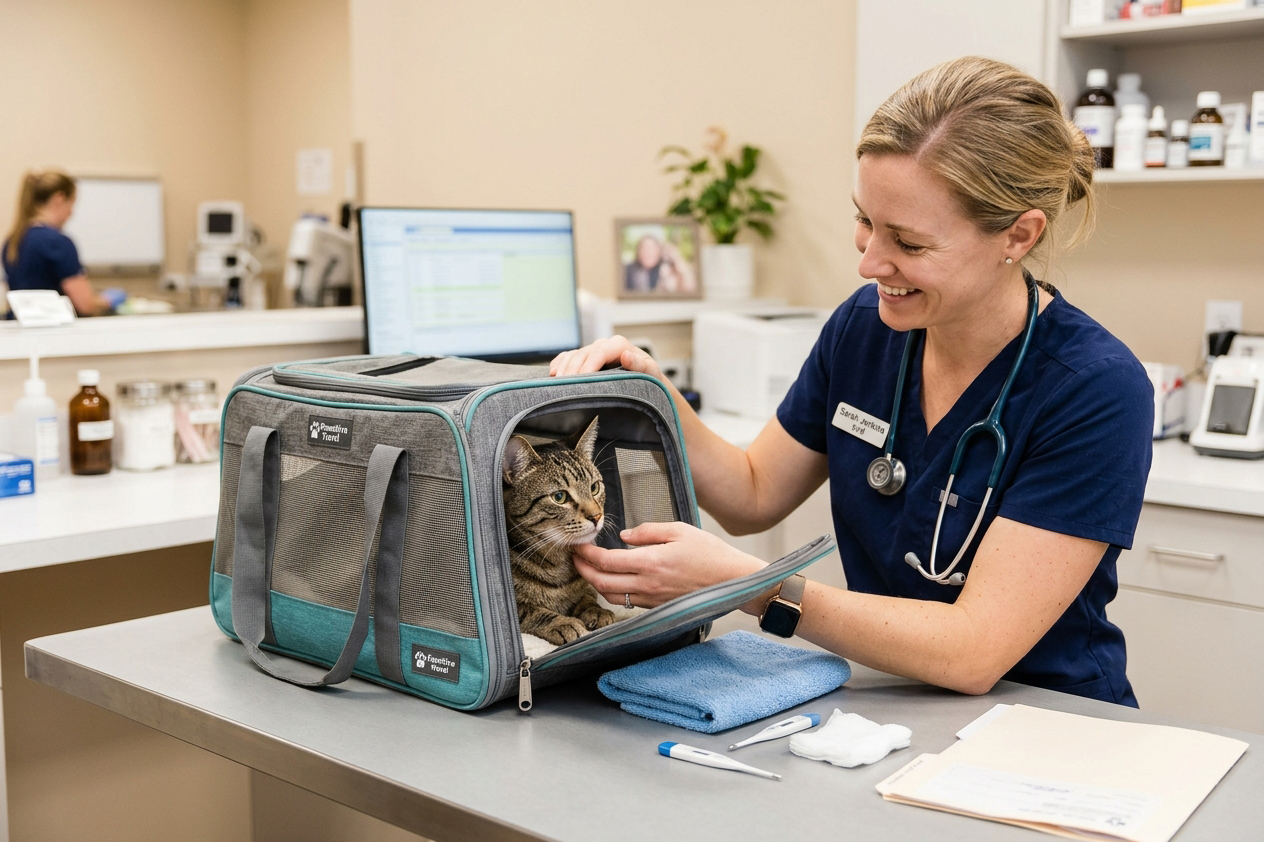
Veterinary access matters because some cats are easier to examine when the carrier allows top access, partial opening, or controlled removal from above. A good carrier supports entry, transport, examination, return, and closure rather than focusing only on the trip to the clinic.
The clinic changes the handling problem
At home, the owner may have time and familiarity. At the clinic, there are new smells, sounds, people, and animals. A cat that entered the carrier at home may refuse to come out in the exam room.
If the only option is pulling the cat through a narrow front door, stress can increase for everyone involved. Some carriers allow the top to open, which gives the veterinary team a better angle. Rigid carriers sometimes allow the upper shell to be removed. Soft carriers may use top panels or large controlled openings.
Not every product needs every solution. A lightweight airline-style soft carrier has different constraints from a clinic-focused carrier. The important point is to evaluate what happens after arrival.
Questions buyers can ask
Brands and OEM buyers can include veterinary access in product evaluation:
- Can the cat be reached without excessive pulling?
- Does the carrier remain stable when opened?
- Is the opening large enough for practical handling?
- Can the veterinarian see the cat’s posture and condition?
- Can the carrier be reclosed quickly after examination?
- Does the access design compromise transport security?
These questions create a more complete product brief. They also help brands avoid shallow feature additions.
Veterinary access and soft carrier limits
Soft-sided carriers have trade-offs. A removable roof may sound useful, but it can weaken the structure or add complexity. A top zipper can help, but only if the lid has enough support. A wide mesh panel improves visibility, but it may reduce stiffness if poorly placed.
For higher-end pet carriers, I prefer to see veterinary access treated as a scenario, not just a feature label. The product team can map the sequence:
- Owner places carrier on exam table.
- Top or front access opens.
- Cat remains inside or is gently removed.
- Carrier stays stable.
- Opening closes again without a fight.
That sequence is more informative than a specification sheet alone.
What Pet Carrier Brands Can Learn from Real Owner Complaints?
Owner complaints can look emotional on the surface. “My cat hates this thing” is not a technical specification. But hidden inside those comments are patterns that can guide product improvement, especially for established brands with proven designs.
Pet carrier brands can learn from owner complaints by translating frustration into testable product requirements. Complaints about escaping, collapsing lids, stuck zippers, unstable floors, or difficult veterinary access point toward specific areas for redesign, sampling, and supplier evaluation.

Turning complaints into development tasks
Online reviews, Reddit threads, customer service emails, and retailer returns all contain useful signals. A single complaint does not prove the root cause. But repeated complaints show where to investigate.
| Customer complaint | Possible product development direction |
|---|---|
| “My cat refuses the front entrance.” | Review entrance size, height, angle, and alternative access |
| “My cat runs out while I zip it.” | Improve closure sequence and reduce remaining gap |
| “The lid falls down.” | Add panel support or change opening geometry |
| “The zipper catches the mesh.” | Improve zipper routing and fabric control |
| “The carrier collapses.” | Review side-wall reinforcement and material stiffness |
| “The bottom bends.” | Improve base board, bedding support, or load distribution |
| “The vet struggled to get my cat out.” | Evaluate top access or controlled removable sections |
This translation step is where product teams can create value. A complaint becomes useful when it leads to a measurable design target.
Improvement may beat reinvention
For an established pet carrier brand, a full redesign may not be necessary. The product may already have market recognition, a price point, packaging, and retailer acceptance. In that case, small improvements can protect the product’s identity while solving real pain points.
Possible upgrades include:
- Revised zipper route
- Better lid support
- Stronger base insert
- Improved door retention
- Cleaner seam construction near mesh
- Reinforced access panels
- More stable handle placement
Small changes still need careful evaluation. A new zipper path may change sewing time. A reinforced lid may increase material cost. A stronger base may affect folding or shipping dimensions. A wider opening may change the carrier’s shape under load.
This is where OEM development becomes more than sample making. A supplier needs to discuss tooling, patterns, materials, workmanship tolerance, and cost impact before recommending changes. Product improvement only helps commercially when it can be manufactured consistently and explained clearly to buyers.
How Anvoya Approaches Cat Carrier Design and OEM Development?
Cat carrier design looks simple until the product must satisfy owners, pets, retailers, veterinarians, and production teams at the same time. For OEM and ODM work, I prefer to start with handling scenes rather than isolated feature requests.
Anvoya approaches cat carrier design by evaluating the full handling journey: home familiarization, entry, closure, carrying, vehicle or stroller compatibility where relevant, veterinary access, cleaning, and storage. The goal is to turn user problems into manufacturable product requirements for B2B customers.

From user scene to product requirement
At Anvoya, the business focus is B2B manufacturing and OEM/ODM development for pet travel and mobility products. The company’s engineering background comes from child car seat and automotive-related product development, and that experience influences how carrier problems are reviewed.
That does not mean every cat carrier needs automotive hardware or a modular base. Many carriers are simply hand-carried travel products. But the engineering habit is useful: define the scenario, identify the failure point, then decide whether the solution belongs in structure, materials, pattern design, hardware, or user instruction.
For example, when a brand says, “We need an easier-entry cat carrier,” the development discussion may include:
- Is the cat refusing to enter, or escaping during closure?
- Is the opening too small, or is it poorly supported?
- Does the floor move when the cat steps in?
- Does the zipper path create delay?
- Will the change affect folding, packing, or cost?
- Does the carrier need to connect with a stroller frame or vehicle-ready system?
Modular systems add another layer
For modular pet travel systems, the opening cannot be designed separately from the whole carrier. A carrier that connects with a stroller frame, docking structure, or vehicle-ready base has extra constraints.
Changing an opening can affect:
| Design change | Possible system impact |
|---|---|
| Larger side opening | Reduced side-wall stiffness |
| New top access | Changed handle placement or load path |
| Additional zipper | More sewing complexity and possible flex |
| Reinforced lid | Higher weight and altered balance |
| Modified base | Docking fit or stroller compatibility changes |
For Anvoya product concepts such as carrier + stroller + vehicle travel systems, access design must work with docking architecture and soft-goods integration. For airline-oriented soft carriers, different priorities apply, such as low weight, ventilation, controlled flexibility, and cabin-size constraints.
The practical goal is not to add features for the sake of adding features. It is to improve the handling experience in a way that can be produced, inspected, and repeated. B2B buyers can ask for prototypes that demonstrate closure, stability, access, and cleaning rather than relying only on appearance samples.
FAQ
Why do cats suddenly refuse pet carriers?
Cats may suddenly refuse pet carriers after a stressful trip, painful veterinary visit, unfamiliar smell, or rough handling experience. The carrier becomes a warning signal. A design issue, such as an unstable base or noisy zipper, can make the reaction stronger.
Are top-loading carriers better for cats?
Top-loading carriers can help when a cat resists front entry because the owner can lower the cat inside. They are not always better, though. The lid must stay open, the zipper must close smoothly, and the structure must prevent escape during closure.
How can I make a cat carrier less scary at home?
Leave the carrier open in a familiar room, add washable bedding, and let the cat explore without pressure. Treats and calm exposure can help. A carrier with a stable base, open front door, and comfortable interior makes this process easier for many owners.
What should pet brands test before launching a cat carrier?
Pet brands should test entry, closure speed, zipper reliability, floor stability, panel support, ventilation, cleaning, and veterinary access. Testing with only a calm cat sitting inside misses the hardest moments: resistance, escape attempts, and one-person handling.
Can carrier design eliminate cat anxiety?
Carrier design cannot eliminate cat anxiety. Anxiety may come from past experiences, temperament, travel stress, or medical handling. Good design can reduce avoidable stress points, such as unstable floors, awkward openings, collapsing lids, and slow closure.
Conclusion
Cats refuse pet carriers for behavioral reasons and design reasons, and both deserve attention. A better carrier supports the full journey: home familiarization, entry, closure, secure transport, veterinary access, return, and cleaning. For pet product brands, the opportunity is to move beyond “easy entry” and develop products that owners can handle with more confidence. If you are reviewing or developing a new carrier line, Anvoya can help translate real user complaints into practical OEM/ODM product improvements.