
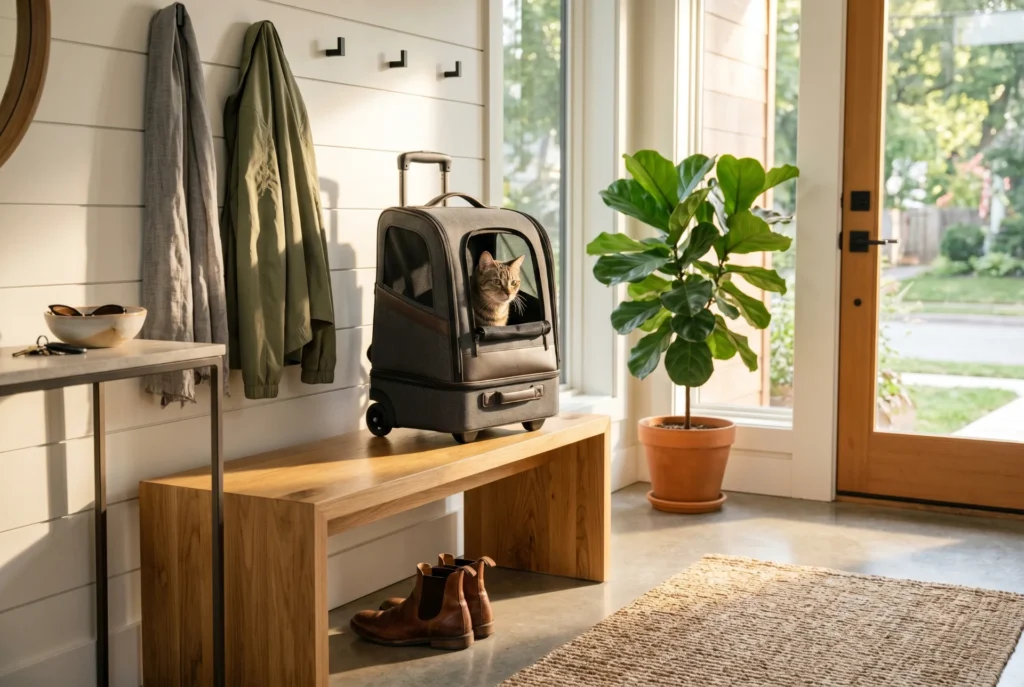
Many brands copy dog stroller ideas for cats. The product looks useful. The cat feels stressed. The owner feels tired before the trip starts.
Cat travel products need a different design logic because cats travel with more stress, less choice, and stronger need for enclosure. A good cat system should reduce handling, limit transfers, feel stable, and support real trips like vet visits, car rides, apartment parking, and short urban movement.
When we design for cats, we cannot start with the same picture that we use for dogs. A dog often wants to go outside. A dog may enjoy a walk, a park, a café, or a long outdoor day. A cat is different. Most cats leave home because the owner has no other choice. The trip may be a vet visit. It may be grooming. It may be a short car ride. It may be a move from an apartment to a parking lot.
This changes the full design logic. The question is not only “How can we move the pet?” The better question is “How can we reduce stress at every small step?” That small step may be the doorway, the elevator, the car seat, the clinic desk, or the return home. For cats, the best travel product is often not the biggest one. It is the one that keeps the cat calmer and helps the owner move with less effort.
What Are the Key Takeaways for Cat Travel Product Design?
Cat owners often buy the wrong product because the market gives them dog-style answers. The result is more stress, more weight, and more transfer.
Cat travel products should not treat cats as small dogs. They need calmer enclosure, lighter handling, fewer transfers, and better support for vet visits, car rides, apartment parking, and short urban trips.
We should start with a simple point. A cat travel product is not only a basket, carrier, stroller, or seat. It is a stress control system. The product must work before, during, and after the trip. If the cat panics before leaving the home, the design has already failed. If the owner has to move the cat from one container to another several times, the design has added risk. If the product is too heavy for one person in an apartment parking area, the design has ignored the real user.
| Design Point | Dog-Style Logic | Cat-Specific Logic |
|---|---|---|
| Main reason to go out | Walk, park, social time | Vet, car ride, grooming, moving |
| Best feeling for pet | Open view, more space | Calm enclosure, controlled view |
| Owner problem | Long walking comfort | Lifting, carrying, car transfer |
| Product risk | Too small or weak | Too open, too heavy, too many transfers |
| Better design goal | Outdoor mobility | Stress reduction and safer movement |
For cats, we often need to design the smallest stressful path, not the biggest travel function. This is why compact, stable, and car-ready systems make more sense than oversized stroller-style products in many real cat travel cases.
Why Do Cats Travel Differently from Dogs?
Many pet travel products are made with a dog owner in mind. That creates a mismatch. Cats do not always want public movement.
Most cats do not need a stroller for adventure first. They need a calmer way to survive the trip. Their common trips are vet visits, grooming, short car rides, apartment-to-car movement, and occasional travel.
We see this difference in the first few minutes of a trip. A dog may run to the door. A cat may hide under the bed. A dog may look at the street with interest. A cat may freeze when the hallway noise starts. This is not bad behavior. It is a different travel pattern. Cats are more sensitive to sound, smell, light, and fast movement. They also build trust with space. When the space changes too fast, the cat may feel unsafe.
The common cat travel route is also more practical than romantic. It is not always a sunny walk in a park. It is often a rushed weekday vet visit. It may start in a small apartment. Then the owner carries the cat to an elevator. Then they cross a parking lot. Then they secure the cat in a car. Then they walk into a clinic full of dog smells and strange sounds.
| Real Cat Trip | Design Need |
|---|---|
| Home to elevator | Stable base and easy lifting |
| Elevator to parking lot | Secure closure and low shaking |
| Parking lot to car | Compact size and fast placement |
| Car to clinic | Fewer transfers and better restraint |
| Clinic waiting area | Controlled visibility and calm enclosure |
So we should not design cats as “small dogs in smaller products.” We should design around their real movement chain. That chain is short, stressful, and full of small transitions. Each transition matters.
Why Does Enclosure Matter More for Cats?
A cat can look calm in a photo but feel unsafe inside a product. Too much exposure can make the cat nervous very fast.
Cats need a stronger sense of enclosure than many dogs. A good cat travel product should feel stable, covered, and controlled, while still giving air flow, access, and enough visibility.
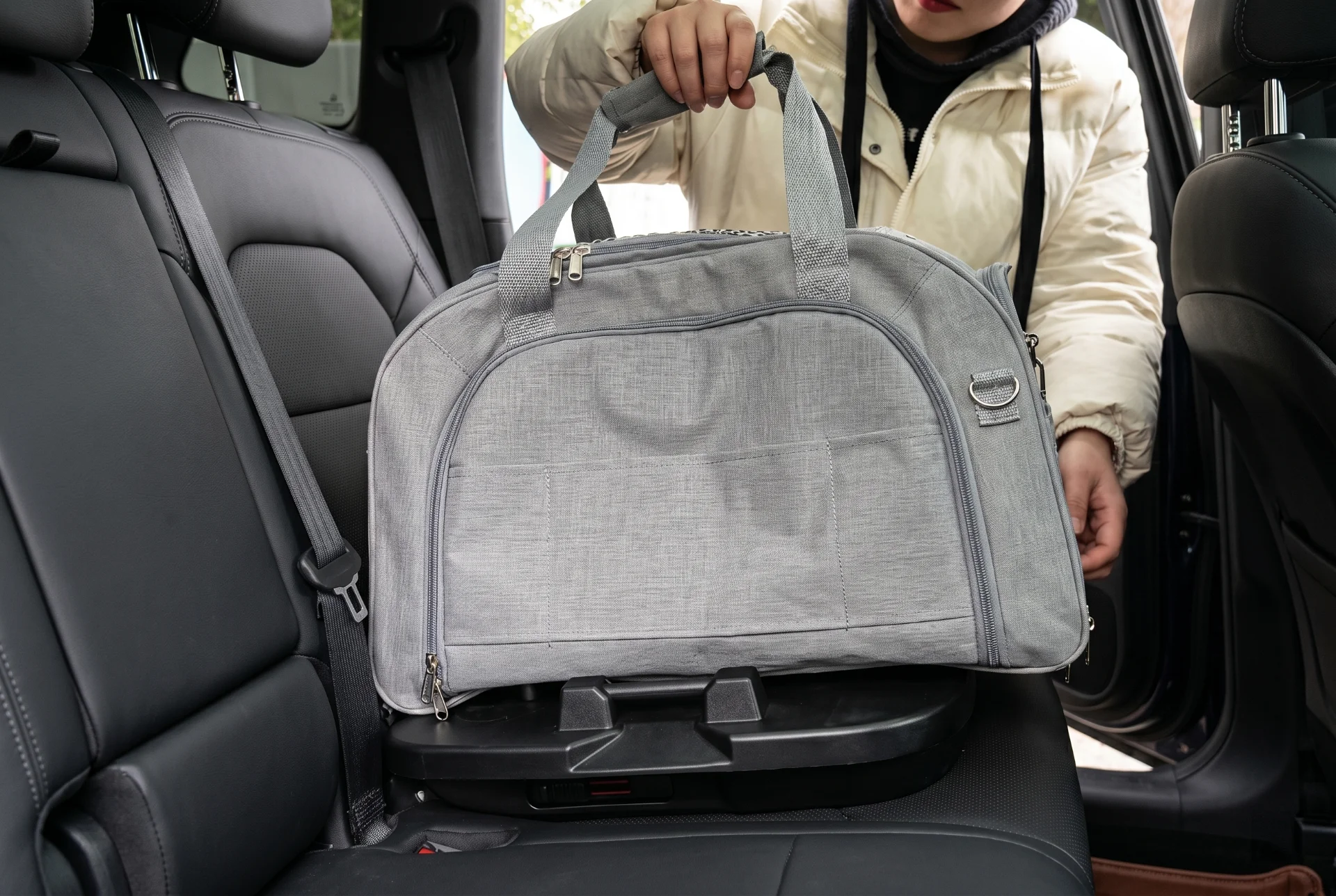
Enclosure is not the same as closing the cat in a dark box. Good enclosure gives the cat a boundary. It tells the cat where the safe space starts and ends. This matters because many cats do not feel safe when every side is open. A wide open stroller can look premium to a human, but it may feel exposed to a cat. The cat sees feet, wheels, dogs, people, cars, clinic lights, and moving shadows. That can create stress before the owner notices it.
A soft product can also create a problem if it feels unstable. Many cats need the base to feel firm. If the floor bends, swings, or collapses, the cat may lose trust. Then the cat may scratch, push, or refuse to enter the carrier next time. The product may still look comfortable, but the cat remembers the unstable feeling.
| Enclosure Feature | Why It Matters for Cats |
|---|---|
| Covered sides | Reduces visual overload |
| Firm base | Gives a stable body feeling |
| Controlled window | Lets the cat see without full exposure |
| Strong closure | Stops escape during stress |
| Low transfer design | Reduces repeated handling |
Visibility should be controlled, not fully exposed. Some cats like to look out. Some cats want to hide. A better product gives the owner a way to manage that. It may use mesh, panels, covers, or partial openings. The point is simple. We should give the cat choice through design, because the cat has very little choice in the trip itself.
Why Is Lightweight Handling Critical for Cat Owners?
A large product can look premium online. Then the owner carries it through a parking lot and feels the real problem.
For cat owners, heavy-duty does not always mean premium. Sometimes premium means easier to carry. Light weight, one-hand handling, compact storage, and fast lifting are critical in cat travel.
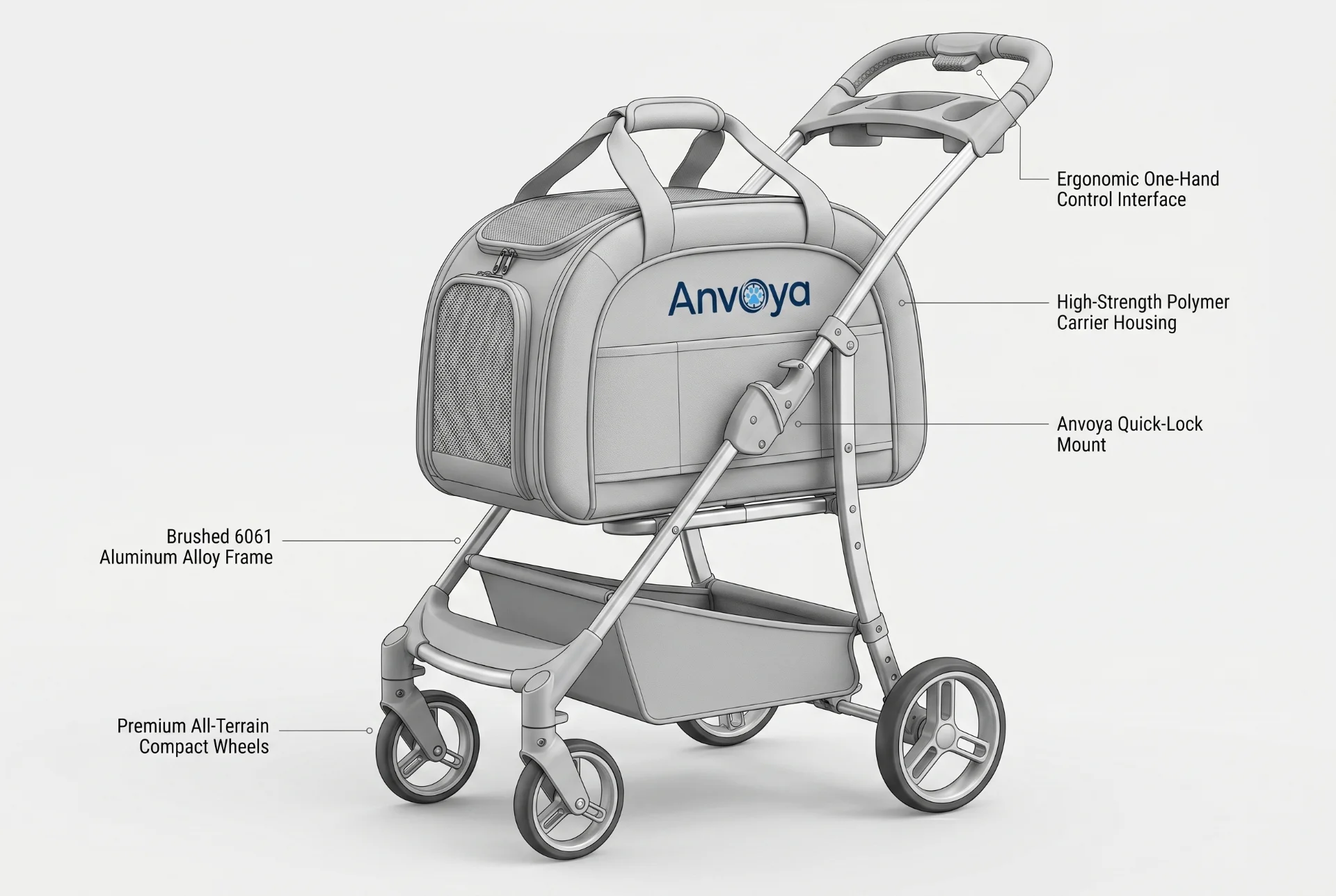
Cat owners often move through tight and busy spaces. They may live in apartments. They may use elevators. They may carry bags, keys, documents, and a phone at the same time. The pet may move inside the carrier. The owner may need one hand for a door or car handle. In this setting, a heavy product does not feel safer. It feels like a burden. The owner may also avoid using it after the first hard trip.
This is why we need to separate “strong” from “large.” A product can be strong without being oversized. A product can feel premium because it is easy to lift, easy to place, and easy to store. For cats, small details shape the whole trip. A balanced handle matters. A stable base matters. A product that fits in a car footwell or on a seat matters. A carrier that can be lifted without twisting the wrist matters.
| Handling Problem | Better Design Answer |
|---|---|
| Heavy carrier | Lighter structure with stable support |
| Two-hand movement | One-hand lift points where possible |
| Wide stroller frame | Compact footprint for urban use |
| Hard storage | Foldable or easy-to-store parts |
| Awkward car placement | Shape designed for car entry and removal |
We should also think about the owner’s emotion. When the product is hard to handle, the owner becomes tense. Cats read that tension. Then the trip gets worse. A lighter and simpler product can reduce stress for both sides.
Why Should Car-to-Clinic Transfer Be Designed First?
Many products show happy outdoor scenes. The real cat travel scene is often a nervous owner, a full parking lot, and a clinic appointment.
The most important cat travel route is often home → elevator → parking lot → car → vet clinic. A good design should make this route smoother, with fewer transfers and less stress.
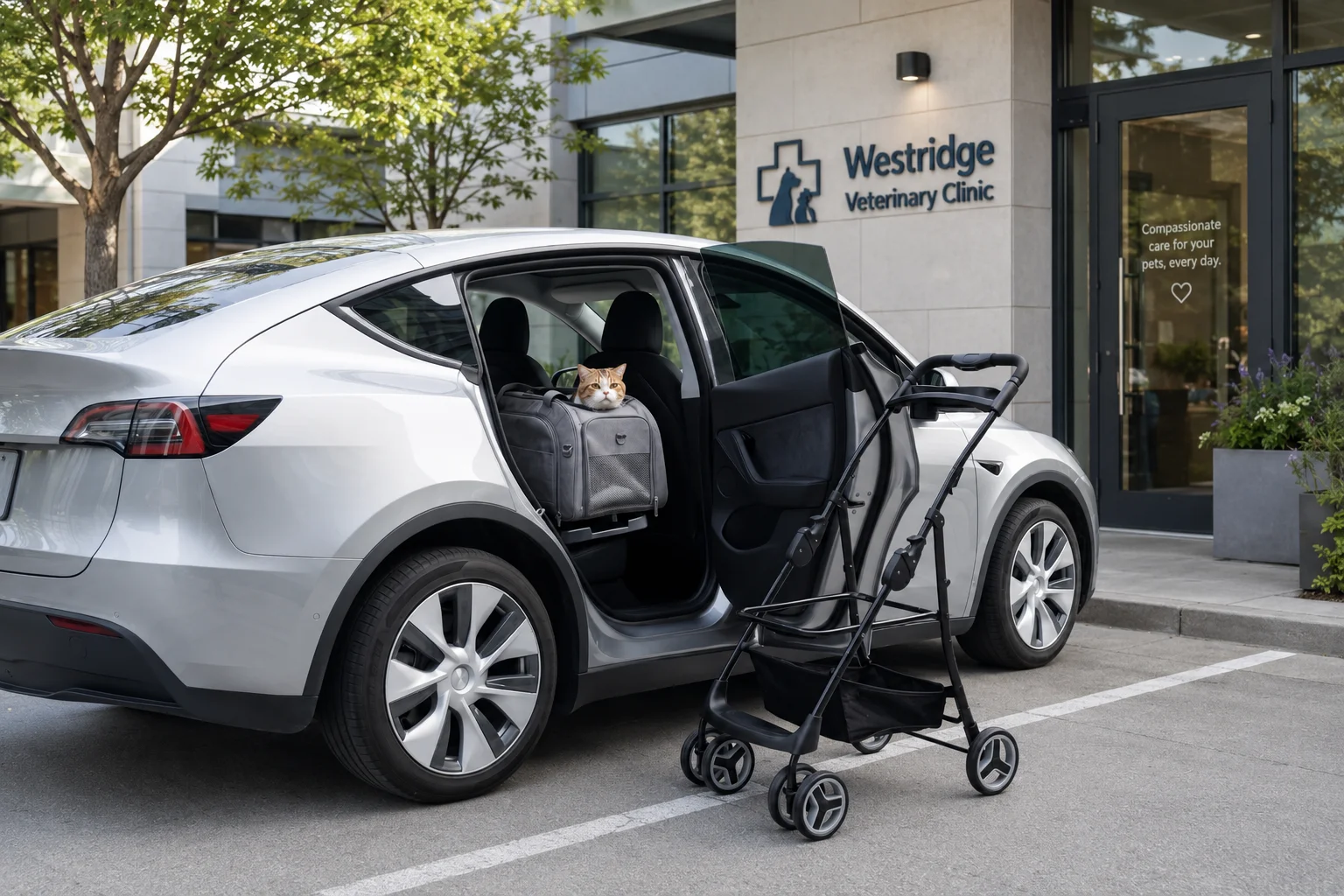
This is one of the most human parts of cat product design. The owner is not always looking for adventure. The owner may be worried about a sick pet. The appointment may be early. The weather may be bad. The parking lot may be far from the clinic door. The cat may already be hiding, crying, or shaking. In this moment, the product should not ask the owner to do many steps.
Frequent transfers are a major problem. If the cat goes from home carrier to car seat, then from car seat to stroller, then from stroller back to clinic carrier, the cat meets stress again and again. Each transfer brings escape risk. Each transfer requires handling. Each transfer breaks the small amount of calm that the owner may have built.
| Transfer Step | Risk If Poorly Designed |
|---|---|
| Cat enters carrier at home | Refusal, scratching, delay |
| Carrier moves to car | Shaking, swinging, fear |
| Carrier is secured in car | Weak restraint, owner uncertainty |
| Carrier leaves car | Heavy lifting, awkward angle |
| Carrier enters clinic | Overexposure, dog noise, panic |
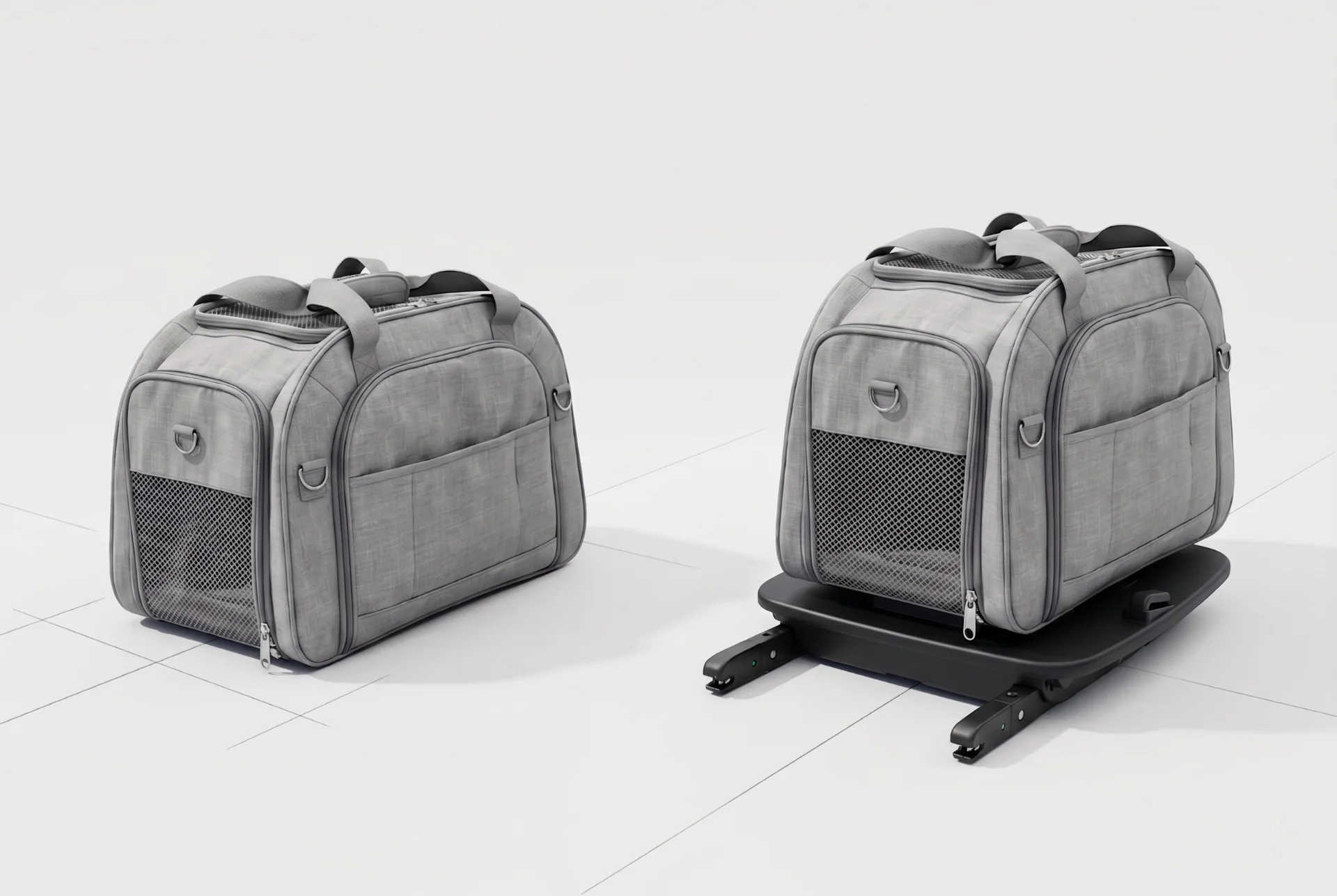
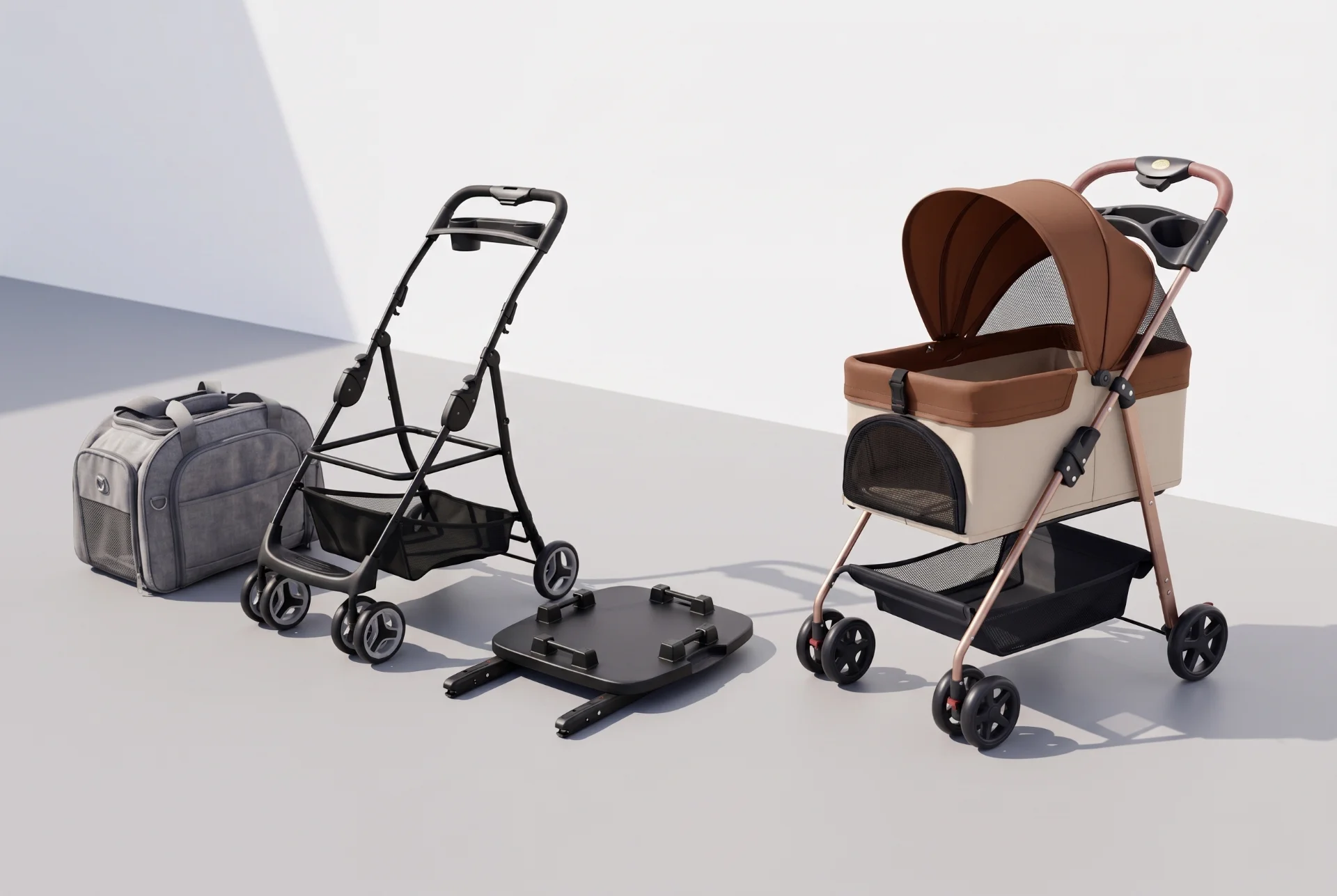
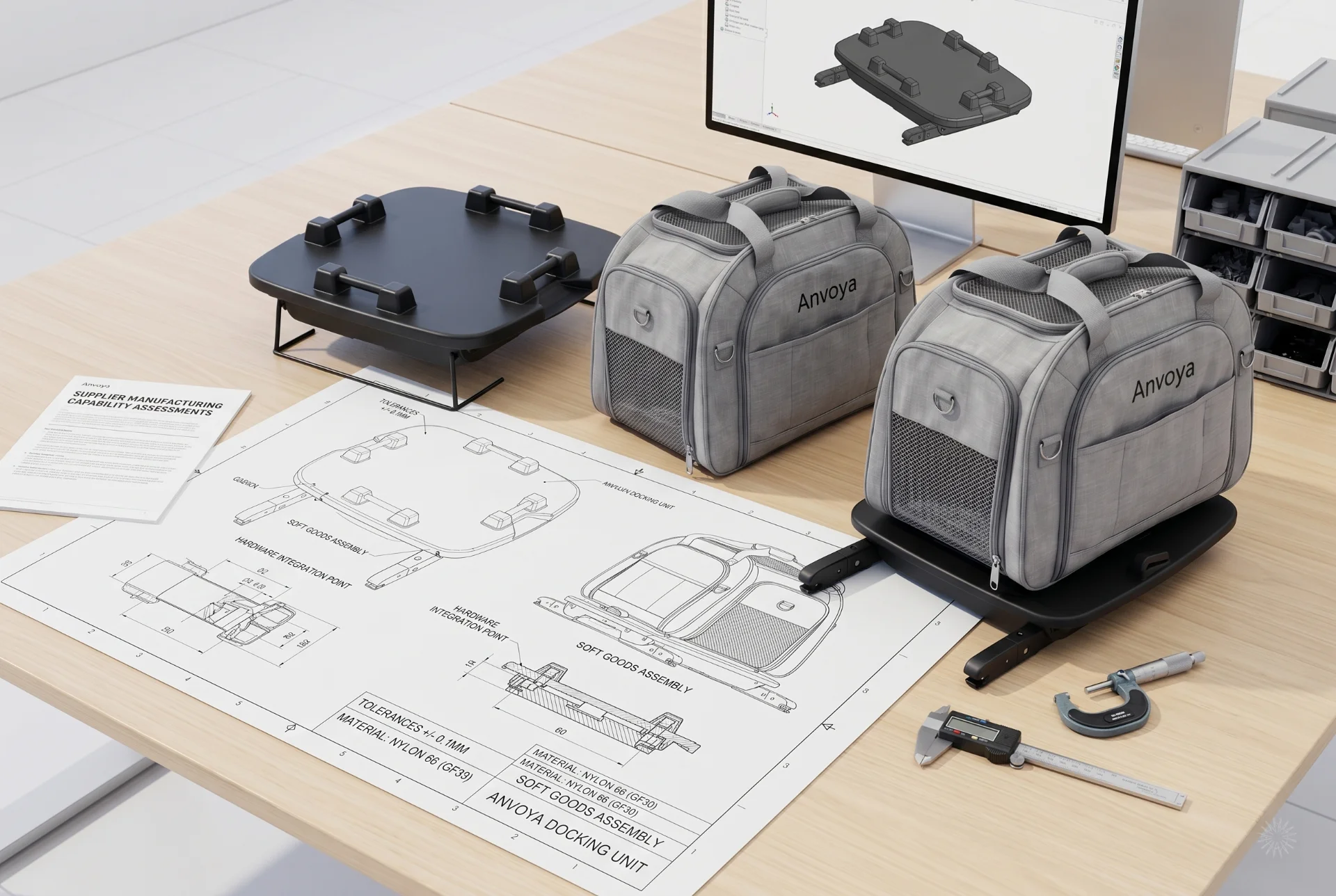
A better design starts with the car-to-clinic route. The product should support secure placement in the vehicle. It should also be easy to remove without waking fear in the cat. It should keep the cat in the same safe space as much as possible. It should allow the owner to walk into the clinic without changing containers. This is why compact ISOFIX carrier systems, such as Anvoya AERO, can be better suited for cats and small pets than oversized stroller-style products. They match the real trip more closely. They support car movement first. They also reduce the need for large outdoor frames when the trip is short, urban, and practical.
Why Should Cat Travel Products Reduce Stress Before, During, and After the Trip?
A product can look successful if it only moves the cat from one place to another. But travel stress starts much earlier and ends much later.
A good cat travel system should reduce stress before the trip, during movement, inside the car, at the clinic, and after returning home. The full journey matters.
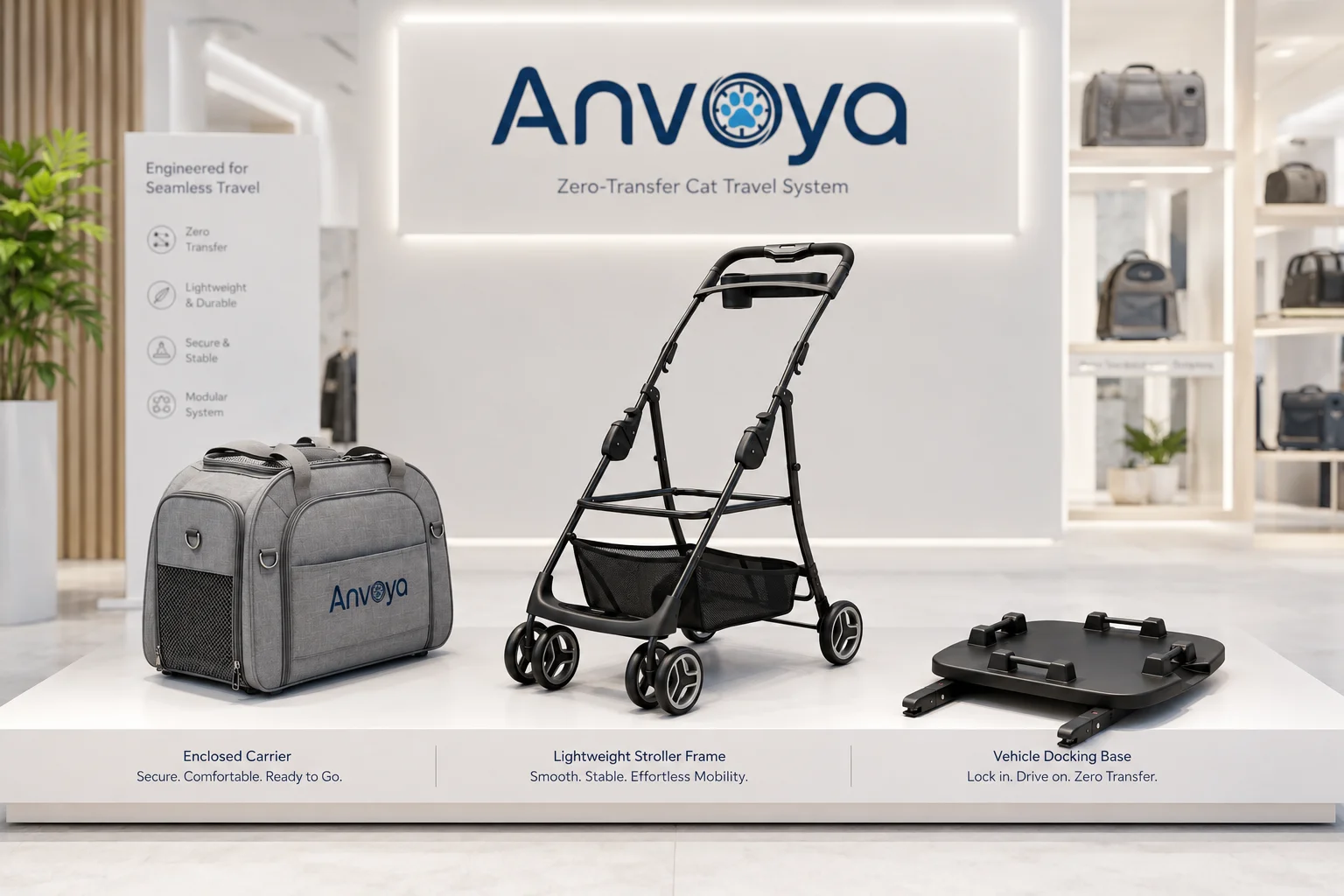
The cat travel journey starts when the owner takes out the carrier. Many cats already know what that means. They may hide because they remember the last vet visit. This tells us that design should help the carrier become less frightening at home. A product with a stable resting shape can stay in the living space before the trip. The cat may smell it, enter it, and treat it as a normal object. That can reduce the first fight.
During the trip, stress control means fewer shocks, fewer sounds, and fewer sudden changes. The carrier should not swing too much. The base should not bend. The cat should not feel fully exposed in an elevator or clinic. In the car, the product should help the owner secure the carrier in a clear and repeatable way. The owner should not need to guess.
| Trip Stage | Stress-Control Design |
|---|---|
| Before leaving home | Familiar shape, easy entry, stable base |
| Walking to car | Light weight, balanced carry, secure closure |
| Inside car | Clear restraint method and stable position |
| Clinic waiting area | Controlled view and calm enclosure |
| Return home | Easy cleaning and low-drama removal |
After the trip, the product still matters. If it is hard to clean, the owner may dislike it. If it is hard to store, it may disappear into a closet. If it feels like a medical warning sign, the cat may fear it next time. A better system becomes part of normal home life. That is a quiet but important design goal.
Conclusion
Cats need travel products built around stress, enclosure, light handling, and real car-to-clinic movement, not dog-style outdoor stroller logic.
FAQ
Q: Why do cat travel products need a different design logic?
A: Cats do not travel like small dogs.
Most cats are not looking for outdoor adventure first. They are usually going to the vet, moving between home and car, or being carried through parking lots, elevators, and clinic waiting rooms.
That means cat travel products should focus on lower stress, lighter handling, better enclosure, and fewer transfers, not just open stroller comfort.
Q: Can a dog stroller also work for cats?
A: Sometimes, but not always well.
Many dog strollers are designed around visibility, outdoor walking, and longer rides. Cats often need a more enclosed and stable space, especially during vet visits or car travel.
A cat travel product should not simply copy dog stroller logic. It should consider how cats react to noise, movement, open spaces, and frequent handling.
Q: What matters most in cat travel product design?
A: The most important points are:
- enclosed but breathable space
- lightweight carrier structure
- stable bottom support
- easy car-to-clinic transfer
- fewer times removing the cat from the carrier
- simple cleaning
- calm visual environment
For cats, comfort is not only softness. Comfort is control and calmness.
Q: Why is lightweight design important for cat owners?
A: Cat owners often carry the product through short but stressful routes: apartment hallway, elevator, parking lot, car, clinic entrance, and waiting room.
A heavy product makes those moments harder.
For cat travel, premium does not always mean bigger or heavier. Premium can mean easier to lift, easier to move, and easier to manage alone.
Q: Why does enclosure matter more for cats?
A: Many cats feel safer when they have a more protected space.
A fully open design may make some cats nervous. Too much exposure, noise, or movement can increase stress. A good cat carrier or cat travel system should balance visibility, airflow, and privacy.
The goal is not to hide the cat completely. The goal is to help the cat feel less exposed.
Q: What are the most common travel scenarios for cats?
A: The most common scenarios are not usually long outdoor walks.
They are more often:
- vet visits
- short car trips
- apartment-to-car movement
- parking lot to clinic transfer
- grooming visits
- moving between home and temporary accommodation
This is why cat travel products should be designed around short, controlled, low-stress movement.
Q: Are 3-in-1 pet travel systems suitable for cats?
A: Yes, if the system is light, enclosed, stable, and easy to transfer between scenes.
For cats, a 3-in-1 system can be useful when it reduces the need to move the cat between separate products. The same carrier space can support car use, stroller use, and short carrying.
That matters because many cats become stressed when they are taken out and placed into a new product.
Q: Should cat travel products focus more on car use or stroller use?
A: For many cat owners, car use and short transfer may matter more than long stroller walks.
A cat travel product should first solve the route from home to car to clinic. Stroller use can still be valuable, especially for parking lots, city areas, or longer indoor movement, but it should support the main travel routine rather than dominate the design.
Q: What mistakes do brands make when developing cat travel products?
A: Common mistakes include:
- treating cats like small dogs
- making the carrier too open
- making the system too heavy
- focusing only on outdoor stroller use
- ignoring vet visit scenarios
- requiring too many pet transfers
- using soft bags without enough bottom stability
A good cat travel product should reduce friction at every step of the trip.
Q: What should retailers highlight when selling cat travel products?
A: Retailers should focus on the real cat-owner pain points:
- easier vet visits
- less stressful transfers
- lighter handling
- enclosed comfort
- car-to-clinic convenience
- fewer product switches
A simple message works well:
“Designed for calmer cat travel, from home to car to clinic.”
Q: Where does Anvoya AERO fit in cat travel?
A: AERO fits the cat and small-pet segment because it is designed as a lightweight 3-in-1 travel system for car use, stroller use, and carrying.
Its role is not to behave like a heavy outdoor stroller. Its value is in making short daily travel easier: home, car, vet, café, parking lot, and back again.