
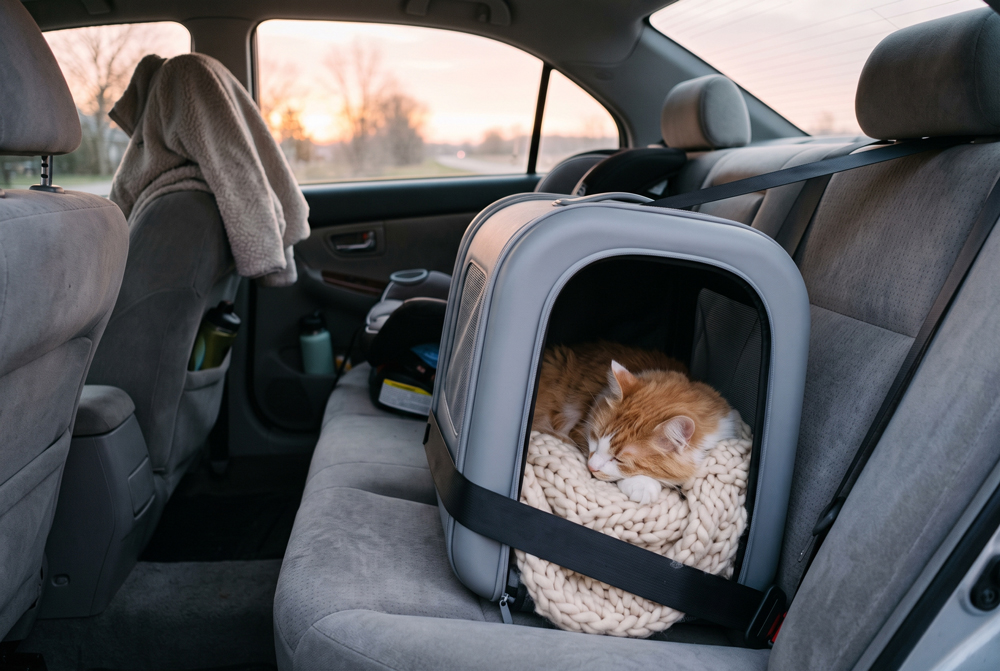
A cat carrier can be great at home and awkward in a car. Once the vehicle starts moving, simple things like position, fixing, and access become much more important.
The best cat carrier for car travel is designed around the vehicle itself, with a clear way to position, secure, or dock the carrier while still working well for everyday use.
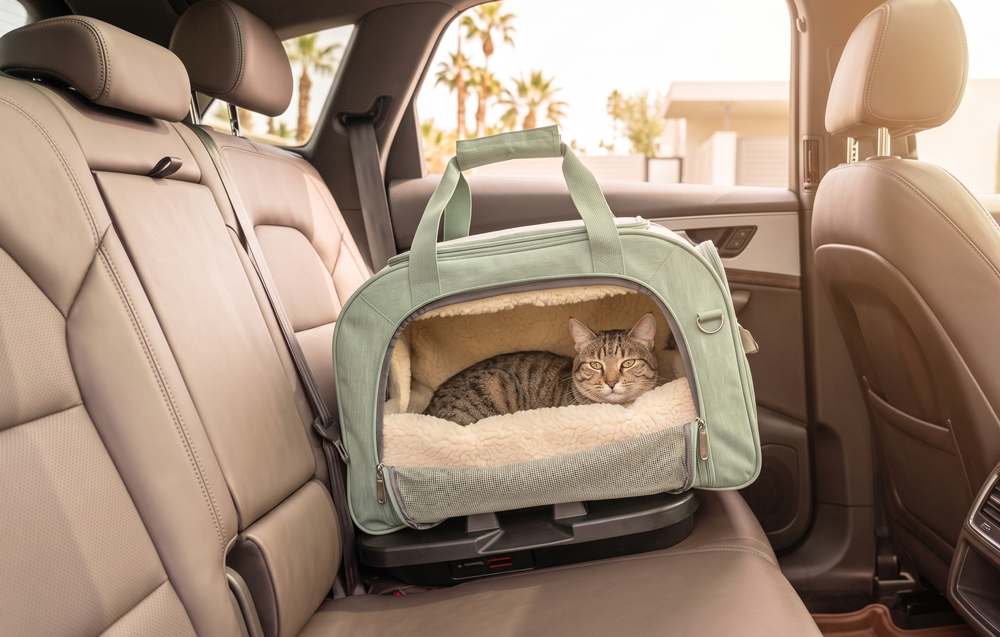
When you search for the best cat carrier for car travel, you might often compare the things you can see right away. Size. Material. Ventilation. Openings. Weight. Style.
All of those matter.
But the car changes the problem.
Once the carrier goes inside a moving vehicle, it has to work with the seat, the seat belt, the available space, and the person using it. Then there is the part nobody thinks about until the trip is already happening.
What happens when you arrive?
The cat may need to go from the car to a clinic, a hotel, or just across a parking lot. Carrying the same carrier again suddenly becomes part of the experience.
That is why I think “the best cat carrier” is the wrong starting point for product development.
A better question is: what kind of carrier works well across the whole journey?
What Should You Look for in a Cat Carrier for Car Travel?
A car-travel carrier needs to do more than carry a cat. The in-car position, fixing method, structure, and everyday portability all become part of the product.
A useful starting point is to look at four areas: where the carrier sits in the car, how it stays there, how the structure supports that connection, and what happens when the carrier leaves the vehicle.

This is where I see a lot of confusion.
A carrier can fit inside a car. That does not make it a car-travel product.
A soft carrier can sit on a rear seat. A rigid carrier can sit in the cargo area. Almost anything can be placed somewhere inside a vehicle.
The more important question is what the product was designed to do once it gets there.
Where Does the Carrier Actually Sit?
The first decision is very practical.
Does the carrier work with a seat belt? Does it connect to a dedicated base? Is there a specific place for it inside the vehicle?
Different products can use different solutions. The issue is having a clear one.
During development, this decision affects much more than the fixing point. It can change the carrier's shape, reinforcement, openings, handles, and even the position of other hardware.
That is why we suggest clients to think about the vehicle early instead of adding the car function at the end.
What Happens After the Car Ride?
Suppose the owner drives to the vet. The carrier works fine inside the car. Then the owner parks fifty meters away from the entrance and needs to carry the cat inside.
Now the carrier is back in everyday mode.
That small example changes the product discussion. The best vehicle interface in the world is not very helpful if the carrier becomes unpleasant to carry once the car door opens.
| Question | What I Would Check |
|---|---|
| Where does the carrier sit? | Is the position practical and easy to understand? |
| How is it fixed? | Is the method part of the product design? |
| Can it be removed easily? | Does the carrier still work outside the car? |
| Can it connect to another platform? | Is there room for a wider travel system? |
| Does one carrier support different parts of the journey? | Is the product solving a bigger problem? |
That last question is where things get interesting.
A carrier that simply goes into the car is one product.
A carrier that works before, during, and after the car ride can become a much stronger product idea.
Are Hard-Sided Cat Carriers Better for Car Travel?
A hard-sided carrier can make structural integration easier, but a rigid shell alone does not make a carrier better for the car.
Hard-sided carriers offer a stable structure that can be useful for defined connection points and docking hardware, but the overall vehicle interface matters more than the shell material by itself.
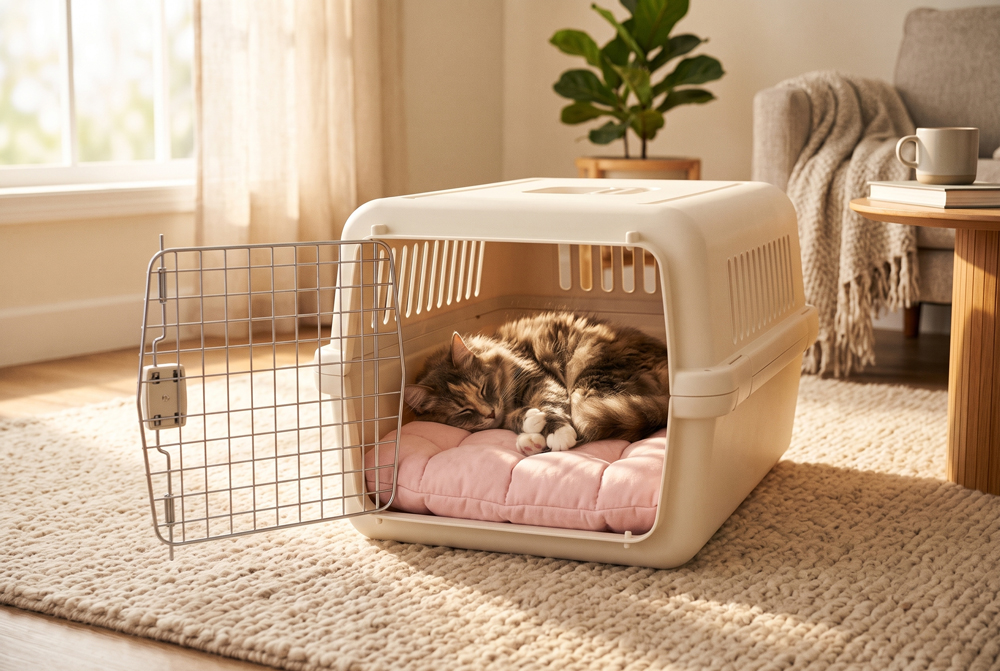
“Hard versus soft” sounds like a simple comparison.
In practice, it is not.
A rigid shell gives the designer a controlled shape. That helps when the product needs specific hardware or connection points.
A soft carrier gives more flexibility. It can be lighter, easier to carry, and more adaptable to everyday use.
Neither construction wins every time.
The right choice depends on what the product is trying to achieve.
Where Does the Structure Become Important?
The answer is usually around the connection areas.
A carrier designed to connect to a vehicle base may need reinforced points or specific structural components. A stroller connection can create similar requirements.
These details are much easier to solve when they are part of the original architecture.
This is one place where ideas from automotive and child car seat engineering are useful. We tend to look at things like interfaces, hardware positions, structural paths, manufacturing tolerances, and repeatable assembly.
That does not mean a pet carrier has the same crash performance or certification as a child car seat.
It does not.
Any claim about crash protection or certification has to come from the actual product testing and certification behind that specific product.
The engineering influence is about the development approach.
What About Soft and Hybrid Carriers?
Soft carriers can still work well for car travel.
The challenge is usually the interface rather than the material itself.
A hybrid structure can sometimes be a better fit. The rigid components can take care of areas where structure matters, while softer materials handle carrying comfort, flexibility, or visual design.
That gives the designer more options.
| Construction | What It Can Offer | Where the Design Gets Tricky |
|---|---|---|
| Soft | Flexible and portable | Creating a stable vehicle interface |
| Hard | Stable and structured | Keeping the product practical to carry |
| Hybrid | Different materials can handle different jobs | More careful part integration |
This is why I use the term vehicle-ready more often than hard-sided.
Hard-sided describes the construction.
Vehicle-ready describes the purpose.
Those are very different things.
How Do You Secure a Cat Carrier in a Car?
There is no single fixing method for every carrier or every vehicle. The important part is that the intended connection is clear and built into the product from the beginning.
A car-travel carrier can use an appropriate seat belt route, a dedicated vehicle base, or another defined interface. The fixing method needs to match the actual design, intended use, and testing of the product.
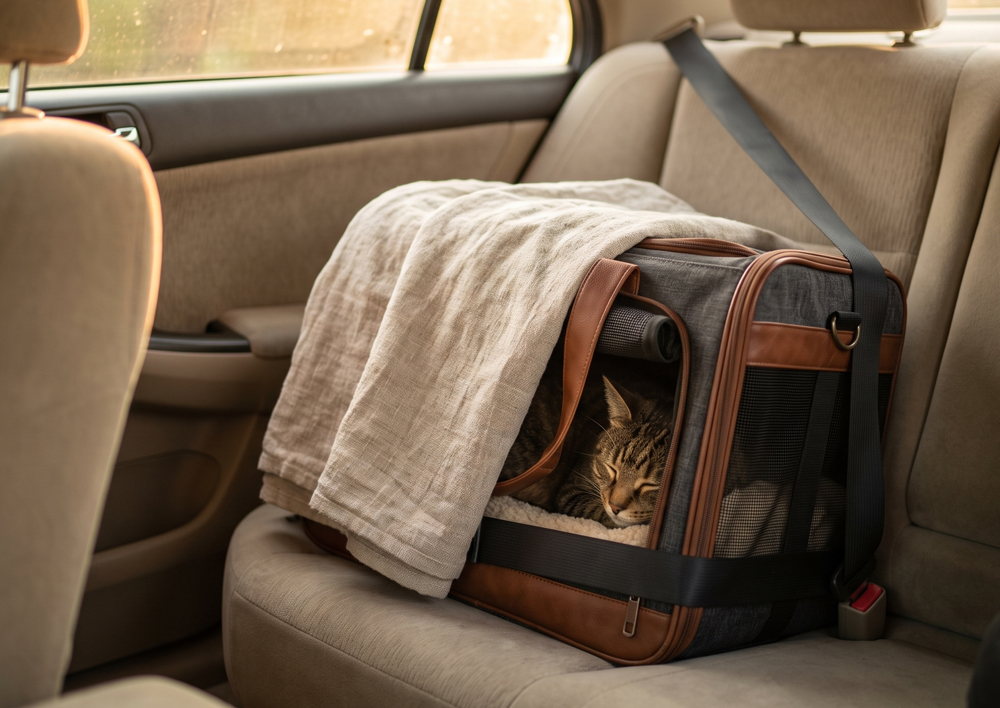
This sounds straightforward until you actually try to prototype it.
A belt route that looks fine in a drawing may interfere with the door.
A buckle that looks convenient may be difficult to reach.
A handle may sit exactly where the belt needs to pass.
Small issues like these show up all the time when a product moves from a screen into a physical prototype.
Is a Seat Belt Route a Good Solution?
It can be.
A carrier with a clearly defined belt route can be a practical way to integrate car use without adding a separate platform.
But the route itself needs attention.
Where does the belt pass? What part of the carrier does it contact? Does it interfere with the opening? Can the user understand the process without having to guess?
These details do not look exciting in a product catalog.
They matter a lot in real use.
The physical design and the instructions also need to agree with each other. If the product says one thing and the carrier naturally encourages another, the user experience becomes confusing.
When Does a Vehicle Base Make More Sense?
A separate base creates a different setup.
The base stays in the vehicle. The carrier becomes the removable part.
That can be attractive for people who travel with their cats often because the same docking action can be repeated every time.
For brands, the bigger advantage may be the architecture.
Once a vehicle base has a defined interface, that same architecture can potentially support more than one carrier.
| Direct Fixing | Carrier + Vehicle Base |
|---|---|
| Fewer components | More system components |
| Simpler starting point | More modular potential |
| Lower initial development complexity | Greater platform flexibility |
| Carrier connects directly to the vehicle fixing method | Base becomes part of the connection system |
| Works well for a focused product | Can support a broader product line |
There is no reason to use a base just because the word “modular” sounds impressive.
A base adds cost. It adds parts. It adds tooling and packaging considerations.
It has to earn its place.
Does the Docking Experience Matter?
Very much.
The hardware can work perfectly and still create a poor user experience.
Picture someone using the carrier every weekend. They get into the car. They put the carrier down. They have to find the right strap, move it around another part, adjust it, and check everything again.
Technically, the carrier may be secure.
The experience can still feel annoying.
A good docking system is easier to understand. The user knows roughly where the carrier goes and what action comes next.
This is one of those things that become obvious during prototyping. Once people actually put their hands on the product, awkward movements show up very quickly.
That is why a docking point is not only a hardware detail.
It is part of the user experience.
What Type of Cat Carrier Is Best for Car and Everyday Travel?
The most useful carrier for both car and everyday travel is one that treats the car as part of the full journey rather than as a separate feature.
For combined use, I think a carrier that remains easy to carry outside the vehicle while also offering a practical vehicle interface and, when useful, compatibility with other mobility products.

Think about a normal trip.
The cat starts at home.
The carrier moves to the car.
The car takes them somewhere.
Then the carrier comes out again.
Maybe the destination is a vet clinic. Maybe it is a hotel. Maybe it is a friend's house.
The car is only one part of the trip.
That is where a modular carrier starts to make sense.
Can One Carrier Work Across Several Travel Modes?
Yes, and this is where a product can become much more interesting.
The carrier remains the core piece.
A vehicle base can handle the car.
A stroller frame can handle longer walking.
A simple handle can handle short-distance carrying.
The customer does not need to change carriers just because the travel mode changes.
| Travel Situation | Possible Configuration |
|---|---|
| At home | Carrier |
| Walking to the car | Carrier |
| Driving | Carrier + vehicle interface |
| Walking after parking | Carrier or carrier + stroller |
| Longer trip | Carrier + stroller |
The value is not really in having five functions.
It is in avoiding unnecessary transfers.
For a pet owner, moving the cat from one product to another can become a hassle. A system that lets the same carrier move through different stages of a trip has a clearer reason to exist.
Does More Function Always Mean a Better Product?
Not really.
This is where multifunction products sometimes go off track.
A carrier starts with one useful idea. Then somebody adds wheels. Then more pockets. Then more clips. Then another adapter. Then a folding feature.
The product keeps growing.
At some point, the owner needs an instruction manual just to understand how to use it.
That is not what I mean by modular design.
A good modular system has a reason behind each component.
The carrier carries.
The vehicle interface connects the carrier to the car system.
The stroller handles mobility.
The connections tie those parts together.
That is enough.
More parts do not automatically create more value.
Sometimes the better product is the one that does fewer things but does each one properly.
What Is the Best Cat Carrier for Car Travel and Stroller Use?
For brands that want car and stroller functions in the same product line, a detachable carrier with a planned docking architecture offers a much stronger starting point than simply adding wheels to a normal carrier.
A strong car-and-stroller carrier keeps the carrier useful on its own while using a planned interface to connect with a vehicle base and stroller frame.

This is where the difference between an accessory and a product system becomes clear.
A stroller attachment can be added to an existing carrier.
But when the original carrier was never designed for that connection, compromises can appear everywhere.
The attachment point may sit too low.
The handle may interfere with the frame.
The balance may feel wrong.
The carrier may be easy to remove but strangely difficult to put back.
None of that is visible in the first product drawing.
It usually becomes obvious during prototyping.
Can One Carrier Become the Center of a Product Family?
That is one of the most useful possibilities.
The carrier becomes the core product.
A customer might buy only the carrier.
Another customer might add a vehicle base.
Another might choose the stroller.
The same core product can then support different levels of use.
For a brand, that creates a very different kind of product line.
Instead of developing a carrier, a stroller, and a vehicle accessory as completely separate products, the team can build around a shared architecture.
That can also make future development easier.
A second carrier size, a new base, or another mobility platform may be possible without starting the whole project again.
Of course, that only works when the original architecture has been planned well.
What Needs Attention Before the First Prototype?
This is where I would spend more time in the early development stage.
Not on the logo.
Not on the color.
Not even on the fabric.
I would first make sure the core connections make sense.
| Development Area | Questions Worth Asking |
|---|---|
| Vehicle interface | Where exactly does the carrier connect? |
| Fixing | What method is used to keep the intended position? |
| Docking | Can the user understand the connection quickly? |
| Structure | Are the connection areas designed for their intended function? |
| Stroller | Does the carrier connect without making the stroller awkward? |
| Modularity | Can one carrier work across different travel modes? |
| Prototyping | Have people tried the real actions, not just looked at drawings? |
| DFM | Can the product be manufactured consistently at the target volume? |
| Tooling | Can the structure support later changes? |
| Product line | Can the architecture support more than one SKU? |
These questions also change the way I think about differentiation.
A new color is easy to add.
A new print is easy to add.
Another pocket is easy to add.
A completely different way of moving the carrier from the car to the street is much harder to copy.
That is where functional differentiation starts to become valuable.
When Does a Cat Carrier Become a Modular Travel System?
There is no special moment when the product suddenly becomes “modular.”
The change happens in the way the product is developed.
The carrier has defined connection points.
The base has a specific role.
The stroller has another role.
The interfaces are planned together.
That is already a system.
At Anvoya, this way of thinking comes naturally from the kind of projects we work on. Our development work covers structural components, hardware, molding, tooling, prototypes, and soft-goods integration.
That mix changes the questions we ask.
Instead of asking only how the carrier looks, we also look at what happens when the parts meet each other.
Does the carrier sit correctly?
Can the user connect it without a lot of trial and error?
Can the same architecture support another product later?
Can the factory produce the connection points consistently?
These are not glamorous questions.
They are often the questions that decide whether a product is actually ready for mass production.
For a brand that already sells traditional pet carriers, this can open a different path.
The next product does not have to be another carrier with a slightly different fabric.
It could become a vehicle-ready carrier.
The stroller does not have to remain a separate category.
It could become part of the same travel system.
And the carrier does not have to end up as one more SKU sitting on a retailer's shelf.
It can become the center of a product family.
Before starting the next project, I would come back to a few basic questions:
| Question | What It Tells You |
|---|---|
| Was the carrier designed around car travel? | Whether the vehicle is really part of the product concept |
| Is the fixing method clear? | Whether the car function is properly developed |
| Was docking planned from the beginning? | Whether modular development is realistic |
| Does the carrier still work outside the car? | Whether it supports the full journey |
| Can it connect to a stroller? | Whether another travel mode is possible |
| Can the architecture support future products? | Whether the idea can grow into a family |
| Is the differentiation functional? | Whether the product offers something beyond appearance |
When I hear the question, “What is the best cat carrier for car travel?”, I do not think about one particular shape or material.
The more useful place to start is the journey.
What happens before the drive?
What happens inside the car?
What happens after the car stops?
Once those questions are clear, the product direction becomes much easier to see.
A carrier that can be placed in a car is one thing.
A carrier developed around vehicle use, clear fixing, practical docking, and the rest of the journey is something else.
For a pet brand, that difference can be the beginning of a much more interesting product line.
Conclusion
The best cat carrier for car travel is built around the journey, with a practical vehicle interface, clear docking, everyday portability, and room for modular product development.
FAQ
Can I Use a Regular Cat Carrier for Car Travel?
Yes, a regular cat carrier can be used for some car trips, but it was not always designed around the conditions of a moving vehicle. The main question is how the carrier is positioned and secured inside the car.
A carrier that works well for carrying a cat from the house to the vet may not offer a clear solution for keeping the carrier in a stable position during the drive. This difference becomes more important when the carrier is used frequently.
For occasional travel, a standard carrier may be enough for some owners. For brands developing a dedicated car-travel product, the vehicle interface deserves much more attention.
Is a Soft Cat Carrier Good for Car Travel?
A soft cat carrier can work well for car travel, especially when portability and everyday use are important. The challenge comes when the product also needs a defined fixing or docking system.
Soft materials are flexible, light, and easy to handle. Those are useful qualities outside the car. Inside the vehicle, though, the design may need additional structure around connection points.
That does not rule out soft carriers. A hybrid construction can sometimes make more sense, with rigid components used where the interface needs more support and softer materials used in the main carrier body.
Should a Cat Carrier Have an ISOFIX or LATCH Connection?
An ISOFIX or LATCH-based connection can be considered for a pet travel system, but the right solution depends on the vehicle interface, product architecture, and the testing behind the specific design.
The important point is not to add ISOFIX or LATCH simply because the terms are familiar to consumers. The entire connection needs to be designed as a system.
For product teams, that means looking at the base, carrier, connection points, release mechanism, vehicle compatibility, and user instructions together. Claims about performance or safety also need to match actual testing and certification.
Is a Cat Carrier With a Base Better for Car Travel?
A separate vehicle base can make sense when a brand wants a more structured and repeatable car-travel experience. The carrier can be removed while the base stays in the vehicle.
This setup also creates more possibilities for modular product development. One base may potentially work with more than one compatible carrier or travel configuration, depending on the original architecture.
The trade-off is extra cost, components, tooling, and packaging. A base adds value when it solves a real use problem. It is not automatically better simply because the product has more parts.
Can the Same Cat Carrier Be Used in a Car and on a Plane?
A carrier can sometimes be designed for more than one travel environment, but car travel and air travel create different product requirements.
Airline carriers often have restrictions related to dimensions, ventilation, construction, and airline-specific policies. Car travel introduces a different problem around positioning and vehicle interfaces.
For a product brand, trying to make one carrier satisfy every travel requirement can create compromises. It often makes more sense to define the primary use first and then see which other functions can be added without making the core product worse.
Is a Detachable Cat Carrier Better Than a Traditional Pet Stroller?
A detachable carrier can offer a different kind of travel experience because the customer does not necessarily need to move the cat from one container to another when switching between carrying and stroller use.
The important part is the connection between the carrier and the stroller. A detachable design works better when the carrier and frame were developed together instead of treating the stroller attachment as an afterthought.
For brands, this architecture also creates a chance to connect stroller and carrier products into one product family rather than selling two unrelated products.
What Size Cat Carrier Is Best for Car Travel?
The right size depends on the cat and the intended use, but a car-travel carrier also has to fit the available vehicle space and its fixing or docking system.
A carrier that is comfortable for the cat may become difficult to position if it is too large for the intended seating area. A very compact carrier may solve the space problem while making movement and access less practical.
For product development, I would not set the carrier dimensions in isolation. The cat, internal space, vehicle position, interface hardware, opening, and carrying method all influence the final size.
Does a Cat Carrier Need Ventilation for Car Travel?
Ventilation remains important during car travel, but it is only one part of the overall carrier design.
The carrier also needs to work with its position inside the vehicle. Openings, doors, handles, structural components, and any fixing or docking hardware can affect how the ventilation areas are placed.
This is why I would avoid treating ventilation as a separate checklist item. It needs to work together with the rest of the carrier rather than being added wherever there is spare surface area.
What Makes a Cat Carrier Different From a Vehicle-Ready Cat Carrier?
A standard cat carrier is mainly designed around carrying the cat. A vehicle-ready carrier is developed with the car as one of its main use environments.
That difference can show up in the structure, connection points, belt routing, docking system, base, or other vehicle-specific features.
For a pet brand, this distinction is important. A vehicle-ready carrier is not simply a traditional carrier with an extra strap. It can become the starting point for a wider travel system built around the carrier, vehicle interface, and other mobility products.
How Can a Pet Brand Develop a More Differentiated Cat Carrier for Car Travel?
The biggest opportunity often comes from changing the product architecture rather than adding more cosmetic features.
A brand can look at a carrier, vehicle base, stroller frame, and other travel components as parts of one modular system. That creates more room for product variations while keeping a shared core architecture.
At the development stage, I would start with the actual journey. How does the cat move from home to car? How does the carrier connect to the vehicle? What happens after parking? Can the same carrier move into a stroller?
Those questions can lead to a much stronger product concept than simply changing the fabric, color, or number of pockets.