Pet stroller buyers in different markets are not looking for the same product.
A cream-colored stroller with a full cushion and a high frame may look premium in Korea. The same product may feel too bulky or expensive for a European importer.
A clean black stroller may feel practical and easy to sell in Germany, but too plain for a Japanese boutique pet store. A small-wheel urban model may work well in a shopping mall, but feel completely wrong on Nordic gravel roads.
This is why regional product development cannot stop at changing the fabric color.
Regional preference affects the entire product logic: frame height, wheel size, carrier structure, cushion volume, decorative details, packing volume, landed cost, and final retail positioning.
For OEM buyers, the right question is not:
Which pet stroller looks the best?
The better question is:
Which pet stroller makes sense for the target market, sales channel, freight condition, and retail price?
Regional Preference Is More Than Personal Taste
Market preference is often described as an aesthetic issue.
Japan likes this color.
Europe prefers that style.
Nordic buyers want larger wheels.
That is only the surface.
Behind every visible preference is a wider commercial logic.
| Market Factor | How It Affects Product Design |
|---|---|
| Local aesthetics | Color, frame finish, shape, logo and trim details |
| Pet ownership habits | Carrier size, cushion comfort, enclosure and daily-use scenarios |
| Urban lifestyle | Product weight, folding size and maneuverability |
| Road conditions | Wheel size, suspension and frame stability |
| Retail price level | Material selection, feature level and decoration |
| Freight distance | Whether a bulky structure remains commercially practical |
| Container loading | Landed cost and distributor margin |
| Sales channel | Showroom impact versus e-commerce packing efficiency |
| Premium expectations | How much visual detail customers expect at a higher price |
A customer does not evaluate a pet stroller in isolation.
They compare it with their local lifestyle, the products already available in stores, the amount they are prepared to pay, and what “premium” means in that market.
A product can look right in one market and feel completely wrong in another.
Japan and Korea: Soft Luxury and Higher Visual Value
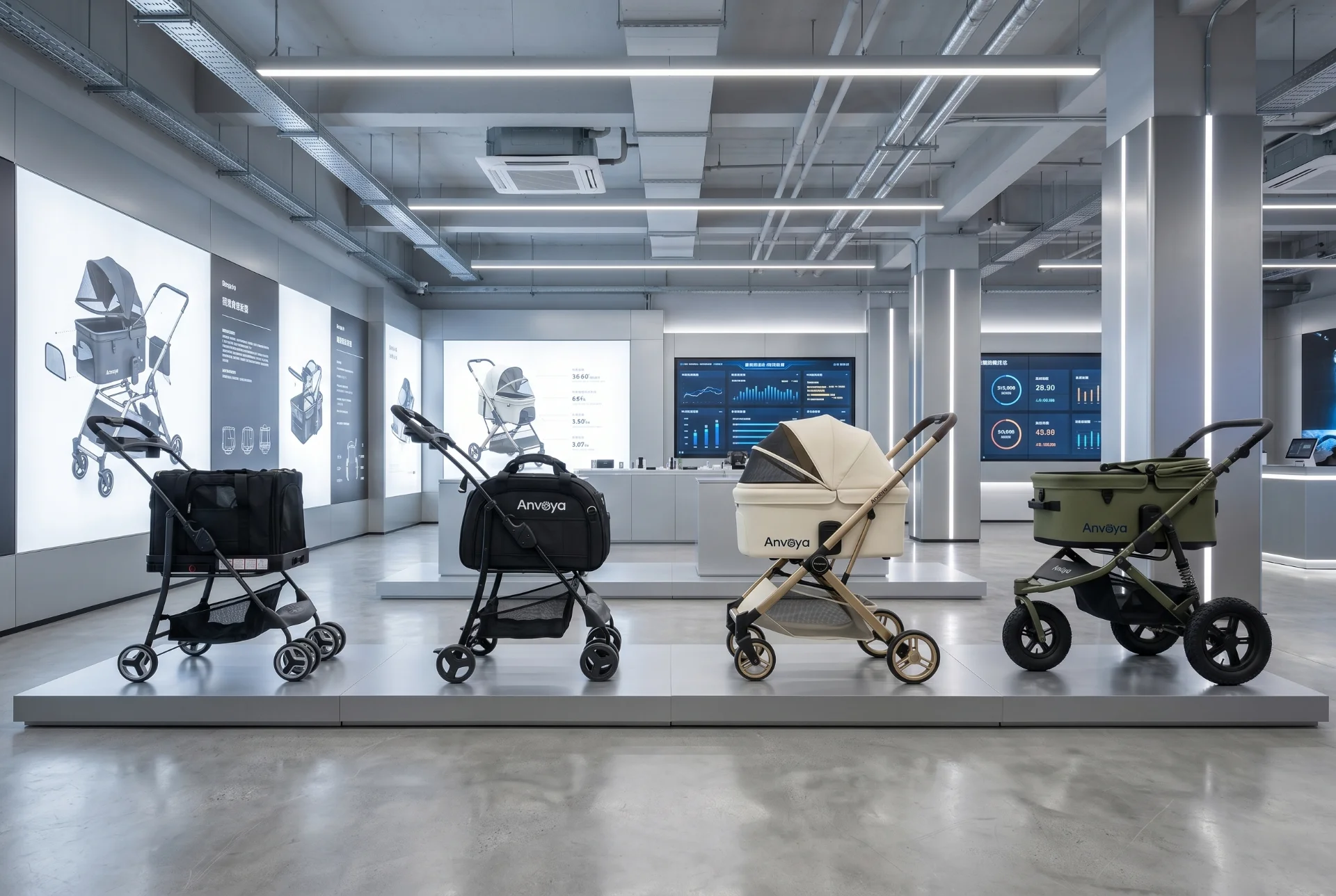
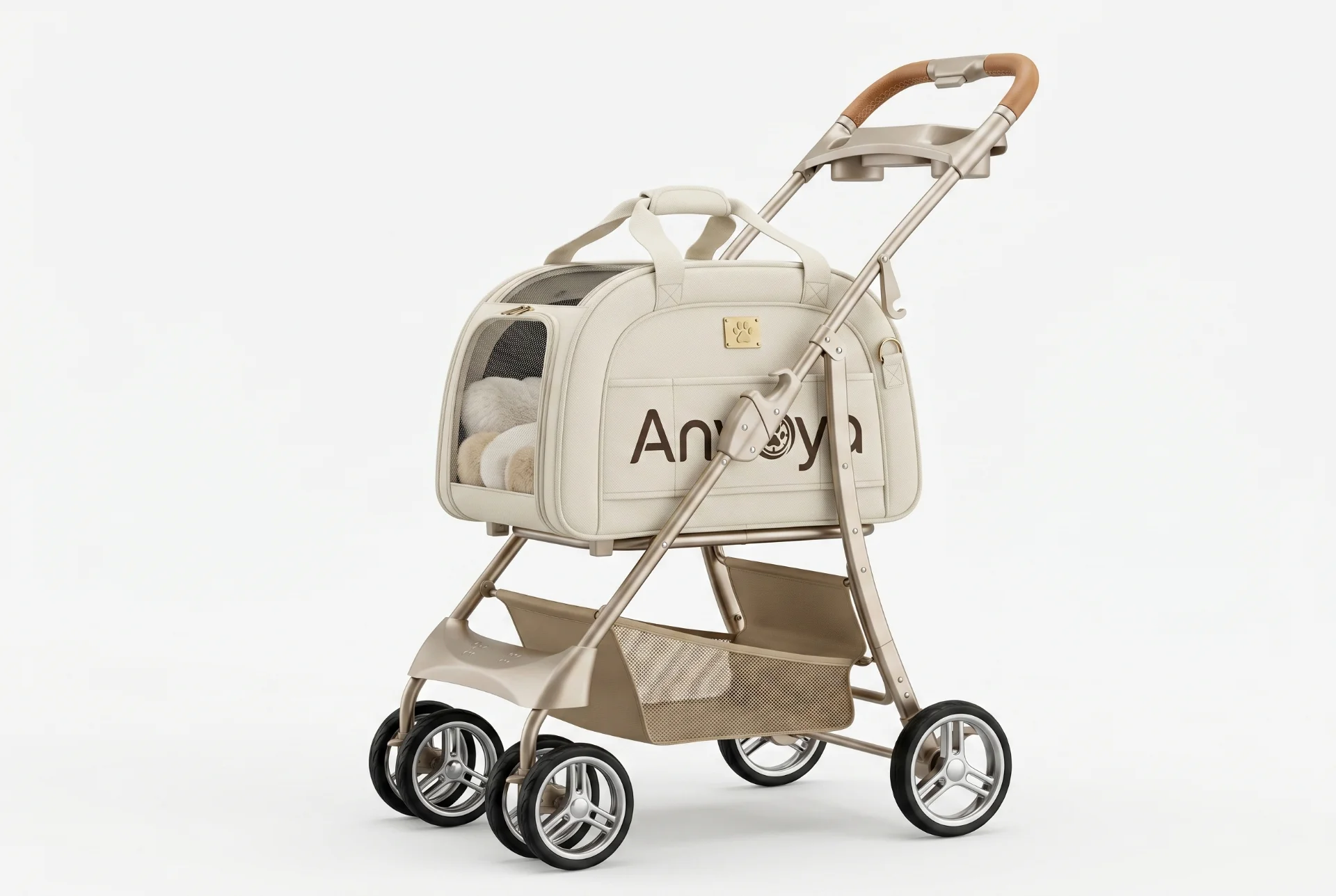
Japan and Korea often prefer a softer and more polished pet stroller style.
Common directions include:
- cream white
- beige
- warm grey
- low-saturation neutral colors
- soft and full cushions
- high-seat stroller frames
- larger wheels
- refined stitching
- metal logo badges
- leather labels
- leather-look handles
- structured but fabric-covered carrier bodies
The overall impression is usually clean, soft and slightly luxurious.
A thin cushion may be functional, but it can look unfinished in this market. A completely soft carrier may be lightweight, but it may not create enough visual value on a retail floor.
That is why many Japanese and Korean products use a carrier body that sits somewhere between a soft bag and a hard shell.
Possible construction methods include:
- PP panels covered with fabric
- PVC structural lining
- reinforced bottom boards
- heat-pressed panels
- thermoformed fabric shells
- padded walls that hold their shape
The goal is not to make the carrier completely rigid.
It is to create a product that looks soft and comfortable while still appearing structured and expensive.
In Japan and Korea, the product often needs to look soft before customers believe it is premium.
Why Bulkier Products Can Still Work in Japan and Korea
This type of design has a clear trade-off.
Full cushions take up space.
Shaped carriers cannot be compressed easily.
Large wheels and high frames increase carton volume.
In other words, these products can become “bulky cargo.”
But Japan and Korea are relatively close to China. Compared with Europe, North America or South America, the shipping distance is shorter and ocean freight pressure can be more manageable.
That does not mean freight cost is unimportant.
It means buyers may have more room to prioritize:
- stronger visual impact
- fuller product proportions
- premium retail presentation
- decorative details
- structured carrier bodies
In Japan and Korea, a bulkier product can still make commercial sense when visual value is strong enough and freight pressure remains manageable.
This is an important product-development lesson.
The preference is not created by logistics, but logistics influence how far the market can afford to follow that preference.
Europe: Clean Design and Rational Premium
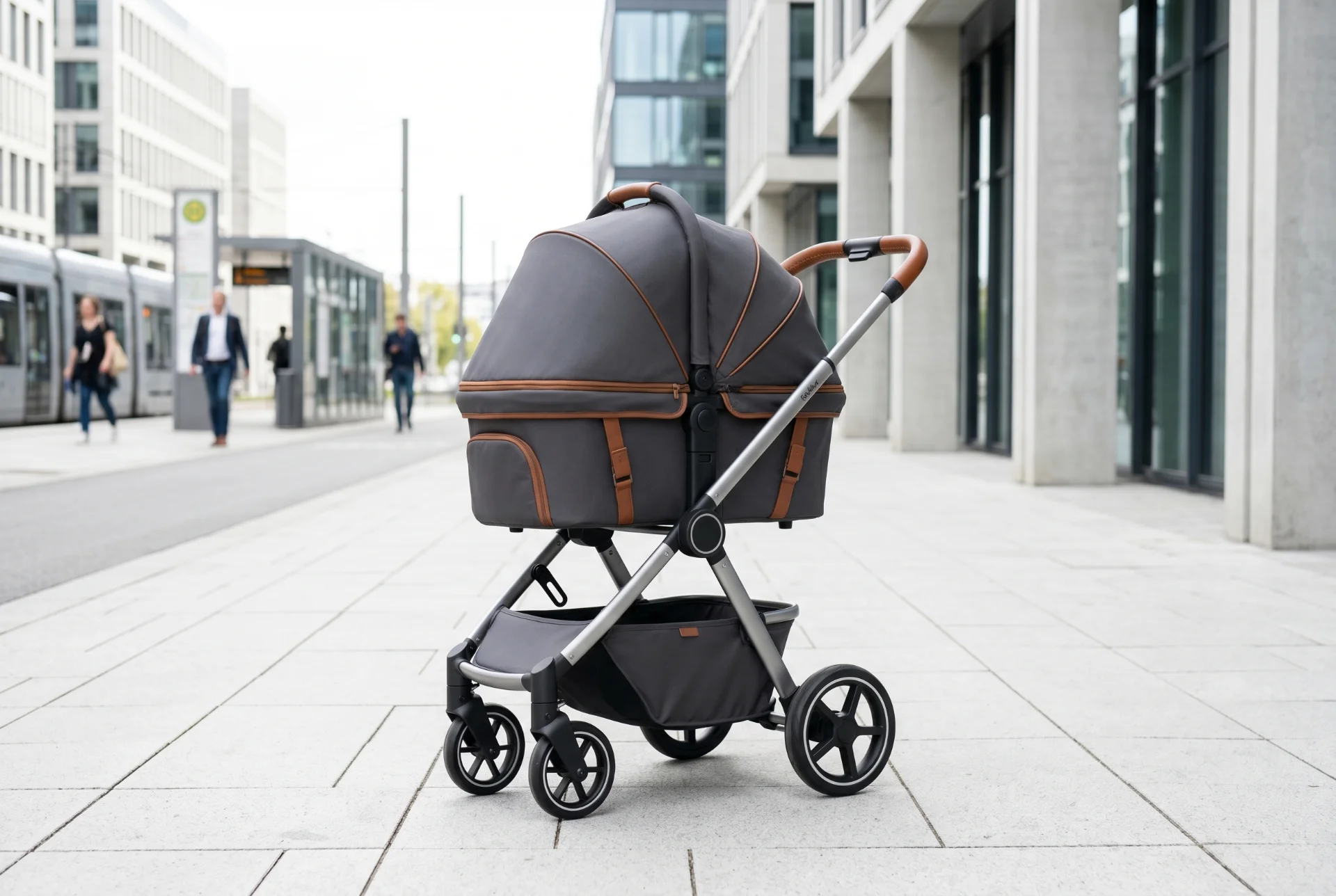
European buyers usually lean toward a cleaner and more restrained design language.
Common colors include:
- black
- charcoal grey
- medium grey
- black-and-white combinations
- muted neutral colors
- increasingly, premium brown and coffee tones
The frame design is often simpler. Branding is usually more controlled. Decorative components need to feel justified rather than added for appearance alone.
A European buyer may still want the product to look premium, but they are more likely to ask:
- Does this feature improve the product?
- Will customers pay for it?
- Does it increase the retail price too much?
- Can the product sell in volume?
- Is the carton size reasonable?
- Is the material easy to clean?
- Does the product offer good value compared with alternatives?
This does not mean Europe is only a low-price market.
It means the product often needs to feel commercially rational.
A metal badge may be accepted. Five decorative trims may not be. A premium brown fabric may work well, but only if the overall product still looks clean and easy to sell.
European buyers often want the product to look premium, but still feel rational.
Why Brown Is Becoming More Relevant
Black and grey remain safe choices because they are easy to sell, easy to match and less likely to look dirty.
However, deeper brown, coffee and warm neutral tones are becoming more useful in premium collections.
They offer an alternative to black without becoming too bright or trend-dependent.
For brands that want to create a more refined European product line, brown can provide premium warmth while keeping the design restrained.
Nordic Markets: Larger Wheels and Outdoor Stability
Nordic markets should not simply be grouped into a general European category.
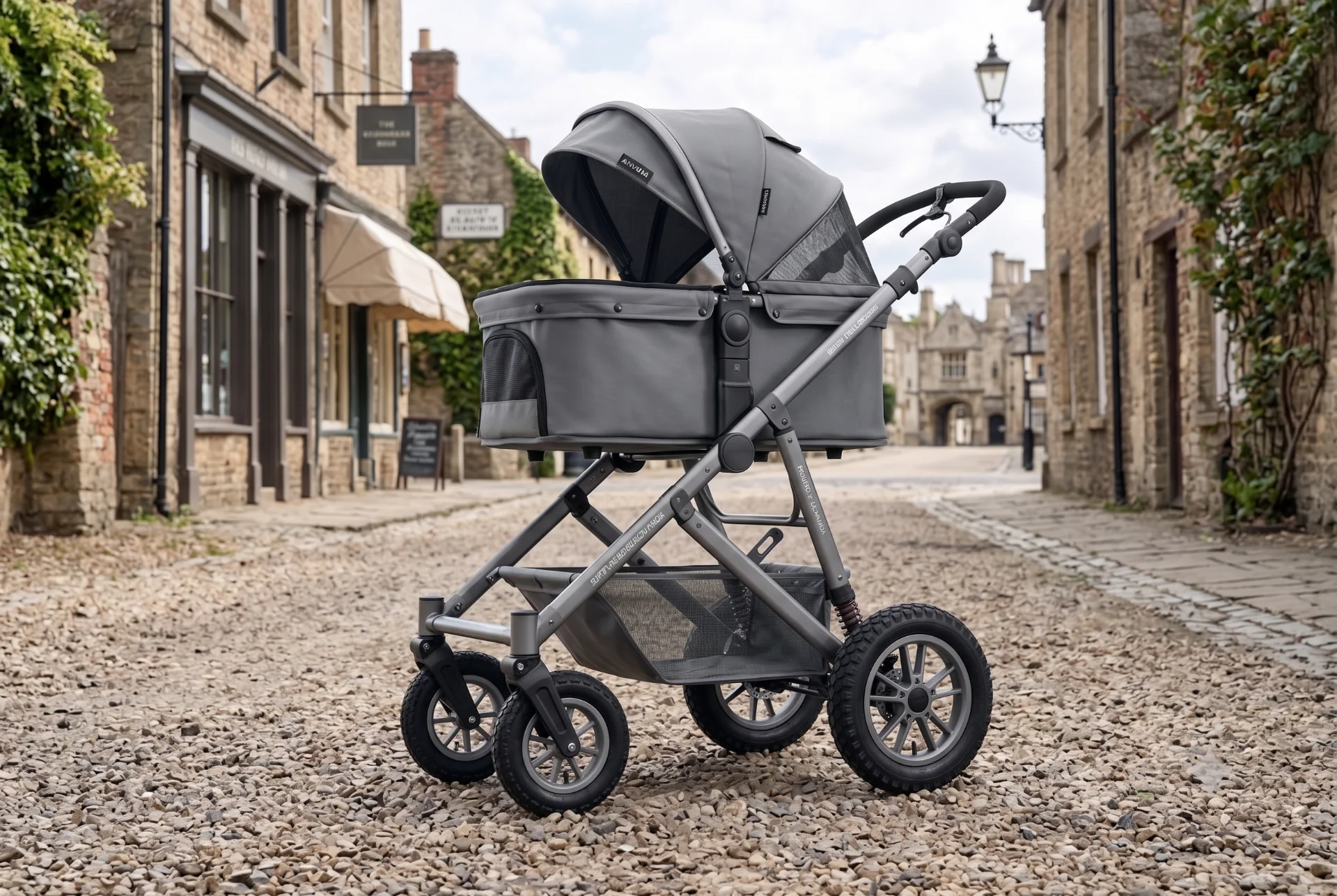
The visual language may still be clean and restrained, but the product requirements are often more outdoor-focused.
Buyers may need to consider:
- uneven roads
- gravel paths
- wet ground
- parks and natural trails
- colder weather
- snow
- longer outdoor walks
- stronger expectations for stability
This usually creates demand for:
- high-seat frames
- larger wheels
- mountain-style wheels
- better suspension
- stronger frame construction
- durable fabrics
- more stable steering
- practical weather protection
A small-wheel stroller may look elegant inside a boutique, but it may not feel convincing on uneven outdoor surfaces.
For Nordic buyers, the first question may not be whether the handle has a leather trim.
It may be whether the wheels can handle the road.
For Nordic markets, wheel performance and outdoor stability can matter more than decorative details.
| Product Area | General European Direction | Nordic Direction |
|---|---|---|
| Wheels | Compact or medium size | Larger, outdoor-ready wheels |
| Frame | Clean and practical | Higher and more stable |
| Suspension | Basic daily use | More important for uneven terrain |
| Colors | Black, grey, brown | Black, grey and natural tones |
| Main use | Urban and mixed use | Outdoor walking and rougher surfaces |
| Buyer priority | Price-value balance | Road handling and durability |
South America: Price Sensitivity and Practical Product Planning
South American markets often require a different calculation.
The product may be affected by:
- long shipping distance
- import duties
- local taxes
- currency fluctuations
- distributor margins
- retail margins
- consumer purchasing power
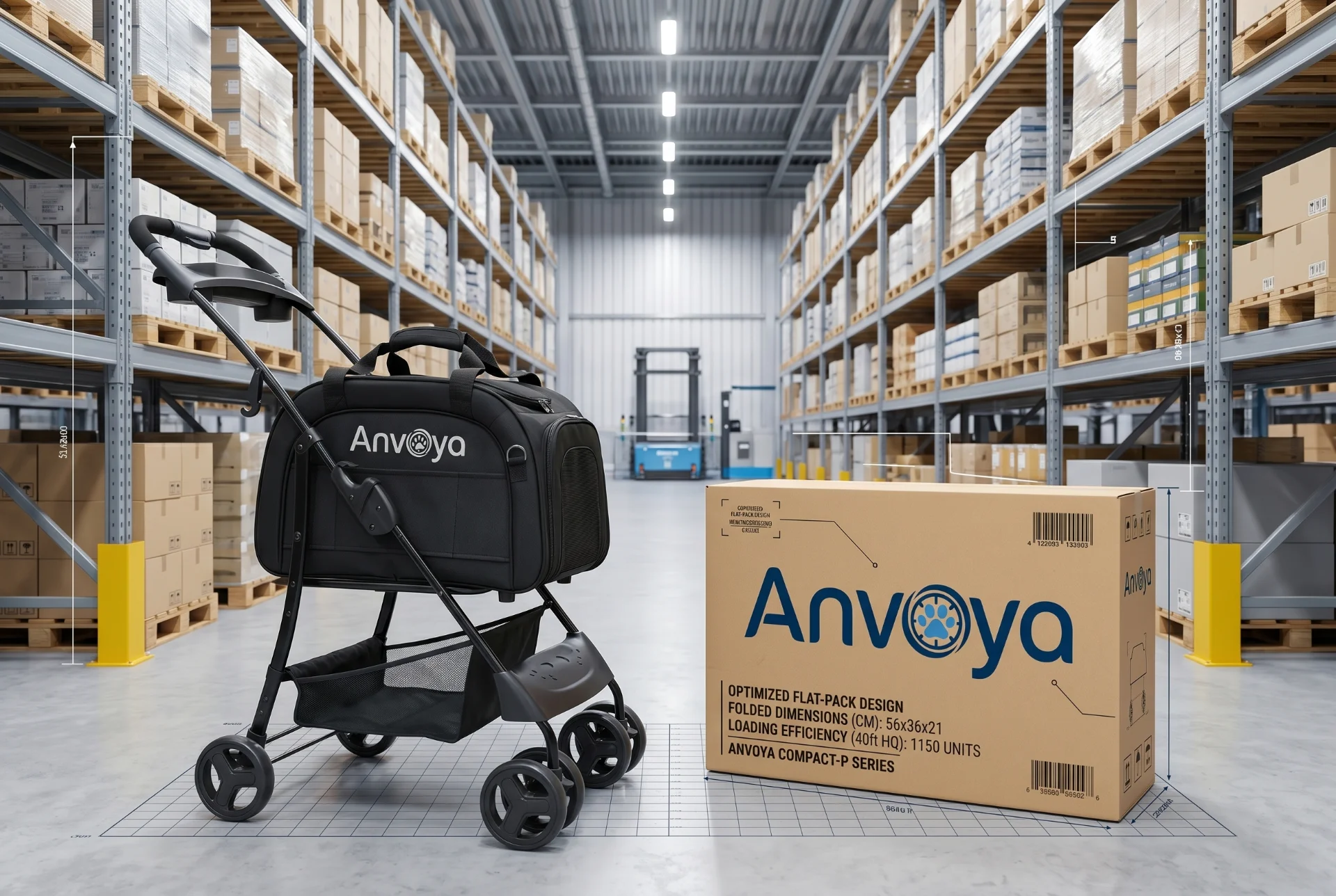
- container loading quantity
A product that leaves the factory at a reasonable price can become expensive by the time it reaches the retail shelf.
That is why product planning should begin with the target landed cost, not only the factory quotation.
Suitable product directions may include:
- simpler frame construction
- controlled carton dimensions
- fewer decorative parts
- practical fabrics
- compact folding
- clear basic functions
- limited color options
- fewer SKUs
- better container loading efficiency
This does not mean the market should only receive cheap products.
A better strategy may be:
- one practical volume model
- one upgraded mid-level model
- one premium hero model for display and brand positioning
The premium product can help establish the category, while the practical product generates the volume.
In price-sensitive markets, the best product is not always the most complete one. It is the one that reaches the right retail price.
A Regional Comparison at a Glance
| Market | Main Visual Preference | Product Focus | Main Business Consideration |
|---|---|---|---|
| Japan & Korea | Cream, beige, grey and soft-luxury details | Full cushions, high frames, larger wheels and structured carriers | Visual value can justify bulkier packing because freight pressure is relatively manageable |
| Europe | Black, grey, clean lines and premium brown | Practical structure, controlled decoration and price-value balance | Premium appearance must still support rational pricing |
| Nordic Markets | Low-key colors and outdoor-ready styling | High frames, larger wheels, suspension and stability | Terrain and road handling have greater importance |
| South America | Practical, simple and price-driven | Cost control, compact packing and clear functions | Landed cost and retail price are critical |
These are broad market patterns, not fixed rules.
Individual brands, retailers and countries can differ. Japan is not identical to Korea. Northern Europe is not identical to Southern Europe. Brazil is not identical to Chile.
But these patterns are useful because they help OEM buyers avoid the most common mistake:
choosing a product before defining the market.
Why Packing Volume Can Change the Entire Product Strategy
Pet strollers are naturally bulky products.
Small changes in structure can create a large difference in container loading.
| Design Choice | Visual or Functional Benefit | Business Trade-Off |
|---|---|---|
| Fuller cushion | Softer and more premium appearance | Larger carton volume |
| High-seat frame | Better view and premium positioning | Lower container loading |
| Larger wheels | Better outdoor handling | More weight and packing space |
| Semi-hard carrier body | More structured, high-end appearance | Less compressible |
| Metal badge | Stronger brand perception | Added cost and production steps |
| Leather-look handle | More refined appearance | Higher material and labor cost |
| Compact folding frame | Better freight efficiency | May limit frame proportions |
This is where a beautiful sample can become a difficult commercial product.
A buyer may love the sample in the showroom. Then the loading calculation arrives.
- How many units fit in a 40HQ container?
- What is the freight cost per unit?
- How much warehouse space does it require?
- Can local e-commerce delivery handle the carton?
- Does the final retail price still make sense?
- Is there enough margin left for the distributor?
A sample can look premium on the table and still fail in the container.
This does not mean every product should be compressed as much as possible.
It means packing efficiency should match the market strategy.
A Japanese premium boutique may accept a lower loading quantity. A South American volume distributor may not.
Offline Retail and E-Commerce Need Different Product Logic
Sales channels also change product preference.
Offline Retail
Physical stores can benefit from:
- fuller cushions
- shaped carrier bodies
- large wheels
- metal badges
- premium handles
- strong visual presence
The product needs to look valuable from several meters away.
A fuller and more structured stroller can help attract attention and justify a higher retail price.
E-Commerce
Online sellers may care more about:
- compact cartons
- warehouse efficiency
- lower delivery cost
- simple assembly
- lower return risk
- clear product photography
- features that are easy to explain online
A product designed for showroom impact may not be the best product for parcel delivery.
The same target market may need two different products depending on whether the main channel is a boutique store or e-commerce.
What Should OEM Buyers Decide Before Development?
Before choosing a fabric or approving a sample, OEM buyers should answer several basic questions.
| OEM Question | Product Decision Affected |
|---|---|
| Which market is the product for? | Overall design direction |
| What is the target retail price? | Material, structure and feature level |
| Is the market visual-driven or price-driven? | Cushion volume, trims and decoration |
| Is the product for urban or outdoor use? | Wheel size, frame height and suspension |
| Will it be sold online or offline? | Packing size and display impact |
| Is it a volume SKU or hero product? | Cost structure and premium details |
| What is the target container loading? | Folding design, cushion and carrier structure |
| Does the brand need private label development? | Color, badge, handle, trim and packaging |
| Is vehicle compatibility required? | Carrier bottom and docking structure |
| Can an existing model be localized? | Development cost and launch time |
The target market should be decided before the product specification.
Not after.
Product development becomes much easier when the buyer knows exactly who the product is for.
Localization Does Not Always Require a New Product
Different markets do not always require completely different tooling or a fully redesigned stroller.
Good localization often means changing the right details.
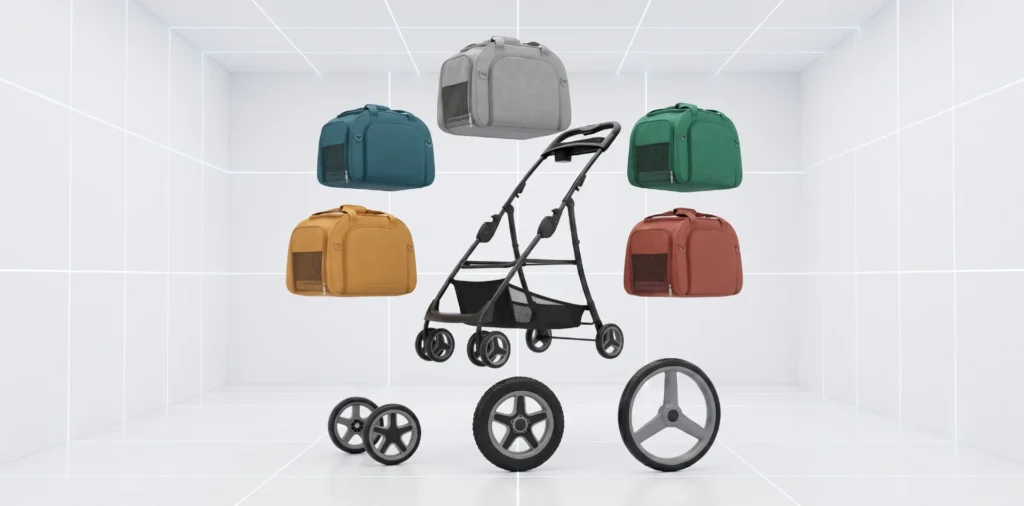
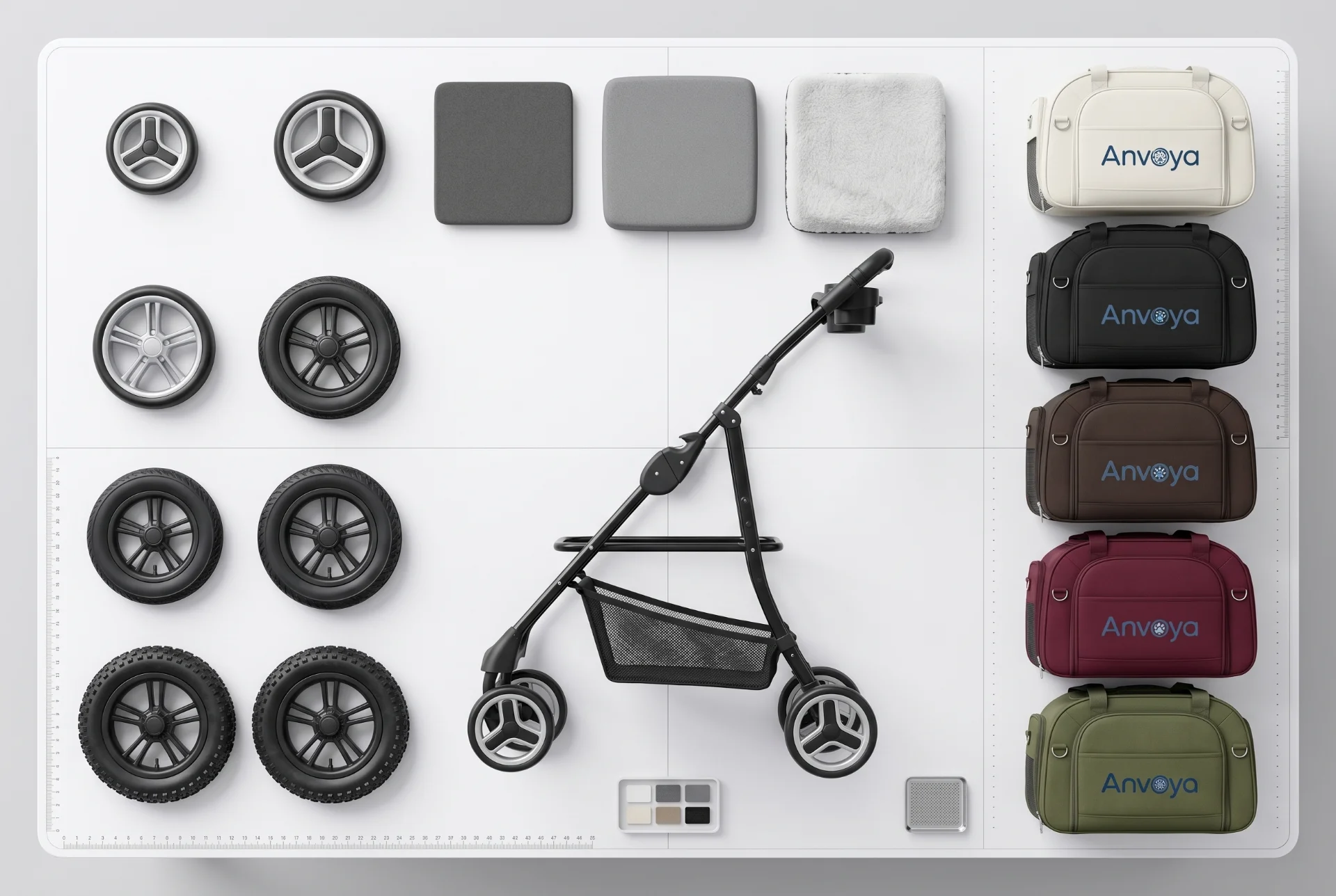
Possible areas include:
- fabric color
- frame finish
- cushion thickness
- carrier stiffness
- wheel size
- wheel style
- handle material
- metal badge
- leather label
- canopy shape
- bottom reinforcement
- packaging
- accessory set
- stroller-to-car docking structure
For example, one base platform may support:
- a fuller, more structured carrier for Japan or Korea
- a simpler black or brown carrier for Europe
- larger wheels for Nordic markets
- a more compact, cost-controlled version for South America
Good localization is not about changing everything. It is about knowing which details carry the most value in each market.
How Anvoya Approaches Regional Product Development
Anvoya does not view OEM development as placing a logo on one fixed model.
A useful pet travel product needs to match the buyer’s market, channel and price position.
That may involve adjusting:
- stroller frame
- wheel configuration
- fabric and colors
- cushion shape
- carrier body structure
- logo and trim details
- packing method
- docking interface
- ISOFIX base compatibility
- private label packaging
For Japan and Korea, the direction may focus more on soft neutral colors, fuller cushions, premium trims and a structured carrier body.
For Europe, the priority may shift toward clean lines, black, grey and brown colorways, controlled decoration and a stronger price-value balance.
For Nordic markets, larger wheels, a higher frame and outdoor stability may become more important.
For South America, the project may need simpler specifications, better loading efficiency and a clear landed-cost target.
The value of OEM development is not making one product for the whole world.
It is helping each buyer build the right product for their market.
Common Mistakes OEM Buyers Should Avoid
Treating regional preference as a color decision
Changing black fabric to beige does not turn a European product into a Korean product.
The cushion, carrier structure, frame height, wheels and trims may also need adjustment.
Choosing from showroom appearance alone
A beautiful product can still have poor loading quantity, awkward handling or the wrong retail price.
Ignoring landed cost
The factory price is only one part of the final product cost.
Long-distance freight, duty, local taxes and distribution margins can completely change the result.
Using one design for every market
A global platform can work.
A single unchanged product is harder.
Over-designing a price-sensitive product
More features do not always create more value. Sometimes they only make the product harder to sell.
Under-designing a visual-driven product
A product can be practical and well made but still look too plain for a premium Asian retail market.
Treating Nordic markets as general Europe
Clean styling may be shared, but road handling and wheel requirements can be very different.
The wrong market match can make a well-made product difficult to sell.
FAQ
Q: Why do pet stroller preferences vary by region?
A: Pet stroller preferences are influenced by local aesthetics, pet ownership habits, terrain, housing, sales channels, retail price levels, freight costs and customer expectations. The differences go far beyond color.
Q: What pet stroller styles are popular in Japan and Korea?
A: Japan and Korea often prefer cream, beige, warm grey and other soft neutral colors. Full cushions, high-seat frames, larger wheels, metal badges, leather-look details and semi-structured carrier bodies are also common.
Q: Why can Japan and Korea accept bulkier pet stroller designs?
A: These markets often place a high value on premium appearance and retail presentation. Their shorter shipping distance from China can also make the freight pressure of bulky products more manageable than in distant markets.
Q: What do European buyers usually look for in pet strollers?
A: European buyers often prefer black, grey and increasingly brown tones, with clean lines, practical structures and limited decoration. Premium appearance matters, but price-value balance remains important.
Q: Why are Nordic pet stroller preferences different from general Europe?
A: Nordic markets often have stronger outdoor-use requirements. Larger wheels, suspension, higher frames and better stability may be more important because of gravel, wet ground, snow and uneven roads.
Q: What should OEM buyers consider for South American markets?
A: Buyers should pay close attention to landed cost, import duty, freight, container loading, local retail prices and distributor margins. Compact packing and clear practical functions are usually important.
Q: Why does container loading matter in pet stroller development?
A: Pet strollers are bulky products. Cushion thickness, wheel size, carrier structure and folding design can significantly change the number of units loaded into a container and therefore the freight cost per unit.
Q: Should brands develop one global pet stroller model?
A: A shared product platform can work, but it usually needs regional adjustments. Fabric, colors, cushions, wheels, trims, carrier stiffness, packaging and accessories may need to change by market.
Q: What parts of a pet stroller can be localized?
A: Common localization areas include fabric color, cushion thickness, frame finish, wheel size, carrier structure, logo badges, handles, labels, packaging, accessories and vehicle docking components.
Q: How does shipping distance affect pet stroller design?
A: Longer shipping distance increases the importance of carton size and container loading. Markets closer to China may have more room to accept bulky premium designs, while distant or price-sensitive markets often need better packing efficiency.
Q: How can Anvoya support regional OEM development?
A: Anvoya can adjust soft goods, carrier structure, stroller frames, wheel configurations, colors, trims, packing methods and vehicle docking systems according to the target market and price position.
Conclusion
A pet stroller is not developed for a map.
It is developed for a specific customer, retail channel, road condition, price level and supply chain.
Regional preference affects far more than appearance. It changes how the product should be designed, packed, positioned and sold.
The best pet stroller design is not the one that tries to please every market. It is the one that knows exactly which market it is built for.