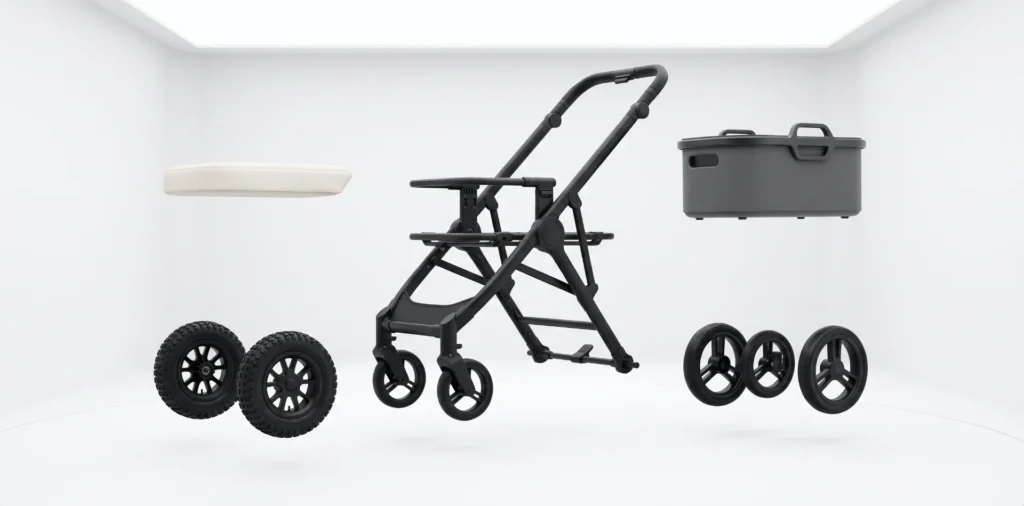
Entering a new market does not always require a new stroller, new tooling, and a completely new supply chain.
In many OEM projects, the smarter route is to keep a proven platform and change the parts that customers will actually notice, use, and pay for.
Good localization is not about changing everything. It is about changing the right things.
A New Market Does Not Always Need a New Product
When buyers talk about localization, the first ideas are often expensive ones:
- a new frame
- new injection molds
- exclusive wheels
- a completely different carrier
- several custom colors
- new packaging
- new accessories
That can quickly increase:
- tooling cost
- sample time
- MOQ
- testing workload
- spare-part complexity
- launch risk
Sometimes a full redesign is necessary. Often, it is not.
A stroller platform may already have the right folding structure, wheelbase, carrier size, and load capacity. The market difference may come from softer colors, a fuller cushion, a different wheel option, better packing, or a more structured carrier body.
In our development work, many projects become easier once the buyer stops asking, “How do we create a completely new product?” and starts asking:
Which parts of the current product do not fit the target market?
That question usually leads to a more practical brief.
Start with the Market, Not the Factory Catalog
A factory catalog shows what already exists.
It does not automatically show what will sell in Japan, Germany, Sweden, or Chile.
The same platform may need different priorities depending on the market.
| Target Market | Localization Priority |
|---|---|
| Japan and Korea | Soft neutral colors, fuller cushions, structured carriers, refined trims |
| Mainstream Europe | Clean lines, black, grey or brown, practical features, controlled cost |
| Nordic markets | Larger wheels, better stability, weather-ready materials |
| Price-sensitive markets | Compact packing, fewer SKUs, clear functions, realistic landed cost |
| E-commerce channels | Smaller cartons, simple assembly, lower delivery risk |
| Boutique retail | Stronger visual impact, premium materials, better display presence |
This does not mean every market needs a separate platform.
It means the product brief should begin with:
- target country
- customer profile
- sales channel
- retail price
- main use scenario
- acceptable carton size
A product should be localized from the market backwards, not from the catalog forwards.
What Can Usually Be Localized Without New Tooling?
A surprising amount of product differentiation can be achieved without opening new molds.
These are often the most practical areas to adjust first.
| Product Area | Typical Localization Options | New Tooling Usually Needed? |
|---|---|---|
| Fabric | Color, texture, coating, water repellency | No |
| Cushion | Thickness, filling, shape, cover | No |
| Branding | Print, woven label, rubber badge, metal badge | Usually no |
| Handle | Fabric wrap, leather-look cover, color | No |
| Frame finish | Black, champagne, grey, custom coating | Usually no |
| Carrier lining | PP, PVC, foam, reinforced panels | Usually no |
| Carrier stiffness | Softer or more structured construction | Usually no |
| Packaging | Carton, manual, hangtag, insert | No |
| Accessories | Rain cover, liner, storage bag | No |
| Wheel option | Existing compatible wheel sizes or styles | Sometimes |
| Carrier bottom | Reinforcement and docking components | Sometimes |
These changes can make the same basic platform feel very different.
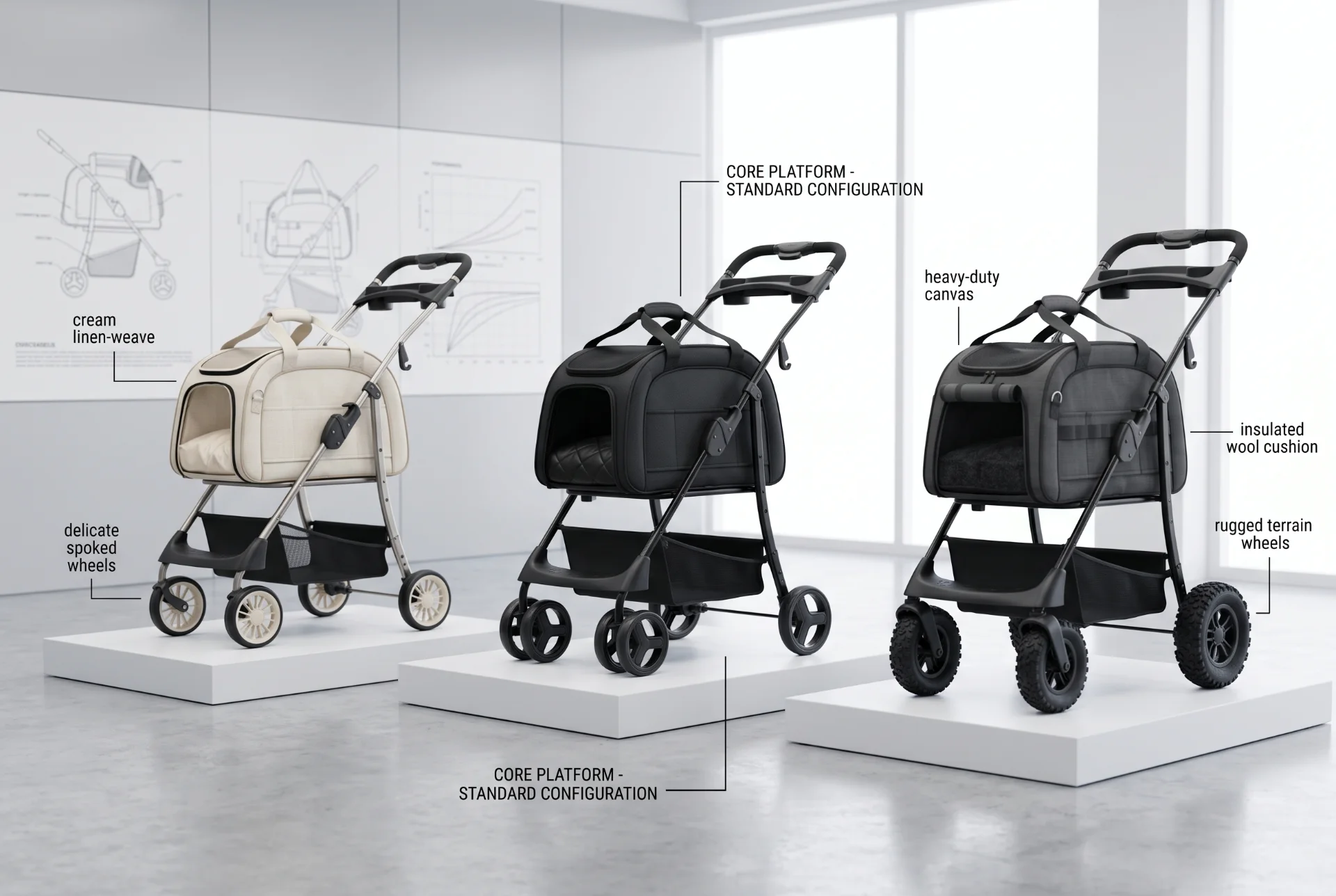
For example, a single stroller frame could support:
- a cream, semi-structured carrier for Korea
- a black, clean carrier for Germany
- a larger-wheel version for Sweden
- a simplified, compact-packed version for Chile
The platform remains familiar to the factory and easier to control. The customer still receives a product designed for the local market.
Color Is the Easiest Change—and the Easiest to Get Wrong
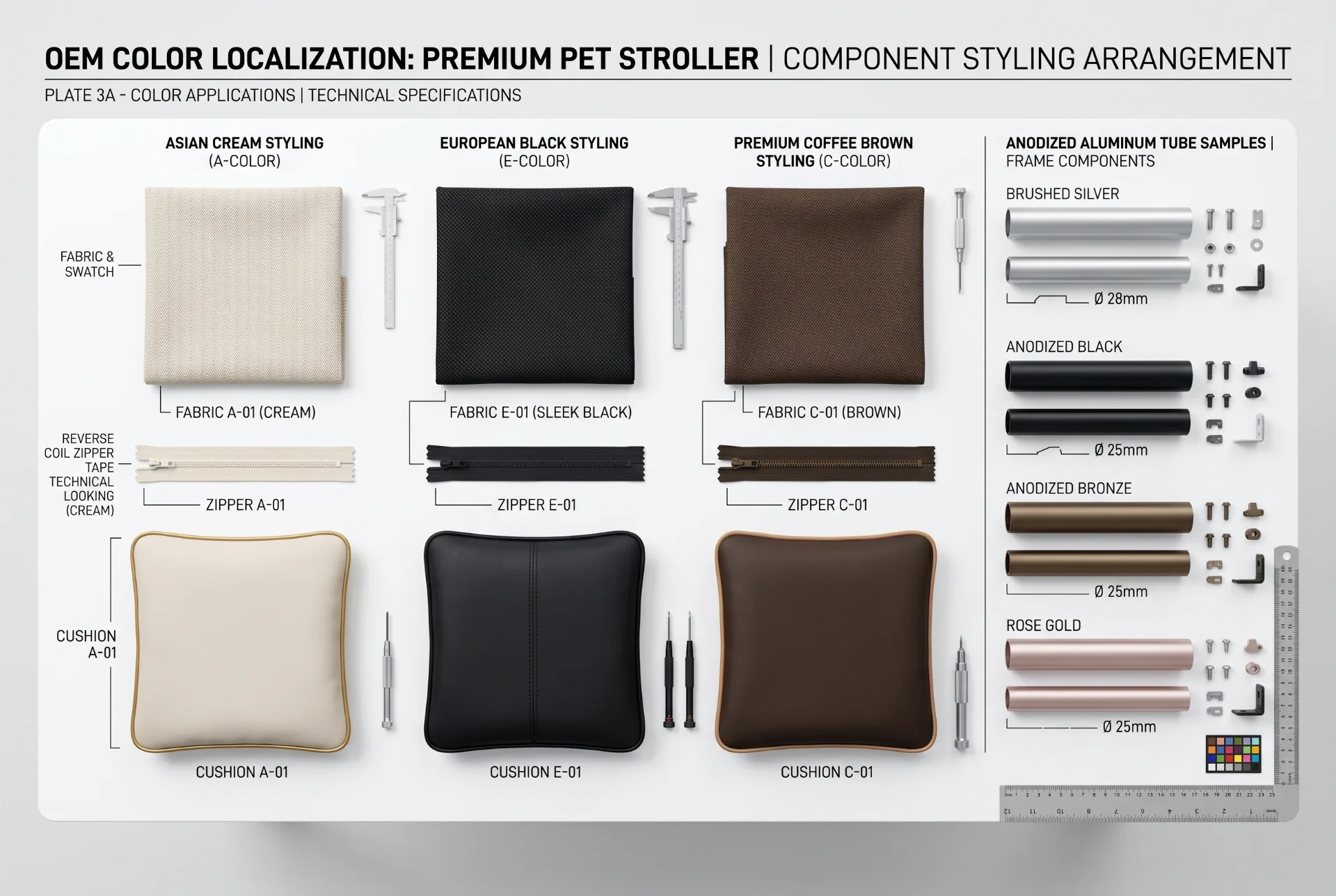
Changing fabric color is simple. Creating the right regional impression is not.
A beige fabric does not automatically create a Japanese or Korean product. A black fabric does not automatically create a premium European product.
The color needs to match:
- frame coating
- zipper tape
- piping
- cushion tone
- handle material
- logo finish
- wheel color
- packaging
In one market, warm grey may feel soft and premium. In another, the same grey may feel too pale or difficult to maintain.
Localization should therefore look at the full color system rather than one fabric swatch.
A color change works only when the whole product speaks the same visual language.
Cushion and Carrier Structure Can Change the Product More Than a New Frame
The soft-goods section often creates the strongest regional difference.
A fuller cushion can make a product feel:
- softer
- more premium
- more suitable for small pets
- stronger in retail photography
A thinner cushion can improve:
- packing efficiency
- internal pet space
- cleaning
- cost control
The carrier body can also be adjusted.
A fully soft carrier may suit a lightweight urban product. A semi-structured carrier may be better for premium retail or stroller-to-car use.
Possible solutions include:
- PP panels covered with fabric
- PVC lining
- foam-supported side walls
- reinforced bottom boards
- thermoformed panels
- removable structural inserts
These changes often do not require a completely new stroller.
They do, however, affect how the carrier sits on the frame and how it connects to a base.
Soft goods may look decorative, but in a pet travel system they are part of the structure.
What Changes Require More Than Surface Customization?
Some requests look simple but change the whole product.
This is where buyers need to separate visual localization from structural development.
Increasing Wheel Size
A larger wheel can affect:
- frame clearance
- brake position
- center of gravity
- folded size
- steering
- carton dimensions
If an existing compatible wheel option is available, the change may be manageable. If not, the frame may need to be modified.
Raising the Carrier Position
A high-view frame can improve product appearance and pet-owner interaction.
It can also increase:
- tipping risk
- frame stress
- folded height
- packing volume
The change needs to be reviewed as a complete structure.
Increasing Load Capacity
A higher weight claim may require changes to:
- frame tubes
- joints
- wheels
- carrier bottom
- locking points
- brakes
Changing the number in the catalog is not enough.
Adding Vehicle Compatibility
Vehicle use affects:
- carrier bottom reinforcement
- docking interface
- locking parts
- base dimensions
- release mechanism
- repeated connection
- hardware-to-soft-goods integration
This cannot be added properly by sewing another strap onto a finished carrier.
A visual change is easy. A structural change needs the whole system to be checked again.
Use a Must Change, Nice to Change, and Later List
Not every localization request deserves the same budget.
A simple three-level list can prevent overdevelopment.
Must Change
These are the changes required for the product to fit the market.
Examples:
- larger wheels for rougher terrain
- controlled carton size for distant markets
- stronger carrier bottom for docking
- target-market colors
- required compliance documents
- correct pet size and load capacity
Nice to Change
These improve market fit but are not essential for the first order.
Examples:
- metal badge
- leather-look handle
- custom cushion stitching
- exclusive accessory color
- premium packaging insert
Change Later
These can wait until the market has been tested.
Examples:
- exclusive frame tooling
- fully custom wheel mold
- several original colors
- new injection parts
- a complete accessory collection
| Priority | Development Question |
|---|---|
| Must change | Will the product be difficult to sell or use without this change? |
| Nice to change | Will the customer notice and pay for it? |
| Change later | Can this wait until demand is proven? |
This approach is especially useful for first orders.
Localization should reduce market risk, not replace it with development risk.
Platform-Based Development Keeps the First Project Manageable
A stable platform gives OEM buyers a better starting point.
It can reduce:
- tooling investment
- sample lead time
- minimum order pressure
- spare-part complexity
- production risk
- future upgrade cost
The visible product can still change through:
- fabric
- color
- cushion
- branding
- carrier stiffness
- wheels
- accessories
- packaging
This is the logic behind modular development.
One platform can support several products without forcing every version to start from zero.
For distributors, this also makes future expansion easier. A successful first model can later gain:
- another carrier
- a different stroller frame
- upgraded wheels
- new accessories
- a vehicle base
- replacement parts
A good platform does not limit customization. It makes customization more commercially realistic.
Existing Pet Carriers Can Also Be Localized and Upgraded
Some brands already have a successful pet carrier.
They may not need a new carrier design. They may only need to make the current product more useful.
Possible upgrades include:
- reinforcing the bottom
- adding a docking interface
- adjusting the carrier shape
- adding stroller connection points
- installing a tube adapter on an existing stroller
- improving handle balance
- adding vehicle-base compatibility
This is particularly valuable when the brand already has:
- proven sales
- recognizable styling
- established fabrics
- customer reviews
- existing packaging
- a working supplier base
The goal is not to replace the bestseller.
It is to give the bestseller another reason to sell.
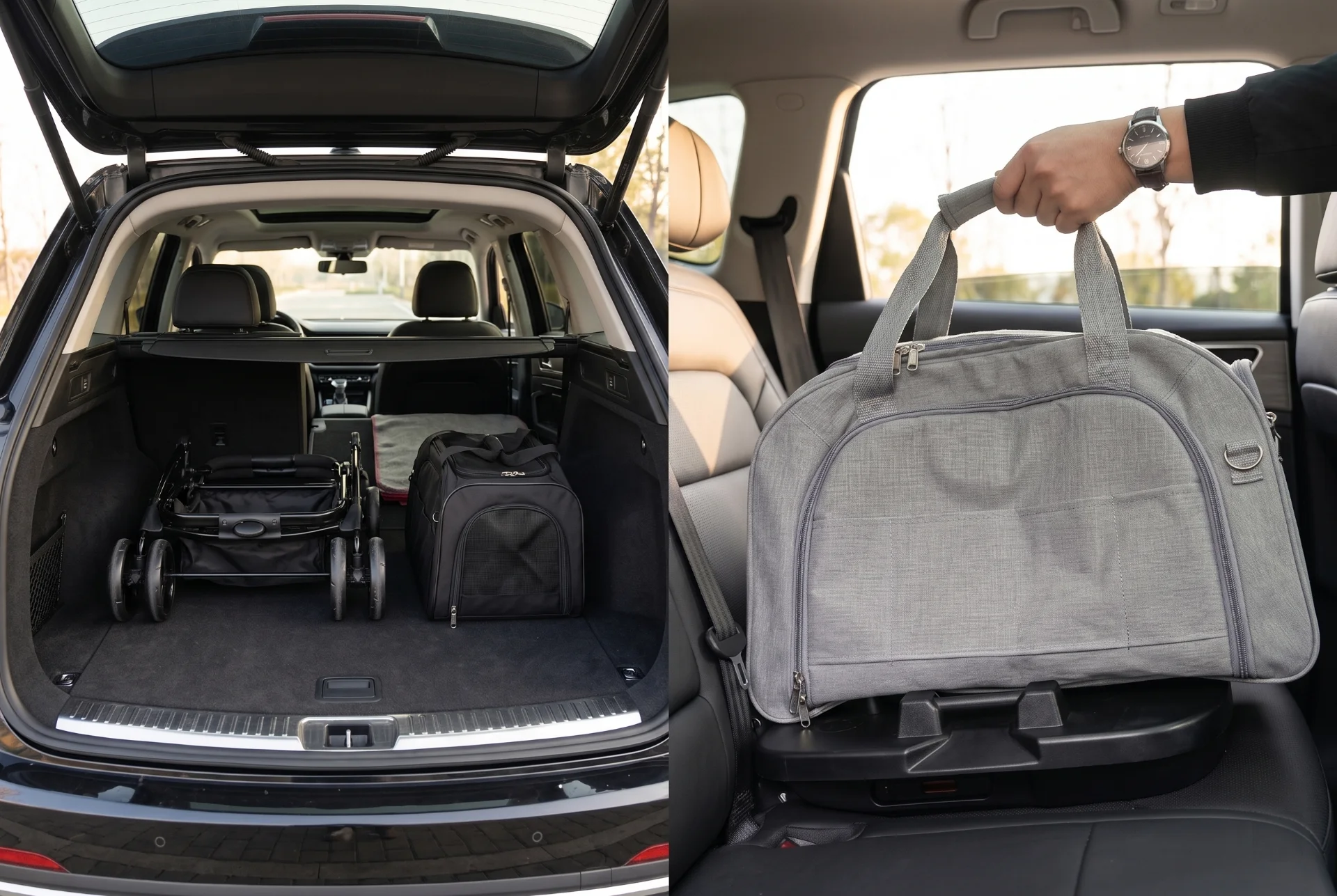
For example, an existing carrier can keep its current look while gaining compatibility with BASE-X through a controlled bottom modification and docking component.
That lets the brand enter the vehicle-ready category without rebuilding its whole soft-goods line.
Where AERO and BASE-X Fit
Anvoya uses two different product-development paths because buyers do not all start from the same place.
AERO: A Ready Lightweight Platform
AERO is suitable for buyers looking for:
- a lightweight small-pet system
- cat and small-dog positioning
- carrier, stroller, and car-use functions
- faster market entry
- regional fabric and branding adjustments
The base product logic is already defined. Localization can focus on:
- colors
- cushions
- soft-goods details
- logo methods
- packaging
- market positioning
BASE-X: A Platform for Existing Products
BASE-X is more suitable for brands that already have:
- a pet carrier
- a stroller-carrier combination
- an established design language
- a bestseller they do not want to replace
The existing product can be evaluated for:
- bottom reinforcement
- docking parts
- stroller adaptation
- ISOFIX base compatibility
- future carrier expansion
AERO helps buyers localize a ready system. BASE-X helps brands turn their own product into a system.
When Is New Tooling Actually Worth It?
Avoiding new tooling is not always the right answer.
New tooling can make sense when:
- the market has already been tested
- the order volume supports the investment
- the structural difference is meaningful
- exclusivity is important
- the existing platform creates a clear limitation
- the new design can become a long-term brand asset
Examples may include:
- an exclusive docking part
- a new base shape
- a proprietary wheel
- a new folding component
- a distinctive carrier shell
- a patented connection structure
The key is timing.
A buyer should not use tooling to guess what the market wants.
Tooling is more valuable after the market has shown what is worth protecting.
Tooling should follow market proof, not replace it.
A Practical Localization Process
A useful OEM process can stay simple.
Step 1: Define the Market
Confirm:
- country
- customer type
- retail price
- sales channel
- main use scenario
Step 2: Review the Existing Platform
Check:
- frame
- wheels
- folding
- load capacity
- carrier size
- docking structure
- carton dimensions
Step 3: List the Gaps
Identify what does not fit the target market.
Avoid adding changes just because they are possible.
Step 4: Separate Visual and Structural Changes
Visual changes may include color, fabric, trims, and packaging.
Structural changes may include wheels, frame height, load, docking, and vehicle use.
Step 5: Set the First-Order Limit
Confirm:
- tooling budget
- MOQ
- carton target
- number of colors
- development schedule
Step 6: Sample the Full Product
Do not approve the fabric, frame, carrier, and wheels separately.
Review how they work together.
Step 7: Test the Real Use Scenario
A Nordic product should be tested outdoors.
A vehicle-ready product should be tested through repeated docking.
An e-commerce product should be reviewed for packing and assembly.
The sample should prove the market fit, not just the factory’s ability to make the parts.
What OEM Buyers Should Confirm Before Sampling
| Question | Why It Matters |
|---|---|
| Which market is the product for? | Defines the localization direction |
| What is the target retail price? | Limits the final specification |
| What is the main sales channel? | Changes display and packing needs |
| Which features must change? | Protects market fit |
| Which changes are optional? | Controls development cost |
| Is new tooling acceptable? | Affects MOQ and lead time |
| What is the carton limit? | Protects freight efficiency |
| Is vehicle compatibility required? | Changes carrier and docking structure |
| Can existing parts be reused? | Reduces risk and cost |
| Is this a trial launch or mature line? | Determines how much customization is justified |
| Are replacement parts required? | Supports after-sales planning |
| What future upgrades are expected? | Helps select the right platform |
How Anvoya Supports Regional Localization
Anvoya does not treat localization as changing one fabric color.
Different markets may require different combinations of:
- stroller frames
- wheel configurations
- carrier structures
- cushion styles
- soft-goods materials
- docking parts
- vehicle bases
- branding
- packaging
A Japanese or Korean project may need softer colors and fuller cushions.
A European project may need cleaner styling, better packing, and controlled cost.
A Nordic project may need larger wheels and stronger outdoor stability.
A price-sensitive project may need fewer SKUs, better container loading, and a simpler first configuration.
The same product does not need to look or perform the same way everywhere.
At the same time, every regional version does not need to start from zero.
Anvoya’s role is to keep the proven parts, change the market-critical parts, and avoid unnecessary development wherever possible.
Common Localization Mistakes
Changing Only the Color
Color matters, but proportion, cushion, structure, wheels, and branding may matter just as much.
Customizing Before Defining the Retail Price
The project can become too expensive before the market position is clear.
Opening Tooling Too Early
Tooling increases commitment before demand has been proven.
Ignoring Packing
A localized product can still fail if carton size destroys the landed cost.
Treating Every Market as One Customer
Japan and Korea share some preferences, but they are not identical. Europe is even more varied.
Adding Vehicle Compatibility at the End
Vehicle use needs early structural planning.
Approving Parts Instead of the Whole Product
A good fabric, wheel, frame, and carrier can still become a poor system if they do not work together.
The smartest localization project is often the one that says no to unnecessary changes.
FAQ
Q: Does pet stroller localization require new tooling?
A: Not always. Fabric, colors, cushions, branding, packaging, carrier stiffness, and some wheel options can often be adjusted without new molds.
Q: What can be changed with a low development budget?
A: Buyers can usually adjust fabric, logo, labels, cushions, handles, packaging, accessories, and selected soft-goods structures.
Q: When does a wheel change require structural development?
A: A larger wheel may affect frame clearance, brakes, steering, center of gravity, folding, and carton size. The full frame should be reviewed.
Q: Can an existing pet carrier be upgraded for stroller or car use?
A: In many cases, yes. The carrier may need bottom reinforcement, docking parts, frame adapters, or vehicle-base compatibility.
Q: What is the difference between visual and structural localization?
A: Visual localization changes appearance. Structural localization changes how the product supports weight, moves, folds, locks, or connects.
Q: Why is platform-based development useful?
A: It reduces tooling cost, sample time, MOQ, spare-part complexity, and future upgrade risk.
Q: When should a buyer invest in new tooling?
A: New tooling is more suitable after demand is proven, volume is clear, and the new structure creates meaningful long-term value.
Q: How can AERO be localized?
A: AERO can be adjusted through colors, cushions, fabrics, branding, packaging, and regional positioning for cats and small pets.
Q: How can BASE-X support an existing product?
A: BASE-X can work with suitable carriers through bottom reinforcement, docking components, stroller adaptation, and ISOFIX base compatibility.
Q: What should buyers confirm before requesting a sample?
A: The target market, retail price, sales channel, required changes, optional changes, tooling budget, carton limit, and future upgrade plan should be clear.
Conclusion
Localization does not need to begin with a blank page.
A proven frame, carrier, or platform may already solve most of the product problem. The real work is identifying which details prevent it from fitting the target market.
Keep what already works.
Change what the customer will notice.
Develop new tooling only when the market justifies it.
The smartest OEM project is not the one that changes everything. It is the one that changes exactly what the market will notice and pay for.