In our work with distributors, one pattern appears again and again: buyers may be genuinely interested in premium pet travel products, but the project stops when the numbers reach the local market.
The factory price may still look acceptable. Then ocean freight, import duty, local tax, distributor margin, retailer margin, and currency risk are added. By the time the product reaches the shelf, it is no longer positioned where the buyer expected.
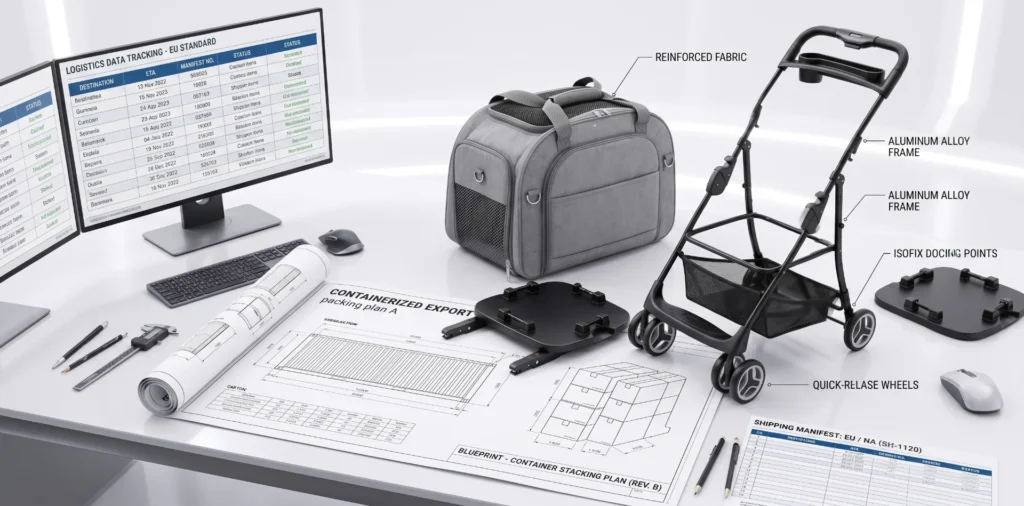
This happens easily with pet strollers and modular pet travel systems. They are bulky products, and every additional feature affects more than the quotation.
Larger wheels increase carton volume.
Thicker cushions take up space.
A more structured carrier costs more to build and packs less efficiently.
A vehicle base adds real product value, but it also needs the correct docking structure and cannot simply be treated as another accessory.
A buyer may ask for all of these features because each one makes sense on its own. Put together, however, they can make the first order commercially impossible.
We learned this especially clearly from a project in Chile.
The customer had already worked as a distributor for a major juvenile-products brand and understood premium strollers very well. They wanted to enter the pet category, but the branded distribution price was simply too high for the local market.
The idea stayed on hold.
Not because the customer doubted the pet category.
Not because the product was unattractive.
The business model simply did not work at the final retail price.
That distinction matters.
Price-sensitive markets do not necessarily reject premium products. They reject products whose final price no longer matches the market.
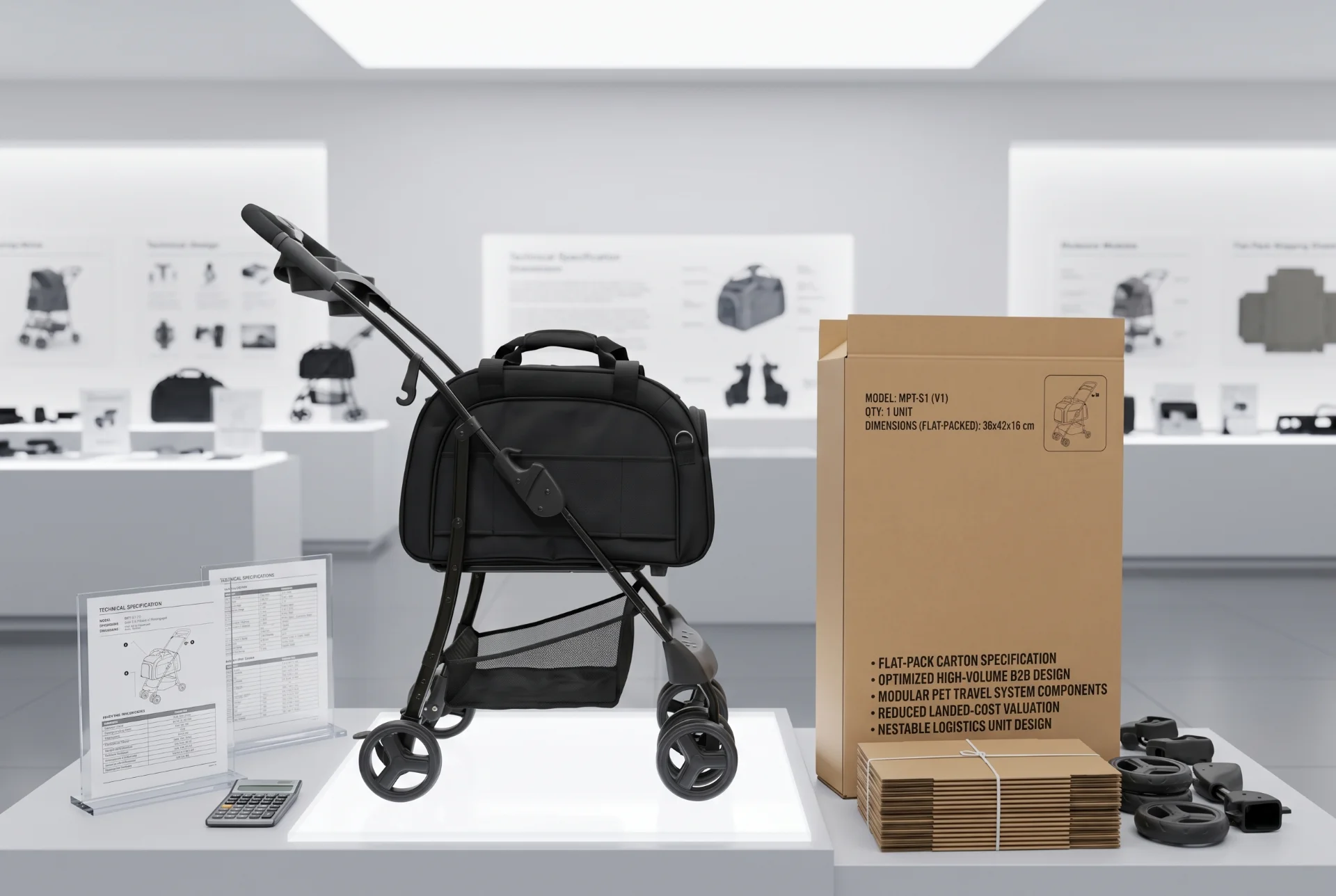
The Real Problem Is Usually Not the Factory Price
When buyers say a product is too expensive, it is tempting to focus only on reducing the unit price.
That can be the wrong starting point.
The actual product cost continues to grow after it leaves the factory.
| Cost Layer | What It Changes |
|---|---|
| Factory price | Initial product cost |
| Ocean freight | Especially important for bulky strollers |
| Import duty and local tax | Raises the landed cost |
| Warehousing | Large cartons require more space |
| Local delivery | Bulky products cost more to move |
| Distributor margin | Supports local sales and service |
| Retailer margin | Determines whether stores will carry it |
| Currency fluctuation | Can quickly reduce expected profit |
| After-sales cost | Returns and replacement parts create hidden expense |
A lower factory price does not automatically solve these problems.
A stroller that saves two dollars in material but loads poorly may become more expensive after freight. A cheaper wheel that creates after-sales complaints may cost the distributor far more than the original saving.
This is why price-sensitive product development should begin with a broader question:
What specification can reach the right retail price without removing the reason customers would buy it?
The cheapest quotation and the lowest total business cost are often two different things.
Start with the Retail Price and Work Backwards
In real projects, buyers often begin by choosing a product they like and then ask the supplier to reduce the price.
That process usually becomes frustrating.
The frame has already been selected.
The wheels are already fixed.
The carrier structure is already defined.
The cushions, accessories, and packaging have already been added.
At that point, cost reduction becomes a series of compromises.
A better development process starts from the market:
- What retail price can the customer realistically accept?
- What margin does the retailer need?
- What margin does the distributor need?
- What are the likely freight, duty, tax, and warehouse costs?
- What factory cost remains available?
- Which product features must fit within that limit?
This approach changes the discussion.
Instead of asking, “How do we make this premium model cheaper?” the buyer can ask:
Which parts of the system create enough value to keep, and which parts are not necessary for the first launch?
That question leads to better products.
A price-sensitive product should be designed from the market backwards, not cut down from an overloaded sample.
Cost Control Should Not Remove the Product Logic
There is always a point where cost reduction begins to damage the product itself.
A pet stroller can use a simpler logo.
It can offer fewer colors.
Its cushion can be less oversized.
Some accessories can be sold separately.
But certain parts should not be weakened simply to reach a lower quotation.
These include:
- frame stability
- reliable locking
- smooth wheel movement
- reasonable load capacity
- sufficient ventilation
- stable carrier support
- practical cleaning
- secure carrier-to-frame connection
- clear and repeatable user operation
This is where product-development experience matters.
We have seen projects where the buyer focused heavily on saving visible material cost but ignored structural details that customers would feel every day. The result looked acceptable in photographs but felt loose, awkward, or unreliable in use.
That is not real value engineering.
Cost reduction should remove unnecessary complexity, not the structure customers depend on.
What Can Be Simplified Without Making the Product Feel Cheap?
The answer depends on the target customer, but a useful starting point is to separate features into three groups: keep, simplify, or make optional.
| Feature | Direction | Why |
|---|---|---|
| Frame stability | Keep | Core product value |
| Reliable locking points | Keep | Affects daily use and confidence |
| Ventilation | Keep | Essential for pet comfort |
| Stable carrier bottom | Keep | Supports stroller and vehicle use |
| Washable cushion | Keep or simplify | Practical benefit without needing excessive thickness |
| Metal badge | Simplify | Printed, woven, or rubber branding may be enough |
| Leather-look handle | Optional | Useful for premium positioning, not every SKU |
| Oversized wheels | Market-dependent | Adds cost and packing volume |
| Extra-thick padding | Simplify | Can increase cost and reduce container loading |
| Multiple accessories | Optional | Can be added after demand is proven |
| Too many colors | Reduce | Creates MOQ and inventory pressure |
| Custom tooling | Delay where possible | Standard platforms lower launch risk |
The important word here is simplify, not remove.
A thinner cushion can still be comfortable.
A simpler logo can still look professional.
A standard frame can still carry a distinctive private label identity.
But a weak docking point cannot be rescued by a nicer hangtag.
Packing Volume Can Matter More Than Small Material Savings
Pet strollers are naturally bulky.
This is especially important in markets far from China, where freight can significantly affect landed cost.
A few design details can reduce loading quantity very quickly:
- large non-removable wheels
- high frames
- thick cushions
- rigid carrier walls
- oversized canopies
- wide wheelbases
- unnecessary separate accessories
- packaging that leaves too much empty space
In our experience, buyers sometimes spend too much time negotiating fabric cost and too little time reviewing carton dimensions.
That can be backwards.
Reducing one dollar from the fabric may look good in the quotation. Improving the folding structure or removing wheels for packing may save more per unit after shipping.
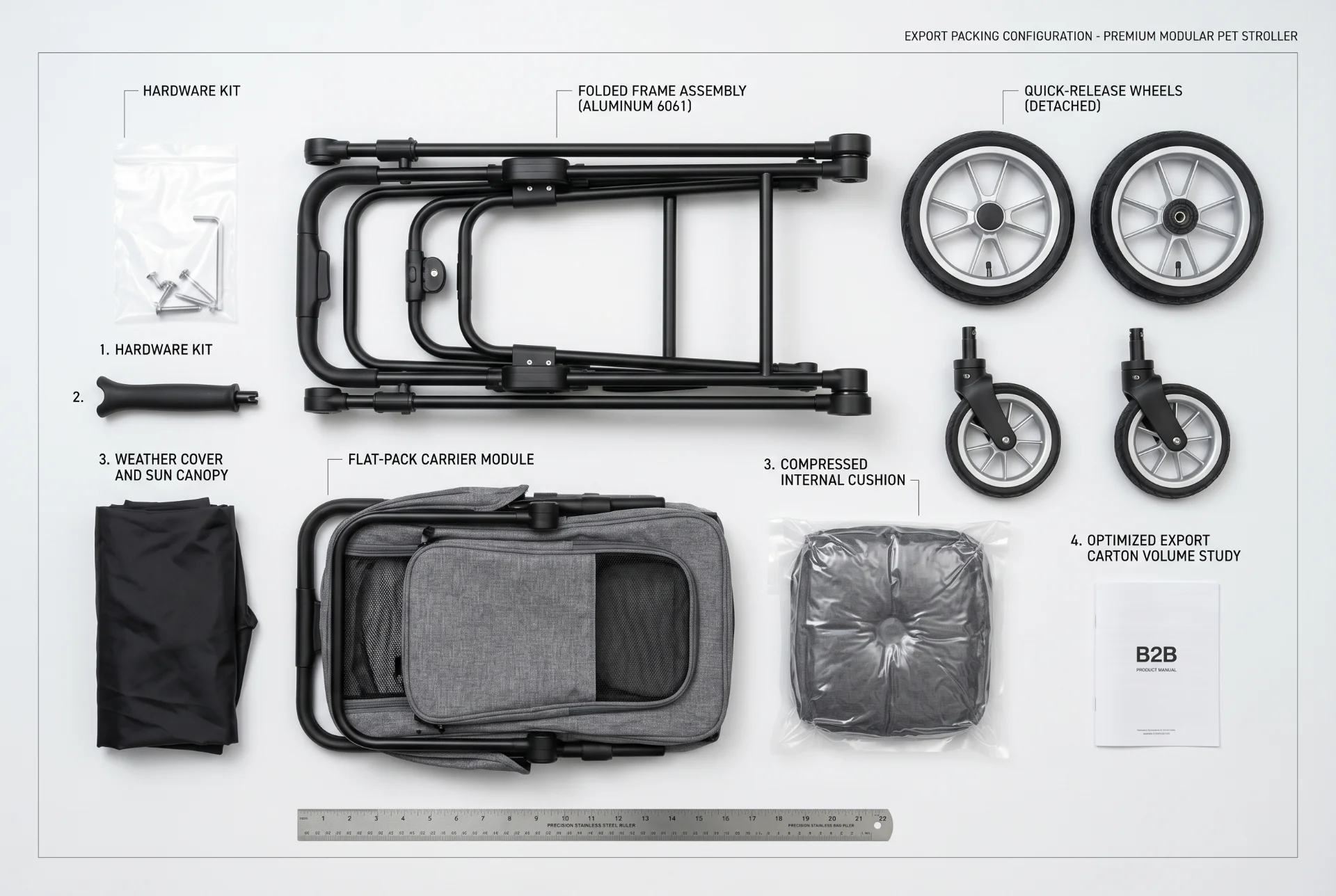
Possible solutions include:
- removable wheels
- more compact frame folding
- compressed cushion packing
- a controlled semi-structured carrier instead of a fully rigid body
- simplified canopy construction
- fewer loose accessories
- better use of carton space
For distant markets, reducing carton volume can create more value than saving one dollar on fabric.
The First Range Does Not Need to Be Large
Price-sensitive markets often come with another risk: buyers try to launch too much at once.
Several colors.
Several stroller frames.
Multiple carrier sizes.
A long accessory list.
Different packaging for each SKU.
It may look like a complete collection, but it also creates:
- larger MOQ pressure
- more inventory
- slower-moving colors
- more complicated replenishment
- more replacement parts
- more cash tied up before demand is proven
For a new category, a focused launch is often more useful.
A practical first range might include:
- one main stroller configuration
- one primary color
- one secondary color
- one carrier specification
- a limited accessory set
- one premium hero product to show the direction of the category
The first order should teach the buyer something.
Which color moves faster?
Do customers understand the vehicle-use function?
Is the removable carrier more important than larger wheels?
Does the market respond to a full system or prefer a simpler entry point?
A focused trial order gives better answers than a large launch built on assumptions.
Price-Sensitive Does Not Mean the Range Should Look Cheap
One mistake is to serve the entire market with only a low-end product.
That may bring the entry price down, but it also makes the category harder to explain and limits the retailer’s ability to trade customers up.
A healthier structure is often:
- an entry model for basic demand
- a stronger middle model for volume
- a premium hero system for category education
The entry model gives customers access.
The middle model may offer better wheels, a removable carrier, or improved materials.
The premium model can introduce vehicle compatibility, modular use, or a more complete travel-system story.
This is where platforms such as BASE-X become useful.
The buyer does not need to place the complete premium configuration into every SKU from the beginning. BASE-X can sit at the top of the line or be introduced after the basic category begins to move.
Premium still has a role in a price-sensitive market. It simply needs to be used strategically.
A Chilean Project Made This Especially Clear
One of our Chilean customers had previously distributed a major juvenile-products brand.
That background mattered.
The customer already understood stroller quality, structured product systems, retail presentation, and the value of a recognizable brand. Moving into pet travel was not a random idea. It was a logical extension of an existing business.
But the branded pet products available through that channel were too expensive for the local market.
Once distribution price, freight, import cost, and retail margin were added, the product landed too high.
The customer did not want to enter the category with a very basic pet stroller. That would have removed the differentiation they were looking for.
At the same time, copying the full premium-branded specification would have kept the project stuck.
So the real development task was not:
How do we make the cheapest stroller possible?
It was:
How do we keep the travel-system value while making the first market entry commercially realistic?
We Rebuilt the Offer Around the Market
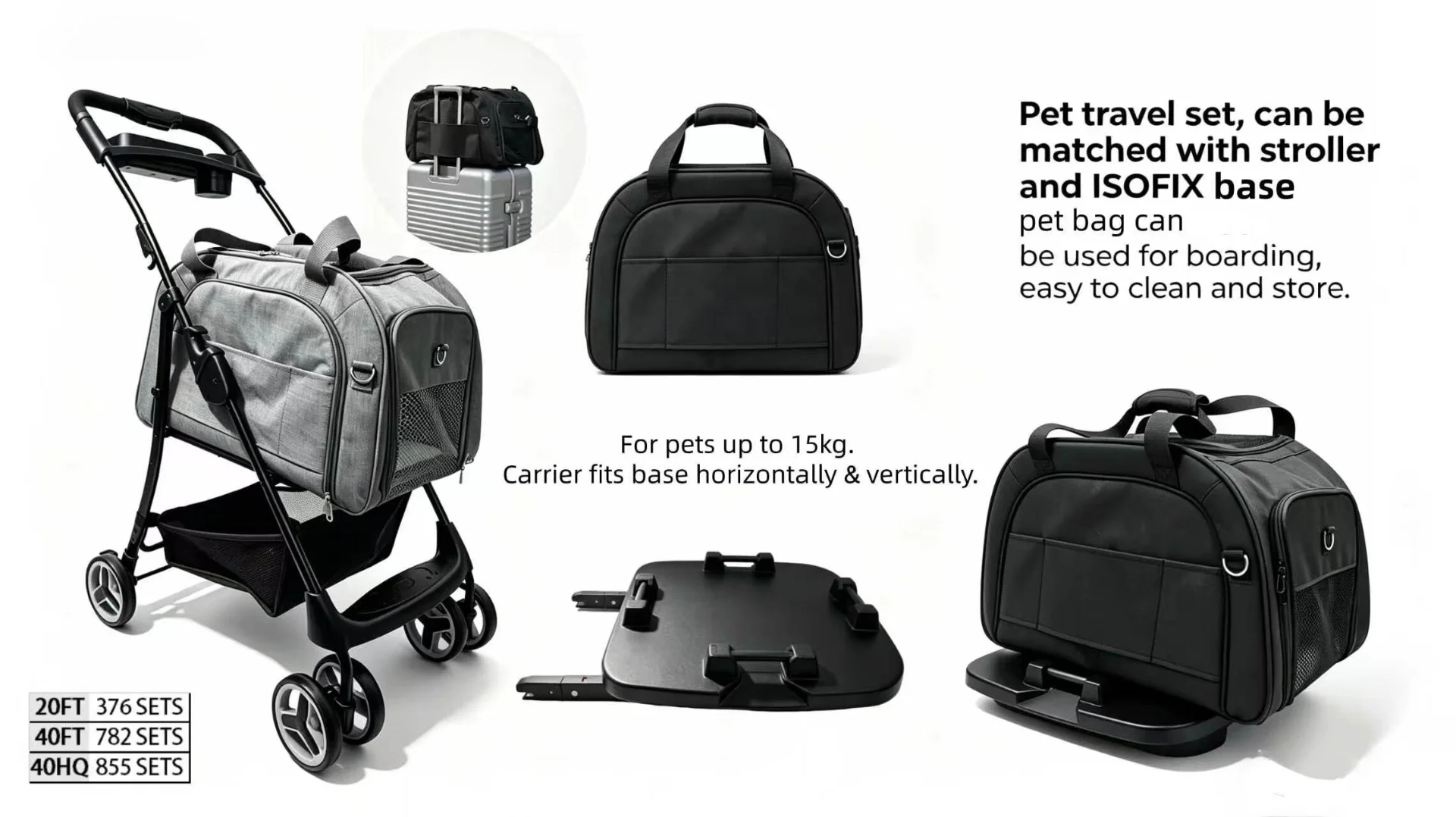
Anvoya developed a configuration using BASE-X together with a stroller and carrier, then adjusted the specification around the Chilean market.
The project kept the important parts:
- a recognizable stroller and carrier system
- a clear vehicle-use function
- modular product logic
- professional product appearance
- room for future product expansion
At the same time, we controlled parts that did not need to be fully premium in the first order:
- decorative complexity
- unnecessary trim cost
- excessive SKU variation
- specifications that pushed the product above the target price
- details that added more visual cost than commercial value
The stroller, carrier, and BASE-X were not treated as three unrelated products. The configuration was planned as a market-entry system.
That allowed the customer to offer something clearly more differentiated than a basic stroller without carrying the full price burden of the original premium brand.
The Decision Changed Once the Product and Market Matched
When the adjusted specification and pricing were presented, the customer did not need a long sales process.
They placed a trial order to test the market.
That reaction told us something important.
We did not convince the customer to want the pet category. We changed the product structure until the category became commercially possible.
The customer already had interest, experience, and a route to market. What had been missing was the right balance between:
- product value
- distribution cost
- final retail price
- first-order risk
The trial order gave them a realistic entry point.
If the market responds well, the range can later expand through:
- additional carriers
- upgraded stroller options
- accessories
- different soft-goods designs
- more premium trims
- broader BASE-X compatibility
This is one of the strongest advantages of a modular platform.
The buyer does not need to predict the entire future of the category before placing the first order.
Private Label Can Start Small and Still Look Professional
A lower-risk launch does not need to look generic.
Private label development can begin with focused changes such as:
- logo printing
- woven labels
- rubber badges
- selected standard colors
- branded cartons
- instruction manuals
- hangtags
- cushion color changes
- limited trim coordination
These details can create a recognizable brand without immediately requiring:
- new injection molds
- exclusive frame tooling
- custom wheel development
- several original colors
- complex metal hardware
- a fully new carrier structure
In many first projects, the best private label decision is not the most customized option.
It is the smallest set of changes that makes the product feel intentional and gives the buyer room to test the market.
Private label value comes from choosing the right details, not changing every component.
Cheap Components Can Create Expensive Problems
When a project is price-sensitive, it is easy to approve the lowest-cost wheel, connector, zipper, or frame part.
The problem may only appear after the goods reach the market.
Common after-sales issues include:
- wheel damage
- loose frame joints
- difficult folding
- broken plastic components
- weak carrier bottoms
- locking points that become loose
- unavailable replacement parts
The real cost then includes:
- replacement shipments
- retailer complaints
- customer refunds
- service time
- damaged brand confidence
- lost repeat orders
This is why Anvoya does not treat every component as an equal cost-cutting opportunity.
Some parts are visual.
Some parts are structural.
Some parts are inexpensive but difficult to replace after sale.
A slightly stronger component can cost less than one international replacement shipment.
The cheapest specification is not always the lowest-cost business decision.
What Buyers Should Confirm Before Sampling
A price-sensitive project needs a sharper brief, not a vaguer one.
Before the first sample, the buyer should be clear about:
- target country
- target retail price
- acceptable landed cost
- main sales channel
- first-order quantity
- essential product function
- optional features
- carton-size target
- number of colors
- private label level
- vehicle compatibility
- replacement parts
- expected future upgrades
The most useful question is not:
How low can the supplier make the price?
It is:
Which specification gives this product the best chance of selling profitably in this market?
A good sample should prove more than sewing quality and appearance.
It should show that:
- the customer can understand the product
- the distributor can import it
- the retailer can margin it
- the final buyer can afford it
- the product still has a reason to exist
A successful sample proves the business model as well as the product.
How Anvoya Approaches Cost-Controlled Development
Different markets need different kinds of value.
Japan and Korea may accept fuller cushions, more structured carriers, and stronger light-luxury details.
Nordic buyers may pay more for large wheels and outdoor stability.
Mainstream European buyers may look for a cleaner balance between function, packing, and price.
In markets such as Chile, the specification may need to work harder to reach the right landed cost.
Anvoya can adjust:
- stroller frame
- wheel specification
- carrier structure
- fabric and cushion
- private label details
- accessory combination
- folding method
- carton size
- docking components
- vehicle-ready functions
- BASE-X configuration
The point is not to strip down the same product until it reaches a number.
The point is to decide what the market needs first, then build the most convincing product within that commercial limit.
A buyer can also begin with a more focused configuration and expand later. Standardized platforms, shared components, and modular docking make that path easier.
Cost-controlled development should protect the reason the product is worth selling.
FAQ
Q: Do price-sensitive markets only want cheap pet products?
A: No. Many buyers still want differentiated and premium-looking products, but the landed cost and final retail price must suit the local market.
Q: Should buyers choose the lowest factory quotation?
A: Not automatically. Freight, container loading, duty, after-sales risk, and retailer margin can matter more than a small difference in factory price.
Q: Which pet stroller features should be protected?
A: Frame stability, reliable locking, smooth wheels, ventilation, carrier support, practical cleaning, and secure connections should not be weakened carelessly.
Q: Which features can be simplified?
A: Decorative trims, excessive cushion thickness, multiple colors, luxury packaging, and optional accessories can often be simplified or introduced later.
Q: Why is packing efficiency important?
A: Pet strollers are bulky. A better folding structure or smaller carton can significantly reduce freight cost per unit in distant markets.
Q: How many models should a new distributor launch?
A: A focused trial range is often safer: one main configuration, one or two colors, limited accessories, and a clear premium upgrade path.
Q: Can BASE-X work in a price-sensitive market?
A: Yes. BASE-X can be configured as part of a focused modular offer rather than added to every SKU. It gives the buyer a stronger vehicle-ready product story and room to expand later.
Q: How did Anvoya help the Chilean distributor?
A: Anvoya combined BASE-X with a stroller and carrier, then adjusted the specification and cost around the Chilean market while keeping the modular and vehicle-use logic.
Q: Does private label require new tooling?
A: Not always. Logos, labels, selected colors, packaging, manuals, and trim changes can create a professional private label product with lower development risk.
Q: Why can very cheap components cost more later?
A: Weak components can lead to returns, replacements, retailer complaints, and damaged brand trust. A stronger specification may reduce the total cost of doing business.
Conclusion
Price-sensitive product development is not about removing ambition.
It is about being disciplined.
Keep the structure customers will depend on. Simplify features that do not support the target price. Improve packing where freight matters. Start with a focused range instead of trying to predict the whole market in the first order.
The Chilean project did not move forward because the customer suddenly became interested in pet travel.
The interest was already there.
It moved forward because the product, the price, and the market finally matched.
The best cost-controlled pet travel product is not the one with the lowest quotation. It is the one that makes the business possible.