
Flying a Dog From the USA to the UK: What Does It Really Take?
A dog flies from the USA to the UK as manifest cargo, never in the cabin. It needs an ISO microchip, a rabies vaccination at least 21 days before arrival, a Great Britain health certificate endorsed by USDA APHIS, and a tapeworm treatment 24 to 120 hours before landing.
Your dog flies to London in three weeks. The airline just told you the cabin is not an option.

A client relocating to London asked me whether her dog could fly in the cabin with her. The answer is no — and the five steps that follow are why the answer matters. The UK checks them in a fixed order, and the order is the whole game. A step done out of sequence does not just delay the trip. It restarts the clock.
Can my dog fly in the cabin to the UK?
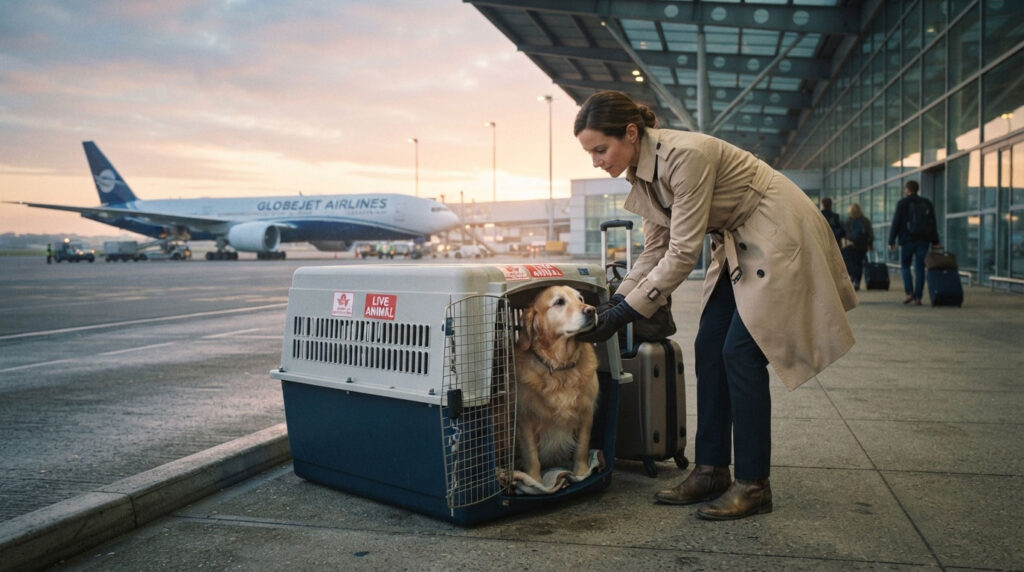
No. A dog flies into Great Britain as manifest cargo on an approved route. The only exceptions are a guide or assistance dog, and a chartered private plane. Your dog rides in the hold, in an IATA crate, and you collect it after customs clears it.
Manifest cargo sounds like freight. That is the point. Your dog travels on the same aircraft as you, in a pressurised hold, booked through the airline's cargo arm. Not through the passenger booking. Not as checked baggage.
The UK government runs an approved-routes list. Only those routes and carriers can bring a pet into Great Britain. The list changes, so check it on gov.uk before you book, not after. British Airways cargo into Heathrow is the route most relocation guides name first. Virgin Atlantic is the other direct option. Lufthansa and KLM are the usual alternatives, through Frankfurt and Amsterdam.
A cargo booking is a separate booking from your seat. It has its own cutoff times and its own paperwork check. Cargo space for pets runs out. Book it early, not in the last week.
On arrival, your dog goes to the airport's Animal Reception Centre. Staff scan the microchip and check every document against the certificate before they release the dog. Heathrow's centre is the busiest. It offers a pre-check of your paperwork before the USDA endorsement. Use it. A mistake found at Heathrow costs a delay. A mistake found after landing costs a quarantine.
The crate is an IATA crate. Rigid, ventilated, big enough for the dog to stand, turn, and lie down. No sedatives. Airlines refuse them, and a sedated dog cannot balance or regulate its temperature in the hold.
Two exceptions exist. Neither one helps most owners. A recognised guide or assistance dog flies in the cabin. A chartered private plane carries the dog with you. Everyone else books cargo. That is the rule, and no airline's pet policy overrides it.
What does my dog need before the flight?
| Step | What | When |
|---|---|---|
| 1. Microchip | ISO 11784/11785, 15 digits | Before or on the same day as the rabies shot |
| 2. Rabies vaccination | Inactivated or recombinant vaccine; vet proof the dog is 12+ weeks | At least 21 full days before arrival |
| 3. Health certificate | Great Britain pet health certificate, completed by a USDA-accredited vet | Vet signs it (valid 30 days); APHIS endorses within 10 days of arrival |
| 4. Tapeworm treatment (dogs) | Praziquantel or equivalent against Echinococcus multilocularis | 24 to 120 hours before arrival; vet records product, date, time |
| 5. Owner declaration | You will not sell or transfer the dog | Signed before travel |
Five things, in this order: an ISO microchip, a rabies vaccination, a 21-day wait, a Great Britain health certificate endorsed by USDA APHIS, and a tapeworm treatment for dogs. Get the order wrong and the clock restarts.

The order is the rule, not a suggestion. The microchip goes in first. Or on the same day as the rabies shot. Never after it. A rabies vaccination given before the chip does not count for UK travel, and the vet has to give it again. The health certificate records both dates, and the chip date has to sit on or before the vaccine date.
Check the chip before the appointment. A US chip that is not ISO 11784/11785 — some older 9- or 10-digit chips — will not scan at a UK airport. A chip that cannot be read means refused entry or quarantine. Add an ISO chip, or travel with a reader.
The 21-day wait starts the day after the shot. Day 1 is the day after the vaccination, not the day of it. Most vaccines clear the dog for travel after 21 full days. Some take 30 days. Your vet knows which one your dog got, and the gov.uk guidance gives the 30-day example for a reason. A booster given on time, with no break in cover, needs no wait at all.
The practical floor is 15 weeks of age. Twelve weeks for the first rabies shot, plus the 21-day wait. A puppy younger than 15 weeks cannot enter. USDA APHIS says so in plain terms.
The certificate is the Great Britain pet health certificate. A USDA-accredited vet completes it and submits it through the VEHCS system. USDA APHIS then ink-signs and embosses it. The pet has to arrive in the UK within 10 days of that endorsement date.
Most families use the non-commercial version. Up to five pets, with the owner or an authorised person landing within five days of the pet. If the pet travels alone, or more than five days apart from you, or changes hands, it is the commercial certificate. Then the vet has to inspect the pet within 48 hours of departure.
If you land at Heathrow, send the paperwork to the Heathrow Animal Reception Centre for a pre-check before the endorsement. It catches the mistakes that cost a quarantine.
The tapeworm dose is the tightest clock in the whole move. A USDA-accredited vet gives it no less than 24 hours and no more than 120 hours before the dog lands. The window counts to the hour against your landing time. The vet records the product, the maker, the date and the time on the certificate, and signs it only after giving the dose. Cats skip this step entirely.
Do I need a rabies blood test?
No — not from the USA. The UK asks for a rabies blood test only from countries it has not listed. The USA is a listed country, so your dog skips the test, and skips the three-month wait that comes with it.
This is the step where owners lose the most time. It comes from a rule that does not apply to them.
The UK divides the world into listed and unlisted countries. The USA sits on the Part 2 listed list, alongside Canada, Australia, Japan, and Mexico. A dog from a listed country needs the microchip, the rabies vaccination, the certificate, and the tapeworm treatment. It does not need a rabies blood test. Gov.uk says it plainly: a blood test is needed only from a country that is not part of the EU and not listed.
The blood test exists for unlisted countries. It is a long road. The vet draws blood at least 30 days after the rabies vaccination, sends it to an EU-approved laboratory, and the result has to show an antibody level of at least 0.5 IU/ml. Then the dog waits three months from the date the blood was drawn before it can travel.
Add the 30 days to the three-month wait, and you get the four-month figure that floats around online. That figure is real — for unlisted countries. It does not apply to a dog flying from the USA.
So when a guide tells you to allow four months and book a titer test, check which country it is talking about. From the USA, the official floor is the 21-day wait after the rabies shot, not four months. The four-month number is the unlisted-country clock. It has no place in a US move. Skip the test, keep the money, and spend the time on the steps that do apply — the chip, the certificate, and the tapeworm window.
How long does it take, and what does it cost?
You need the dog in London by March, and you just started the paperwork. The calendar decides the plan, not the other way around.
From scratch, allow one to two months: the 21-day wait after the rabies shot is the floor, and vet scheduling, the endorsement window, and cargo booking fill the rest. Published cost runs about $1,800 to $6,000 for one dog, depending on crate size and route.
The timeline
The official floor is short. If your dog already has an ISO chip and a current rabies vaccination with no break in cover, the move takes as long as the certificate and the cargo booking take. Days, not months. The certificate needs a USDA-accredited vet. The endorsement needs USDA APHIS. The tapeworm dose needs to land inside its 24-to-120-hour window. None of those steps has a long wait built in.
The wait comes from scheduling. Getting the accredited vet appointment. Getting the endorsement back. Getting a cargo slot on the flight you want.
From scratch — no chip, no rabies shot — the floor is the 21-day wait after the first vaccination, plus the days around it for the vet visits and the endorsement. Relocation guides put the practical window at one to two months for a US dog starting from zero. That matches the official rules: the 21 days is the only fixed wait, and everything else is logistics.
The four-month figure you see online is the unlisted-country clock. It does not apply here. Plan for one to two months, start earlier if you can, and treat the 21 days as the floor, not the plan.
The cost
Cost is where the range gets wide, and the range is honest. Canine Cab Company publishes $1,800 to $6,000 for one dog. The low end is a small dog. The high end is a large dog in cargo. My Pet Air Travel puts a single pet at roughly $3,500 to $5,000.
Three things move the number. The size of the dog: a bigger dog needs a bigger crate, and cargo is priced by size and weight. The route: a direct flight costs more than a connection, and the connection adds a stop the dog has to clear. The service level: a customs agent at the UK end, door-to-door collection, or airport-to-airport only.
Vet fees, the certificate, the endorsement, and the tapeworm dose sit on top of the flight cost, or inside the shipper's quote. Ask which one before you compare two quotes. A quote that leaves the vet fees out looks cheaper than it is.
Where do I start?
Start with the microchip. Then find a USDA-accredited vet, book the cargo flight early, and send the paperwork to Heathrow for a pre-check. The rest is dates on a calendar.
-
Check the chip. Get it scanned and confirm it is ISO 11784/11785, 15 digits. If it is not, add an ISO chip before anything else — a rabies shot given before the chip does not count, and you redo the shot.
-
Find a USDA-accredited vet. Not every vet holds the accreditation, and only an accredited vet signs the Great Britain health certificate and gives the tapeworm dose. APHIS keeps a lookup. Find the vet first, then book the appointments around the 21-day wait and the tapeworm window.
-
Check the banned types. Five types of dog cannot enter Great Britain without a Certificate of Exemption: the Pit Bull Terrier, the Japanese Tosa, the Dogo Argentino, the Fila Brasileiro, and the XL Bully. The UK decides by what the dog looks like, not by its breed name, so a mixed-breed dog can still count. If your dog is a bully type or a large mastiff type, raise it with your shipper on the first call, not the last.
-
Book the cargo flight early. Cargo space for pets runs out, and the approved-routes list changes. Check the route on gov.uk, then book the cargo slot before you book your own seat — the dog's slot is the one that disappears first.
-
Pre-check the paperwork at Heathrow. If you land at Heathrow, send the certificate to the Heathrow Animal Reception Centre for a pre-check before USDA APHIS endorses it. It catches the mistakes that cost a quarantine, and it takes only a few days.
-
Plan the return trip now. The CDC requires every dog entering the United States to be at least six months old. A puppy that flies to the UK at 15 weeks cannot fly back until it is six months old, so a short stay turns into a long one. Check the CDC's dog import rules before you book the return.
-
Cover the drive to the airport. The UK leg is cargo, and no cabin carrier changes that. The drive to the departure airport is the one leg where a carrier still earns its keep. For a small dog, up to 12 kg, our AERO covers it: carrier, ISOFIX base, and stroller in one product, the bag clicking onto the base for the car ride. It does not fly your dog to the UK. Nothing in the cabin does.
Conclusion
Cargo, a chip, a rabies shot, a certificate, and a tapeworm dose — in that order. Get the order right, and your dog walks out of Heathrow the same day.